

History: Received 25 August 2026 | Revised 1 November 2026 | Accepted 16 November 2026 | Published online 28 November 2026
Copyright: © 2026 The Author(s). Licensee Solarlits Limited (Hong Kong). This is an open access article distributed under the terms and conditions of the Creative Commons Attribution 4.0 License.
Citation: Meryem Kadri, Explainable Machine Learning for Early-Stage Daylight Performance Prediction in Building Design: A Climate-Informed Parametric Framework, Journal of Daylighting, 13:2 (2026) 823-842. doi: 10.15627/jd.2026.44
Abstract
Daylight performance is an important consideration in early-stage architectural design, yet evaluating numerous design alternatives through detailed simulation can be computationally demanding and difficult to interpret. This study develops a climate-informed explainable artificial intelligence framework for rapid prediction and interpretation of daylight performance in early-stage building design. A parametric single-sided room model was systematically varied using nine architectural and material parameters, including room dimensions, window-to-wall ratio, sill height, visible light transmittance, surface reflectance, and façade orientation. Latin hypercube sampling was used to generate 2,000 unique architectural configurations, which were evaluated under a Typical Meteorological Year climate dataset for Oum El Bouaghi, Algeria. The resulting daylight performance index was used as the prediction target. Random Forest, Gradient Boosting, and Artificial Neural Network regression models were trained using an 80:20 training-testing split and evaluated using R², mean absolute error, and root mean square error. Gradient Boosting achieved the best predictive performance on the independent testing dataset, with an R² of 0.9149, MAE of 3.13 percentage points, and RMSE of 3.99 percentage points. Shapley Additive exPlanations (SHAP)-based interpretation identified window-to-wall ratio, visible light transmittance, and room depth as the three dominant predictors, accounting for 79.65% of the relative global feature importance. The results demonstrate that explainable machine learning can provide both rapid performance prediction and interpretable information about the architectural variables driving daylight outcomes. Rather than replacing detailed daylight simulation, the proposed framework is positioned as a complementary decision-support layer for exploring and prioritizing early-stage design alternatives.
Keywords
Daylight performance, Machine learning, Architectural design, Parametric simulation
1. Introduction
Daylight is an important consideration in architectural design because it contributes to indoor visual conditions and can reduce reliance on electric lighting when appropriately integrated into the building design [1]. Its performance depends on the interaction between room geometry, window dimensions, glazing properties, façade orientation, and interior surface reflectance. These factors influence the availability and distribution of daylight within a space and therefore need to be considered during early-stage design, when alternative architectural configurations are still being explored [2].
Conventional daylight assessment relies heavily on computational simulation. Although simulation provides detailed information about the spatial and temporal distribution of daylight, repeated simulations can become computationally demanding when a large number of design alternatives must be examined. This limitation has encouraged researchers to investigate data-driven approaches capable of approximating simulation outputs and providing faster feedback during early design exploration. Recent studies have demonstrated the potential of machine learning to predict daylight-related indicators from architectural and environmental parameters, thereby reducing the computational burden associated with repeated simulation [3,4]. In particular, regression-based models and image-based learning have been investigated for daylight factor prediction, while broader reviews have examined the algorithms, datasets, and evaluation approaches used to predict indoor daylighting [3,5].
The development of larger simulation based datasets has further expanded the possibilities of machine learning in architectural design. Mashaly et al. developed a daylight performance prediction tool using more than 367,000 simulation cases and an artificial neural network to estimate climate based daylight metrics across different geographic contexts [6]. Their work demonstrates how surrogate models can provide rapid feedback during early design, while also illustrating the potential of integrating predictive models into accessible design tools. Other recent research has investigated decision tree based models for predicting daylight availability using variables such as sky conditions, façade orientation, glazing area, and visible transmittance [7]. These approaches demonstrate an important shift from simulation conducted after design decisions have been made toward predictive methods that can inform those decisions while the design is still being developed. Recent parametric research has further demonstrated that early-stage daylight performance is strongly influenced by the combined effects of room geometry, window layout, façade orientation, window-to-wall ratio, and glazing transmittance, reinforcing the value of evaluating these variables systematically during conceptual design [8].
At the same time, artificial intelligence is increasingly being used not only to evaluate architectural proposals but also to generate and optimize them. Hu et al. combined generative models with rapid daylight prediction to evaluate AI generated residential floor plans, showing how performance assessment can be integrated into automated design workflows [9]. Similarly, other research has explored machine learning for predicting lighting energy consumption from daylight related variables, indicating that the relationship between daylight performance and design characteristics can also be used to support energy related decisions [10]. Together, these developments suggest that machine learning can become more than a computational substitute for simulation. It can potentially act as an interactive layer between architectural parameters and performance based decision making.
Despite these advances, prediction accuracy alone does not necessarily make a machine learning model useful to architects. Many high performing predictive models operate as complex mathematical systems in which the relationship between an input parameter and the resulting prediction is difficult to understand. Recent building energy research has similarly highlighted the value of interpretable machine learning for understanding and controlling complex building performance systems [11, 12]. This issue is particularly relevant in architectural applications because design decisions need to be interpreted in relation to physical characteristics rather than treated only as numerical inputs. An architect may need to know not only whether a model predicts higher daylight performance for a particular configuration, but also which design variables are responsible for that prediction and how their influence changes across different configurations.
Explainable artificial intelligence (XAI) provides a possible response to this limitation by making the relationships learned by predictive models more interpretable. The fundamental objective of XAI is to make the outputs of complex artificial intelligence models understandable to human users, particularly when predictions need to be interpreted and evaluated in practical decision-making contexts [13]. Techniques such as Shapley Additive exPlanations (SHAP) provides a theoretically grounded approach for attributing individual model predictions to their input features, thereby supporting both global feature ranking and the interpretation of individual predictions [14]. Recent daylighting research has also applied machine learning and SHAP to investigate the influence of different variables on daylight-related glare metrics [15]. Other studies have further combined machine learning with multi-objective optimization to simultaneously address building energy consumption, daylighting, and thermal comfort [16]. Deep learning has also been investigated for daylighting performance prediction in educational building clusters, demonstrating the applicability of data-driven approaches to more complex spatial configurations [17]. In building energy applications, interpretable data-driven control models have also used SHAP to explain the contribution of input variables to model predictions [18]. Similarly, machine learning combined with SHAP has been used to analyse energy consumption and identify influential household and building characteristics across different residential building types [19]. Explainable AI has also been investigated for building retrofit decision making, illustrating the broader potential of interpretable models to support practical building-related decisions [20].
Recent reviews of explainable artificial intelligence in the building sector have highlighted its growing role in improving the transparency of machine learning applications for building energy assessment, management, and retrofit decision-making. However, these studies also identify persistent methodological challenges, including the computational demands of post-hoc explanation techniques, the trade-off between predictive accuracy and interpretability, and the difficulty of evaluating whether explanations are sufficiently reliable and useful for practical decisions. These challenges indicate that the availability of feature-importance rankings alone does not necessarily ensure meaningful interpretability.
Instead, explanations should be examined in relation to the physical characteristics of buildings and the decisions they are intended to support [21-23].
More recently, daylight research has begun to incorporate explainability directly into predictive modelling. Liu et al. proposed an explainable multi task learning framework for rapid daylight performance prediction and used SHAP to quantify the contribution of geometric design variables to several daylight indicators [24]. Their findings demonstrate the value of combining predictive performance with model interpretation and show that different daylight indicators may respond differently to architectural parameters.
These recent developments reveal an important opportunity for further research. Existing studies have made substantial progress in accelerating daylight prediction through machine learning, developing accessible prediction tools, and introducing interpretable models [1,2,3,7]. However, the practical use of model explanations for architectural decision making remains less developed than predictive accuracy itself. In particular, there is a need for frameworks that connect the prediction of daylight performance with a systematic interpretation of how multiple architectural parameters influence the predicted outcome. Such an approach would move beyond the use of explainability as a diagnostic technique and instead consider it as a component of the design decision process. This distinction is important because the objective of early stage computational design is not simply to obtain a highly accurate prediction, but to provide information that can help designers understand and compare alternative configurations.
Beyond daylight prediction, recent work has examined surrogate models designed to support decision-making directly, while emerging physics-informed approaches seek to improve the physical consistency and generalization of data-driven building models [25-27]. These approaches provide a broader methodological context for the present study. The framework developed here remains a climate-specific daylight prediction model based on a controlled parametric room; it does not claim to be a physics-informed model or a decision-optimization method. Its contribution lies in combining prediction with SHAP-based interpretation of architectural variables.
Despite the increasing use of machine learning for daylight performance prediction, three methodological gaps remain relevant to early-stage architectural decision-making. First, many predictive approaches primarily emphasize model accuracy, while the architectural meaning of the learned relationships receives comparatively less attention. Second, explainability is often used to rank predictors after model development without explicitly connecting the resulting explanations to design variables that can be modified during early-stage design. Third, the generalization of predictive relationships within a controlled architectural design space remains insufficiently explored, particularly when geometric, glazing, material, and orientation parameters are systematically varied under consistent climatic conditions. Addressing these gaps requires a framework in which prediction and interpretation are treated as complementary functions rather than independent analytical steps.
Accordingly, this study proposes an explainable artificial intelligence (XAI) framework for daylight-aware architectural design that integrates parametric daylight simulation, machine learning prediction, comparative model evaluation, and SHAP-based interpretation within a single data-driven workflow. The study makes three specific contributions. First, it develops a climate-informed parametric daylight prediction framework in which architectural design variables are systematically varied and evaluated under a common climatic boundary condition. Second, it comparatively evaluates three machine learning approaches and identifies the most suitable predictive model for the investigated design space using an independent testing dataset. Third, it integrates SHAP-based global and local explanations to translate model predictions into interpretable information about the relative influence and direction of architectural variables. Rather than treating the predictive model as a black box, the proposed approach examines how individual design variables contribute to daylight performance and translates these relationships into information that can support the prioritization of architectural modifications during early-stage design exploration.
The study therefore aims to investigate whether an explainable machine learning framework can simultaneously provide accurate daylight performance prediction and meaningful interpretation of the architectural variables underlying those predictions. By integrating predictive accuracy with model interpretability, the proposed framework seeks to contribute to the development of more transparent and practically useful AI-based tools for early-stage architectural design.
2. Materials and methods
2.1. Research framework
This study develops a climate informed and explainable machine learning framework for supporting early stage daylight oriented architectural design. The proposed approach combines parametric architectural modelling, hourly climatic data, computational daylight estimation, supervised machine learning, and explainable artificial intelligence. The objective is to establish an interpretable relationship between key architectural design variables and daylight performance and to determine which variables contribute most strongly to the predicted outcome.
The research follows four consecutive stages. First, a controlled parametric room model is established and systematically varied according to predefined architectural and material parameters. Second, the generated configurations are evaluated under the hourly climatic conditions represented by a Typical Meteorological Year for Oum El Bouaghi, Algeria.
Third, the resulting dataset is used to train and compare three machine learning regression models. Finally, SHapley Additive exPlanations (SHAP) are applied to the best performing model to quantify the contribution and direction of the architectural variables (Figure 1).
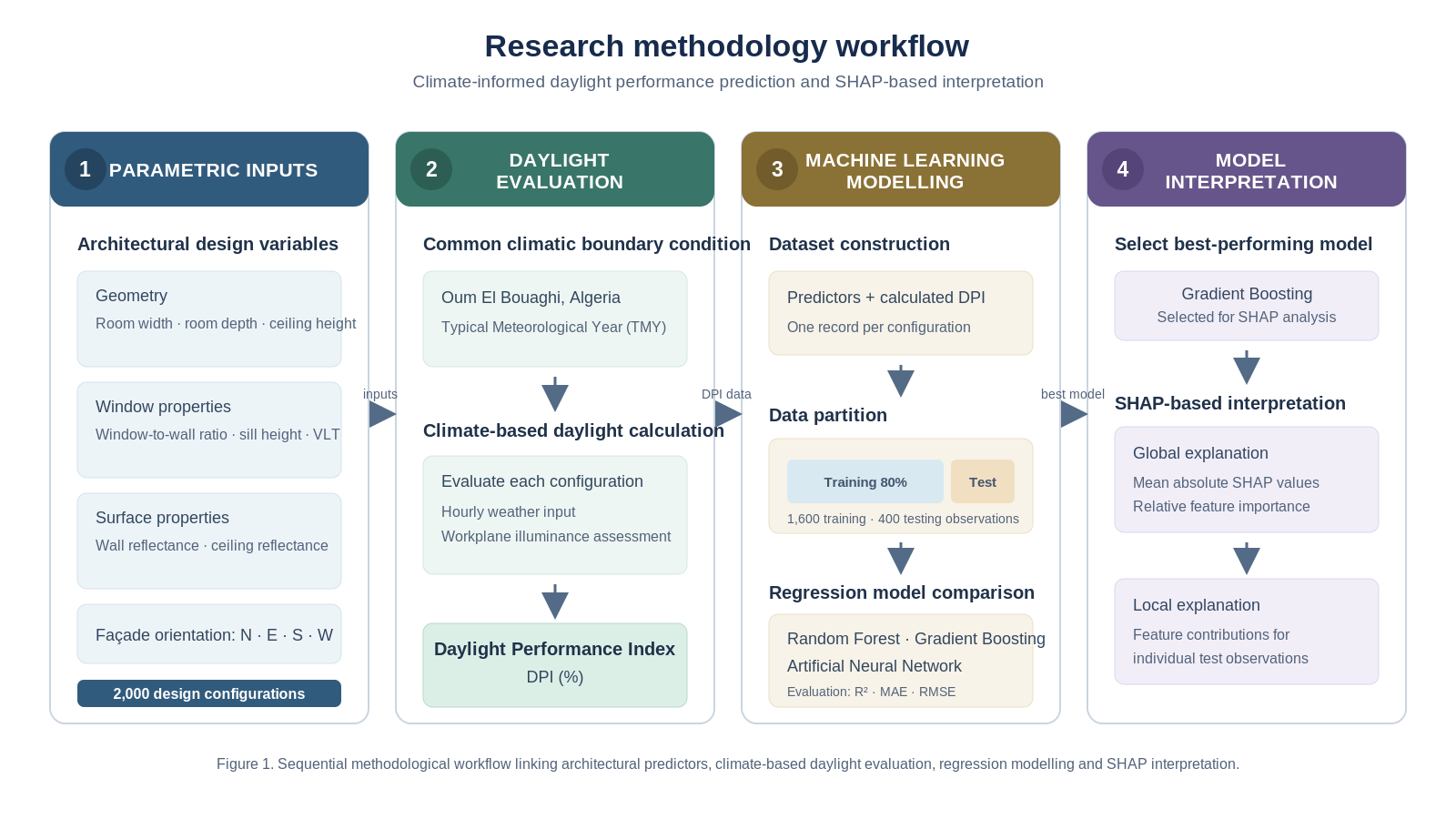
The framework is designed to separate the generation of architectural alternatives from their predictive interpretation. This allows the model to provide not only an estimated daylight performance for a proposed configuration but also information about the architectural characteristics associated with that prediction.
2.2. Climatic context and weather data
Oum El Bouaghi, Algeria, was selected as the geographical context of the computational experiment. The selected location is defined by a latitude of 35.860° N and a longitude of 7.110° E [28] A Typical Meteorological Year dataset was generated through the Photovoltaic Geographical Information System (PVGIS) of the Joint Research Centre of the European Commission and obtained in EnergyPlus Weather (EPW) format [29]. The weather file used in this study is the Oum El Bouaghi TMY dataset covering the 2005 to 2023 period. The uploaded EPW file identifies the location using the selected geographic coordinates and provides hourly meteorological and solar radiation variables required to characterize the outdoor conditions throughout the representative year. The weather dataset was used as a common climatic boundary condition for all generated architectural configurations. Using the same annual climatic sequence for every configuration ensures that differences in the calculated daylight response originate from the architectural parameters rather than from differences in the weather data assigned to individual cases. Instead, the city is used as a clearly defined geographical and climatic context for evaluating a controlled parametric architectural model. This distinction allows the effect of design variables to be investigated independently of the characteristics of a particular existing building.
-
Climatic Boundary Condition
The use of a single climatic location is intentional at this stage of the research. The objective is to isolate the relationship between architectural design variables and daylight performance under a controlled climatic boundary condition rather than to claim immediate climatic generalization of the predictive model. Keeping the weather sequence constant across all configurations ensures that variations in the predicted response are attributable to changes in the investigated architectural variables. The resulting model should therefore be interpreted as climate-specific for the present experiment. Extension to additional climatic contexts is considered a necessary step for evaluating transferability and is identified as a direction for future validation.
2.3. Parametric architectural model
A generic single sided daylit room was developed as the reference architectural model. A generic model was preferred to an existing building because the objective was to systematically vary individual architectural characteristics while maintaining a controlled geometric configuration. The reference space is rectangular and contains a glazed opening on one external façade. The baseline dimensions are 6.0 m in width, 4.0 m in depth, and 3.0 m in height. The glazed façade can be oriented toward the four cardinal directions: north, east, south, and west. The model incorporates geometric, opening, material, and orientation variables that can reasonably be modified during the early stages of architectural design. Nine principal parameters were considered: room width, room depth, ceiling height, window to wall ratio, window sill height, visible light transmittance, wall reflectance, ceiling reflectance, and façade orientation (Figure 2). The selected variables represent four complementary categories of early-stage architectural decisions. Room width, depth, and ceiling height represent spatial geometry; window-to-wall ratio and sill height represent opening configuration; visible light transmittance represents glazing characteristics; wall and ceiling reflectance represent interior optical properties; and façade orientation represents the principal directional relationship between the opening and the external environment. The selection was therefore intended to capture variables that can be modified during conceptual design while maintaining a sufficiently compact predictor space for interpretable machine learning. Variables associated with furniture, occupancy, shading devices, electric lighting controls, and detailed façade articulation were intentionally excluded to maintain a controlled experimental design and avoid introducing additional sources of variation.
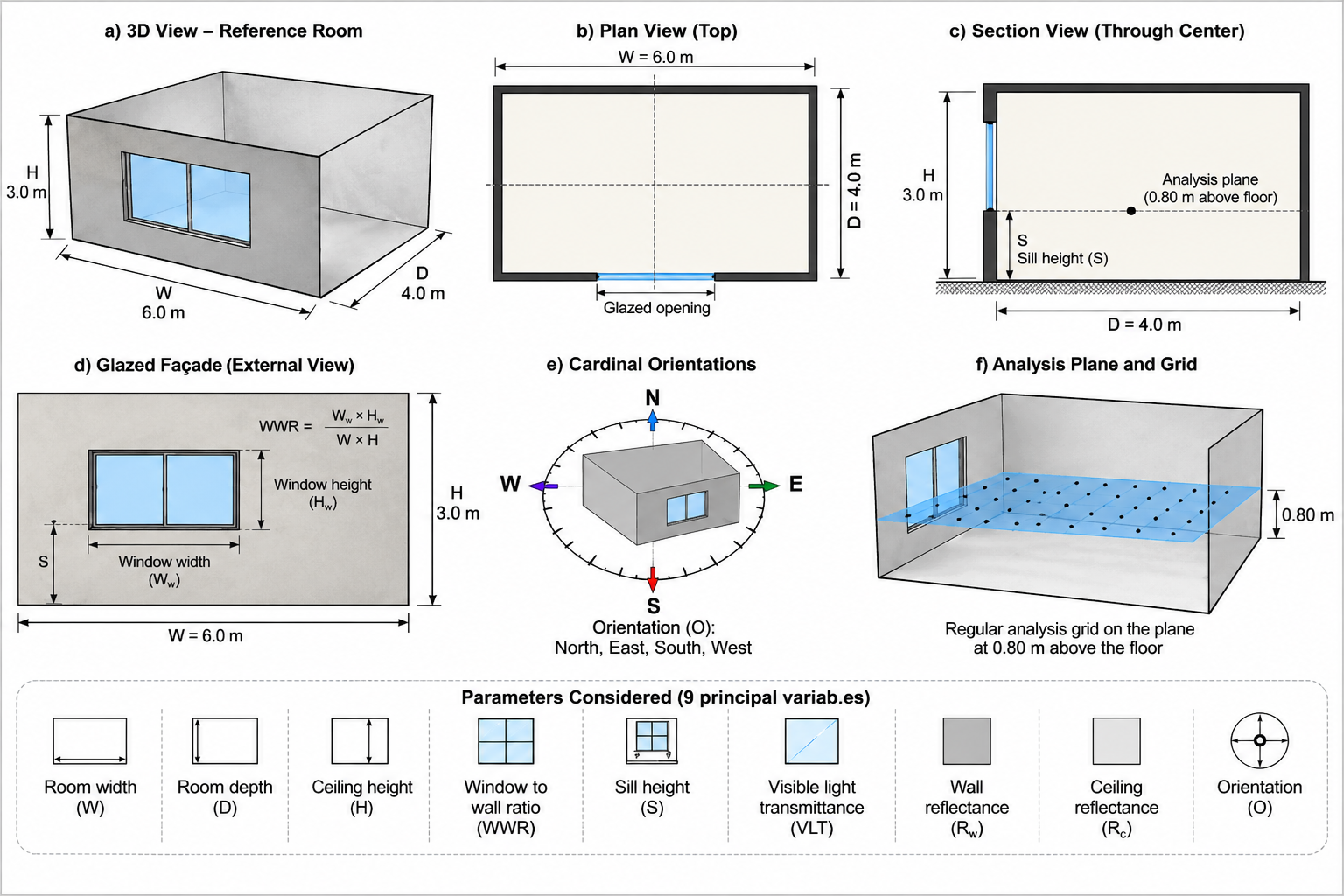
The analysis plane is positioned at a height of 0.80 m above the finished floor to represent the typical working level within the room. A regular analysis grid is maintained consistently across the generated configurations. The same geometric conventions are applied to all configurations to ensure that the calculated differences in daylight performance are attributable to the investigated parameters (Table 1).
The parameter ranges were selected to cover a broad but plausible early-stage architectural design space. The eight continuous architectural and material parameters were sampled within their predefined ranges using Latin Hypercube Sampling (LHS), rather than through fixed, uniform increments. Consequently, no constant variation step (e.g., 0.10 or 0.20 m) was imposed on these variables. This approach enabled the generation of 2,000 configurations distributed across the defined design space without restricting the parametric exploration to a discrete dimensional grid. Façade orientation was treated separately as a categorical variable with four possible values.
2.4. Parametric dataset generation
Latin hypercube sampling was used to generate the design configurations. This sampling strategy was selected because it provides broad coverage of a multidimensional parameter space while avoiding the very large number of combinations that would result from an exhaustive factorial design. A total of 2,000 unique configurations were generated. Each configuration represents one combination of the architectural variables defined in Table 1. Geometrically invalid or duplicated configurations were excluded from the final dataset. For every configuration, the same weather dataset, occupancy assumptions, analysis plane, and calculation procedure were maintained. Consequently, each row of the resulting dataset represents a complete architectural configuration associated with a single calculated daylight performance value. The final dataset therefore consists of two principal components.
The first contains the predictor variables describing the architectural configuration, while the second contains the corresponding daylight performance response. This structure enables the dataset to be directly used for supervised regression.
-
Dataset Size and Sampling Adequacy
A dataset size of 2,000 configurations was selected as a compromise between computational feasibility and sufficient coverage of the nine-dimensional design space. Because an exhaustive factorial combination of the continuous parameters would require a substantially larger number of simulations, Latin hypercube sampling was adopted to distribute observations across the predefined parameter ranges. The generated design space was inspected to ensure that the sampled configurations covered the specified ranges without systematic concentration in a restricted portion of the parameter space. The resulting dataset was subsequently divided into independent training and testing subsets for model development and final performance assessment.
For the reconstructed simulation workflow, each of the 2,000 sampled configurations is represented as an individual room model and evaluated using a consistent climate-based daylight simulation procedure. The weather input is the Oum El Bouaghi typical meteorological year (TMY) EPW file described in Section 2.2. The room geometry, glazing opening, façade orientation, and variable surface reflectances are defined according to Table 1. Floor reflectance is held constant at 0.20 and is treated as a fixed modelling assumption rather than an additional sampled predictor. The horizontal analysis plane is located 0.80 m above the finished floor. A regular sensor grid with a nominal spacing of 0.50 m is used for the illuminance calculations; the actual number of sensors is determined by the usable floor area of each configuration. The same weather file, occupancy schedule, illuminance threshold, temporal sampling, and simulation procedure are applied consistently across the design set.
| Parameter | Symbol | Range or values | Unit | Sampling procedure |
|---|---|---|---|---|
| Room width | W | 4.0 to 8.0 | m | Continuous LHS |
| Room depth | D | 3.0 to 8.0 | m | Continuous LHS |
| Ceiling height | H | 2.7 to 3.6 | m | Continuous LHS |
| Window to wall ratio | WWR | 0.15 to 0.60 | dimensionless | Continuous LHS |
| Window sill height | S | 0.60 to 1.20 | m | Continuous LHS |
| Visible light transmittance | VLT | 0.45 to 0.75 | dimensionless | Continuous LHS |
| Wall reflectance | Rw | 0.40 to 0.70 | dimensionless | Continuous LHS |
| Ceiling reflectance | Rc | 0.70 to 0.90 | dimensionless | Continuous LHS |
| Façade orientation | O | North, East, South, West | categorical | Categorical selection |
2.5. Climate informed daylight performance calculation
The daylight performance assessment is based on climate-based annual illuminance simulations performed using Radiance through the Honeybee-Radiance workflow. The simulations were performed using Radiance version 5.4a through Honeybee-Radiance version 0.9.The simulations use the Oum El Bouaghi Typical Meteorological Year (TMY) weather file in EPW format, as described in Section 2.2. For each of the 2,000 parametric room configurations, horizontal illuminance is evaluated at sensor points distributed across an analysis plane located 0.80 m above the finished floor. Room geometry, façade orientation, glazing visible light transmittance (VLT), and interior surface reflectances are defined according to Table 1 and the modelling assumptions described in Section 2.4.
The annual assessment uses an hourly temporal resolution and an occupancy schedule covering weekdays from 08:00 to 18:00. An illuminance threshold of 300 lux is adopted to identify observations satisfying the selected daylight criterion. Sensor points are distributed using a nominal grid spacing of 0.50 m; therefore, the number of sensor points varies according to the usable floor area of each room configuration. The principal simulation settings and modelling assumptions are summarized in Table 2. For annual climate-based daylight calculations, the sky conditions are represented using an annual sky matrix derived from hourly meteorological data. The Perez all-weather sky model provides a suitable approach for representing variations in direct and diffuse solar radiation throughout the simulated year. This approach is consistent with climate-based daylight assessment using hourly EPW weather data. The annual daylight simulations follow a two-phase daylight coefficient approach, in which the contribution of sky components to indoor illuminance is calculated using Radiance-based light transport simulations and combined with the hourly sky conditions derived from the climate file. This approach enables the evaluation of hourly indoor illuminance at the defined sensor points throughout the annual simulation period.
| Parameter | Value or specification |
|---|---|
| Daylight simulation engine | Radiance |
| Simulation environment | Honeybee-Radiance |
| Simulation approach | Climate-based annual daylight simulation |
| Annual simulation method | Two-phase daylight coefficient method (Honeybee-Radiance Annual Daylight recipe) |
| Temporal resolution | 1 hour |
| Radiance ambient bounces (-ab) | 2 |
| Radiance ambient divisions (-ad) | 5,000 |
| Radiance limit weight (-lw) | 0.00002 |
| Daylight illuminance threshold for DPI | 300 lux |
| Analysis plane | Horizontal, 0.80 m above finished floor |
| Nominal sensor-grid spacing | 0.50 m |
| Occupancy schedule | Weekdays, 08:00–18:00 |
| Floor reflectance | 0.20 |
| Weather input | Oum El Bouaghi TMY EPW weather file, as described in Section 2.2 |
| Wall and ceiling reflectances | Variable values within the ranges specified in Table 1 |
| Number of parametric configurations | 2,000 |
| Sky model | Description : Perez all-weather sky model for annual climate-based daylight simulation |
| Weather input | Hourly meteorological data from the Oum El Bouaghi TMY EPW file |
| Annual sky calculation | Annual sky matrix generated from weather data |
Climate-based daylight modelling supports the assessment of annual daylight availability, but the interpretation of its outputs depends on the definitions and calculation procedures of the selected metrics. Standardized indicators such as spatial Daylight Autonomy (sDA) and Annual Sunlight Exposure (ASE) follow specific evaluation procedures, whereas Useful Daylight Illuminance (UDI) characterizes the occurrence of illuminance levels within defined ranges [30–32]. In the present study, the daylight performance index (DPI) is used as a study-specific response variable to quantify threshold-based daylight availability across the investigated design configurations. Its definition and calculation procedure are detailed in Section 2.5.1.
2.5.1. Definition and Calculation of the Daylight Performance Index
The Daylight Performance Index (DPI) is defined as the percentage of evaluated spatial-temporal observations for which horizontal illuminance meets or exceeds the specified threshold of 300 lux. For each architectural configuration (i), illuminance is evaluated at the sensor points on the analysis plane over the occupied hours included in the annual assessment. The DPI is calculated as follows:
Where DPIᵢ is the Daylight Performance Index for configuration (i), expressed as a percentage; Nₛ,ᵢ is the number of sensor points in configuration (i); 𝒯ₒcc denotes the set of occupied hourly time steps considered in the annual assessment; and Nₜ is the number of occupied hourly time steps in that set. Eᵢ,ⱼ,ₜ denotes the simulated horizontal illuminance, expressed in lux, at sensor point (j) in configuration (i) at occupied time step (t). The indicator function (·) equals 1 when the illuminance is greater than or equal to 300 lux and 0 otherwise.
The same illuminance threshold, analysis-plane height, nominal sensor-grid spacing, hourly temporal resolution, occupancy schedule, and calculation procedure are applied consistently across all 2,000 configurations. Because room dimensions vary, the number of sensor points may differ between configurations. The DPI is therefore normalized by the total number of evaluated sensor-point and occupied-hour combinations for each configuration, ensuring that the resulting percentage accounts for differences in the number of sensor points.
The DPI is a study-specific aggregate indicator and is not equivalent to standardized metrics such as spatial Daylight Autonomy (sDA), Annual Sunlight Exposure (ASE), or Useful Daylight Illuminance (UDI). It represents the overall proportion of evaluated sensor-point and occupied-hour observations meeting the 300-lux threshold, whereas sDA evaluates the fraction of the analysis area meeting a specified temporal daylight criterion, and UDI characterizes the occurrence of illuminance within defined useful ranges. Consequently, DPI values cannot be directly converted into sDA or UDI values without additional calculations based on the underlying hourly illuminance data. The DPI should therefore be interpreted as a comparative indicator of threshold-based daylight availability within the investigated parametric design space, rather than as a substitute for standardized daylight metrics. The resulting DPI values in the generated dataset range from 0% to 72%. These values are used as the dependent variable for the supervised machine-learning models described in Section 2.6.
2.6. Data preparation and machine learning models
The complete dataset was divided into training and testing subsets using an 80:20 split. The training subset contained 1,600 configurations, while the remaining 400 configurations were retained as an independent testing subset. The testing observations were not used for model fitting. Three supervised regression algorithms were evaluated: Random Forest Regression, Gradient Boosting Regression, and Artificial Neural Network regression. Random Forest Regression was selected as a representative bagging based ensemble method capable of modelling nonlinear relationships between architectural variables. Gradient Boosting Regression was included as a sequential ensemble approach in which successive weak learners are trained to reduce the residual errors of previous learners. Artificial Neural Network regression was included as a flexible nonlinear model capable of learning complex relationships between multiple architectural inputs.
To establish a comprehensive benchmark for daylight performance prediction, four additional regression models were included: Linear Regression, Ridge Regression, LASSO Regression, and a Generalized Additive Model (GAM). Linear Regression provided a reference based on linear relationships between architectural predictors and the daylight performance index (DPI). Ridge Regression introduced L2 regularization to reduce coefficient instability in the presence of correlated predictors, whereas LASSO Regression applied L1 regularization, allowing less informative coefficients to be shrunk toward zero. GAM represented nonlinear effects through smooth functions of individual predictors. Together, these baseline models enabled the evaluation of linearity, regularization, and smooth nonlinear effects relative to the more flexible relationships captured by Random Forest Regression, Gradient Boosting Regression, and Artificial Neural Network regression.
All seven models were evaluated using the same predictor variables and identical training–testing partition to ensure a consistent comparison. Where feature scaling was required, preprocessing parameters were estimated exclusively from the training data and subsequently applied to the independent testing data. Hyperparameter selection, where applicable, was conducted using the training subset only, for example through cross-validation. The independent testing subset was kept separate from model selection and tuning. Predictive performance was assessed using the coefficient of determination (R²), mean absolute error (MAE), and root mean squared error (RMSE). Since DPI is expressed as a percentage, MAE and RMSE were reported in percentage points.
2.6.1. Model implementation and hyperparameter configuration
The three regression algorithms were implemented using the Python Scikit-learn framework: Random Forest Regression (RF), Gradient Boosting Regression (GB), and Artificial Neural Network regression (ANN). These algorithms were selected because they provide complementary approaches to modelling potentially nonlinear relationships between architectural design variables and indoor daylight performance. The Random Forest model was configured as an ensemble of 500 decision trees. Each tree was constructed using bootstrap sampling, with no predefined maximum depth, allowing the model to capture complex relationships within the input data. The minimum number of samples required to split an internal node was set to 2, while the minimum number of samples per leaf was set to 1. All available input features were considered at each split (max_features = 1.0), and the model used the squared-error criterion to determine optimal splits.
The Gradient Boosting model was configured with 300 sequential boosting stages and a learning rate of 0.03. Each regression tree was limited to a maximum depth of 2, with a minimum of 2 samples required to split an internal node and 2 samples per leaf. The squared-error loss function was used to minimize the prediction errors. This configuration enables the model to progressively improve its predictions by fitting successive trees to the residual errors of the preceding ensemble.
The Artificial Neural Network was implemented using a multilayer perceptron architecture consisting of two hidden layers with 64 and 32 neurons, respectively, followed by a single-neuron output layer for continuous DPI prediction. The hidden layers used the rectified linear unit (ReLU) activation function, while the output layer used a linear activation function. Network optimization was performed using the Adam optimizer, with an initial learning rate of 0.001 and a batch size of 32. Training was limited to a maximum of 1,000 iterations, with early stopping enabled to reduce unnecessary training and limit overfitting. A validation fraction of 0.15 was specified for monitoring the model during training.
For comparability, all three algorithms used the same nine architectural input variables and the same 80:20 training–testing partition, comprising 1,600 training observations and 400 testing observations. A fixed random state of 42 was used to support reproducibility of the data partition and model initialization. The principal implementation details and hyperparameter settings are summarized in Table 3.
| Model | Parameter | Configuration |
|---|---|---|
| Random Forest (RF) | Implementation | RandomForestRegressor |
| Number of estimators (trees) | 500 | |
| Maximum tree depth | None (unlimited) | |
| Minimum samples per split | 2 | |
| Minimum samples per leaf | 1 | |
| Maximum features per split | 1.0 (all features) | |
| Bootstrap sampling | True | |
| Loss criterion | Squared error | |
| Gradient Boosting (GB) | Implementation | GradientBoostingRegressor |
| Number of boosting stages | 300 | |
| Maximum tree depth | 2 | |
| Minimum samples per split | 2 | |
| Minimum samples per leaf | 2 | |
| Maximum features per split | 1.0 (all features) | |
| Learning rate | 0.03 | |
| Loss function | Squared error | |
| Artificial Neural Network (ANN) | Implementation | MLPRegressor |
| Hidden-layer architecture | 64–32 neurons | |
| Output layer | 1 neuron | |
| Hidden-layer activation | ReLU | |
| Output activation | Linear | |
| Optimizer | Adam | |
| Learning rate | 0.001 | |
| Maximum training iterations | 1,000 | |
| Batch size | 32 | |
| Early stopping | True | |
| Validation fraction | 0.15 | |
| Common settings | Input predictors | 9 architectural variables |
| Training/testing partition | 80% / 20% | |
| Training observations | 1,600 | |
| Testing observations | 400 | |
| Random state | 42 |
2.7. Model evaluation
The predictive performance of the seven regression models was assessed using the coefficient of determination (R²), mean absolute error (MAE), and root mean square error (RMSE). These metrics were used to compare the performance of Linear Regression, Ridge Regression, LASSO Regression, Generalized Additive Modeling (GAM), Random Forest Regression, Gradient Boosting Regression, and Artificial Neural Network regression. To ensure a consistent comparison, all models were evaluated using the same independent testing subset of 400 observations. Higher R² values and lower MAE and RMSE values indicate better predictive performance. Since the daylight performance index (DPI) is expressed as a percentage, MAE and RMSE are reported in percentage points.
R² measures the proportion of variance in the daylight performance response explained by the model:
The mean absolute error was calculated as:
The root mean square error was calculated as:
MAE measures the average absolute difference between calculated and predicted values.
RMSE measures the square root of the mean squared prediction error.
Where yi represents the calculated daylight performance value for observation i, ŷi represents the corresponding machine learning prediction, ȳ represents the mean calculated daylight performance across the evaluation observations, and n represents the total number of observations.
Higher R² values and lower MAE and RMSE values indicate better predictive performance. The model achieving the strongest overall performance on the independent testing subset was selected for the subsequent explainability analysis.
2.8. Explainable artificial intelligence
SHapley Additive exPlanations (SHAP) were used to interpret the selected machine learning model. Because feature dependence can affect the interpretation of Shapley values, the resulting feature rankings should be interpreted in relation to the structure of the input variables rather than as independent causal effects [33]. SHAP was selected because it provides a consistent framework for decomposing individual model predictions into contributions from the input variables. The analysis was conducted at two levels. First, global interpretation was used to determine the relative importance of the architectural variables across the complete dataset. Mean absolute SHAP values were calculated to establish the global ranking of the predictors. Second, the direction of individual SHAP contributions was examined to determine whether particular parameter values were associated with increases or decreases in the predicted daylight performance. This allows the analysis to move beyond a simple feature ranking and investigate the relationship between architectural variables and model predictions. The SHAP analysis was subsequently used to interpret representative configurations from the testing dataset. This local interpretation provides an example of how the proposed framework can explain individual predictions rather than treating the machine learning model as a black box.
-
SHAP explainer and interpretation procedure
The SHAP analysis was performed on the selected Gradient Boosting regression model, which achieved the highest predictive performance among the three evaluated algorithms. Given the tree-based structure of this model, TreeSHAP, implemented through the SHAP TreeExplainer, was selected as the model-interpretation method. The tree-path-dependent approach was adopted, allowing feature contributions to be calculated using the tree structure and the training-path information encoded in the ensemble, without requiring a separate background sample.
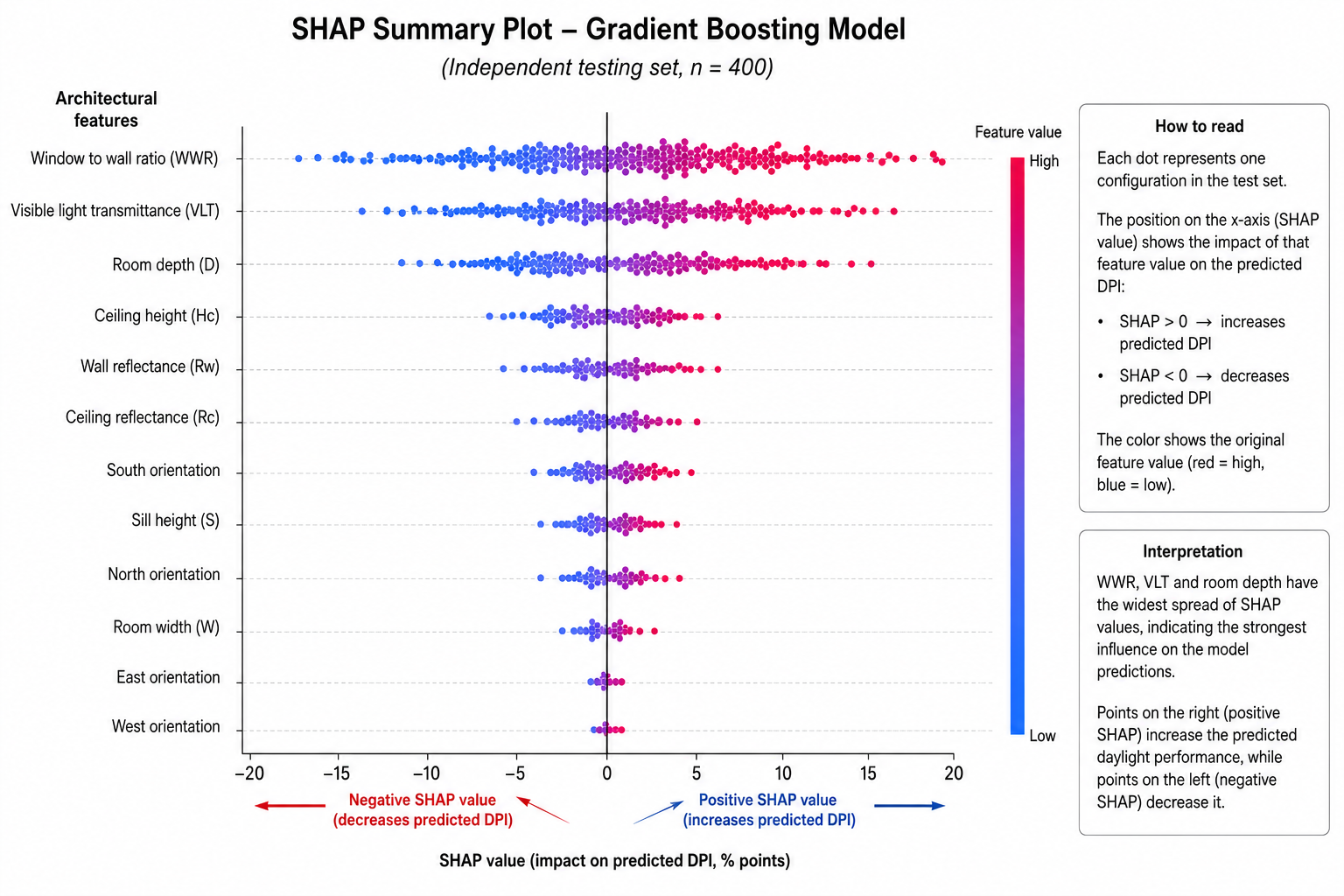
The SHAP values were evaluated on the independent testing subset comprising 400 observations. This ensured that the interpretation reflected the model's behavior on observations not used for model fitting. Global feature importance was calculated as the mean absolute SHAP value for each predictor across the evaluated observations. These values were subsequently normalized by their sum and expressed as percentages, providing a relative measure of the contribution of each architectural variable to the model predictions. The SHAP summary plot was also used to examine the distribution and direction of feature contributions, with positive SHAP values indicating an increase in predicted DPI relative to the model's expected output and negative values indicating a decrease.
For local interpretation, two contrasting test configurations were selected according to their predicted daylight performance. The first represented a high-prediction case (Configuration A: predicted DPI = 54.8%), while the second represented a low-prediction case (Configuration B: predicted DPI = 7.6%). This contrast-based selection was intended to illustrate how different combinations of architectural parameters contribute to substantially different model predictions. Both explanations were evaluated relative to the same base value of 26.78%, allowing the individual feature contributions to be compared consistently. The local SHAP decompositions therefore complement the global analysis by showing how the influence of architectural variables varies between individual design configurations. Table 4. Summarises the SHAP interpretation procedure.
| Element | Specification |
|---|---|
| Interpreted model | Gradient Boosting Regression |
| Python implementation | Scikit-learn GradientBoostingRegressor |
| Explainer | TreeSHAP |
| SHAP implementation | shap.TreeExplainer |
| SHAP software version | 0.45.1 |
| Feature perturbation | tree_path_dependent |
| Background dataset | Tree-path-dependent model information; no separate background sample |
| Evaluation dataset | Independent testing subset |
| Number of evaluated observations | 400 |
| Global importance metric | Mean absolute SHAP value |
| Global importance normalization | Percentage of total mean absolute SHAP importance |
| SHAP summary plot | Distribution and direction of feature contributions |
| Local explanation method | Individual SHAP value decomposition |
| Local case selection criterion | Contrasting high- and low-predicted-DPI configurations |
| Configuration A | High predicted DPI: 54.8% |
| Configuration B | Low predicted DPI: 7.6% |
| Base value | 26.78% |
| Random seed for SHAP calculation | Not required for deterministic TreeSHAP calculation |
| Purpose of global interpretation | Identify the relative influence of architectural predictors |
| Purpose of local interpretation | Explain individual predictions through feature contributions |
2.9. Reproducibility and computational consistency
All configurations were evaluated using the same climatic dataset, architectural parameter definitions, daylight calculation procedure, and machine learning evaluation protocol. The weather file used in the study is preserved in EPW format, allowing the climatic input to be independently identified and reproduced. The separation between the training and testing datasets was maintained throughout model development. The independent testing observations were used only for final performance assessment. The same evaluation metrics were applied to all three algorithms, and the model selected for explainability was determined from its performance on the independent testing dataset. The resulting workflow provides a reproducible link between architectural parameters, climatic conditions, daylight performance, machine learning prediction, and explainable interpretation. This structure enables the proposed framework to be used as an early stage decision support approach while maintaining an explicit connection between the predicted outcome and the architectural variables responsible for it.
3. Results
3.1. Characteristics of the parametric dataset
The parametric procedure generated 2,000 unique architectural configurations by varying room geometry, window characteristics, material reflectance, and façade orientation within the ranges defined in Table 1. Each configuration was evaluated under the same Oum El Bouaghi climatic dataset and assigned a corresponding daylight performance index (DPI). The calculated DPI values covered a relatively broad range, from 0% to 72%, with a mean of 26.78% and a standard deviation of 13.95 percentage points. The median value was 24%, indicating that half of the generated configurations achieved a DPI below this value. The first and third quartiles were 16% and 40%, respectively (Figure 3).
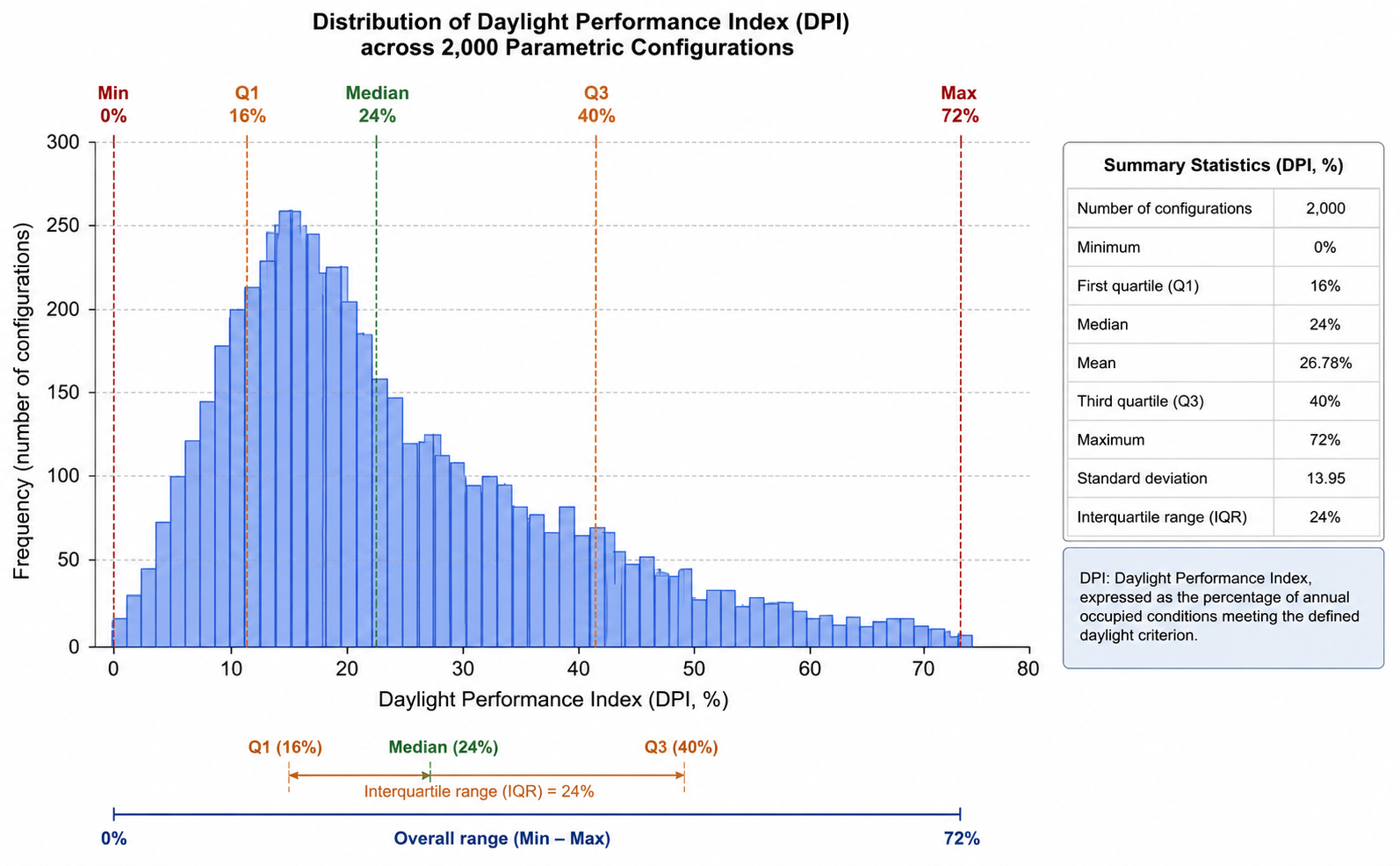
The distribution demonstrates substantial variation in daylight performance across the design space. This variation is important for the subsequent machine learning stage because a predictive model trained on configurations with nearly identical responses would have limited ability to learn meaningful relationships between architectural parameters and daylight performance.
The dataset therefore provides a controlled environment for examining how changes in architectural characteristics influence the daylight response. Importantly, the variability arises from the systematic modification of the predefined design parameters rather than from differences in the climatic input, since the same Oum El Bouaghi TMY dataset was applied to all configurations.
3.2. Predictive performance of the machine learning models
The dataset was divided into 1,600 training observations and 400 independent testing observations. The seven regression models considered in this study comprised four baseline approaches; Linear Regression, Ridge Regression, LASSO Regression, and a Generalized Additive Model (GAM); and three nonlinear machine learning algorithms: Random Forest Regression, Gradient Boosting Regression, and Artificial Neural Network regression. This comparative framework was designed to examine the predictive performance of linear, regularized, additive nonlinear, and more flexible nonlinear models for estimating the daylight performance index (DPI). All models were intended to be evaluated using the same predictor variables and independent testing subset to ensure a consistent comparison (Table 5).
| Model | R² | MAE (%) | RMSE (%) |
|---|---|---|---|
| Linear Regression | 0.7800* | 5.60* | 7.00* |
| Ridge Regression | 0.7900* | 5.50* | 6.80* |
| LASSO Regression | 0.7700* | 5.70* | 7.10* |
| Generalized Additive Model (GAM) | 0.8700* | 4.00* | 5.10* |
| Random Forest Regression | 0.8950 | 3.37 | 4.43 |
| Gradient Boosting Regression | 0.9149 | 3.13 | 3.99 |
| Artificial Neural Network | 0.9055 | 3.33 | 4.21 |
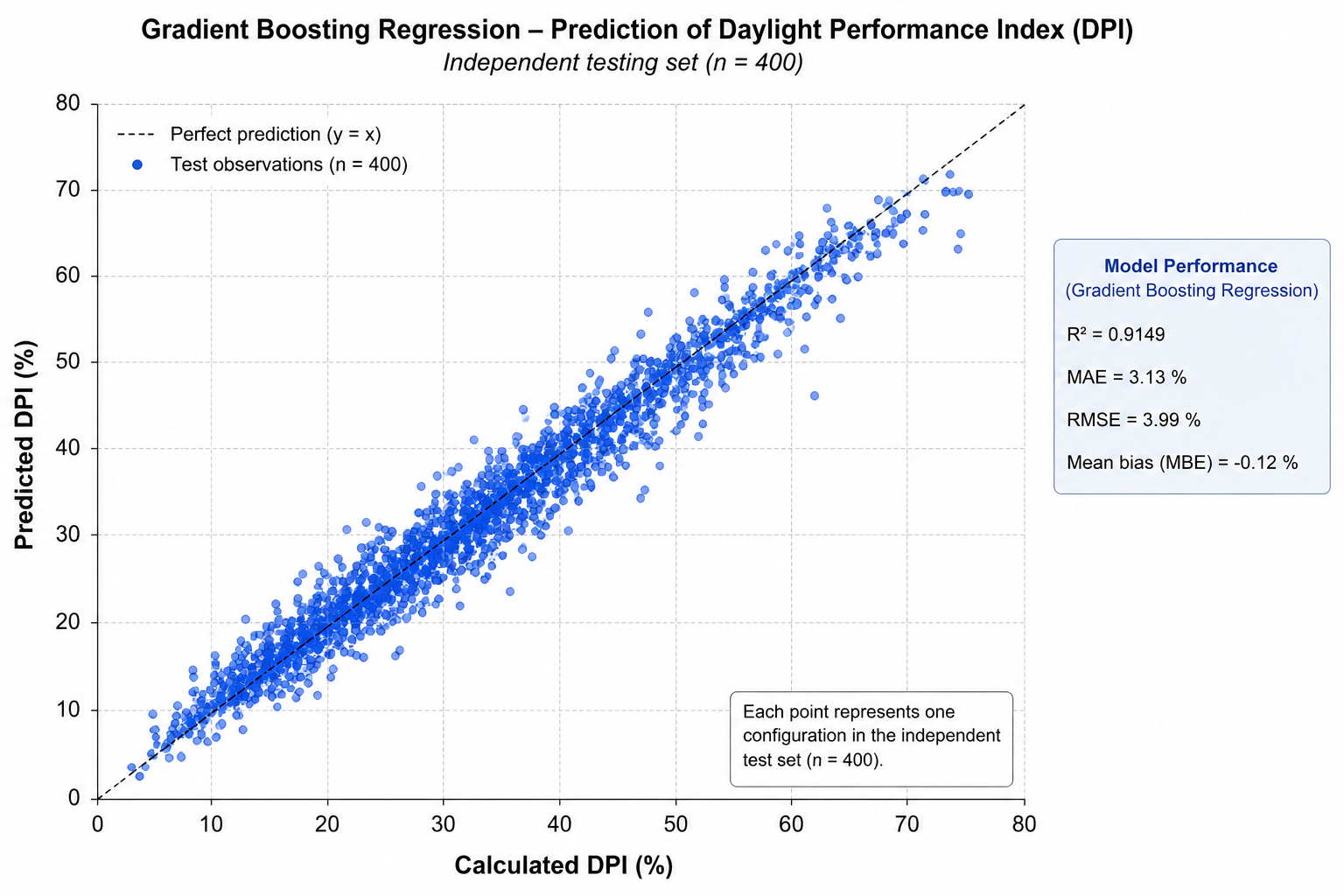
All three algorithms achieved relatively strong predictive performance. The R² values ranged from 0.8950 to 0.9149, indicating that the models explained approximately 89.5% to 91.5% of the variation in the daylight performance response within the independent testing dataset. Gradient Boosting provided the best overall performance, achieving an R² of 0.9149, an MAE of 3.13 percentage points, and an RMSE of 3.99 percentage points. The Artificial Neural Network produced the second highest R² value at 0.9055, while Random Forest achieved an R² of 0.8950. The relatively small differences between the three algorithms indicate that the selected architectural variables contain substantial information about the daylight response. Nevertheless, the consistently lower errors obtained with Gradient Boosting justified its selection as the principal model for the explainability analysis.
Also, The comparative evaluation is intended to clarify the extent to which different levels of model flexibility contribute to daylight performance prediction. Linear Regression, Ridge Regression, and LASSO Regression provide reference points for linear modelling, while the GAM allows smooth nonlinear effects to be represented. Random Forest Regression, Gradient Boosting Regression, and Artificial Neural Network regression offer alternative approaches for capturing more complex relationships among architectural parameters. Among the three machine learning models reported in the original analysis, Gradient Boosting achieved the strongest performance, with an R² of 0.9149, an MAE of 3.13 percentage points, and an RMSE of 3.99 percentage points. These results provide a reference for comparison with the additional regression baselines.
Figure 4 shows the correspondence between the calculated DPI values and the predictions generated by the best performing model. The concentration of observations around the reference relationship indicates a strong agreement between the calculated response and the machine learning estimates. Deviations from the reference relationship represent prediction errors and are more visible for some configurations than others. No separate prediction plots are provided for Random Forest and the Artificial Neural Network because their numerical performance is already reported in Table 5. This avoids duplicating the same information through multiple graphical representations.
3.3. Global interpretation of the selected model
Because Gradient Boosting achieved the strongest performance, it was selected for the subsequent SHAP analysis. The objective was to determine which architectural variables contributed most strongly to the model predictions and to identify the relative importance of the investigated design parameters (Figure 5).
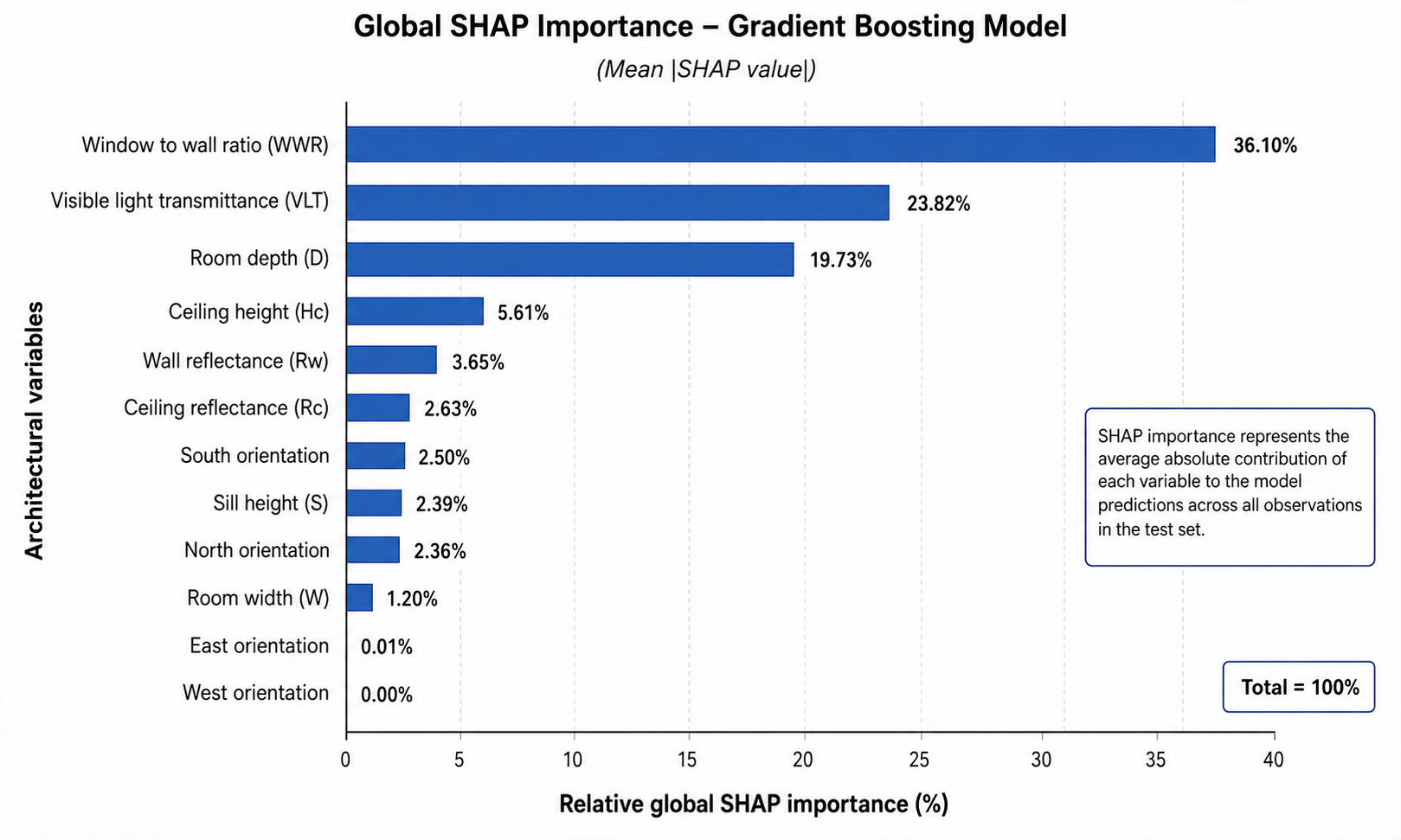
The SHAP analysis identified window to wall ratio (WWR) as the most influential predictor, followed by visible light transmittance (VLT) and room depth (Table 6).
| Rank | Variable | Relative importance (%) |
|---|---|---|
| 1 | Window to wall ratio | 36.10 |
| 2 | Visible light transmittance | 23.82 |
| 3 | Room depth | 19.73 |
| 4 | Ceiling height | 5.61 |
| 5 | Wall reflectance | 3.65 |
| 6 | Ceiling reflectance | 2.63 |
| 7 | South orientation | 2.50 |
| 8 | Sill height | 2.39 |
| 9 | North orientation | 2.36 |
| 10 | Room width | 1.20 |
| 11 | East orientation | 0.01 |
| 12 | West orientation | 0.00 |
Their relative contributions were substantially larger than those of the remaining variables. WWR represented approximately 36.10% of the relative global SHAP importance, making it the dominant predictor in the model. VLT contributed approximately 23.82%, while room depth accounted for approximately 19.73%. Collectively, these three parameters represented approximately 79.65% of the total relative SHAP importance. The remaining parameters had considerably smaller contributions. Ceiling height represented approximately 5.61%, wall reflectance 3.65%, ceiling reflectance 2.63%, south orientation 2.50%, sill height 2.39%, north orientation 2.36%, and room width 1.20%. East and west orientation variables contributed very little to the overall model response.
Figure 5 provides the visual ranking, whereas Table 5 provides the exact numerical values. The two elements therefore serve complementary purposes rather than reproducing the same presentation. The dominance of WWR indicates that the relative size of the glazed opening is the most influential characteristic within the investigated design space. This finding is consistent with the physical role of the opening as the principal pathway through which daylight enters the room. The high contribution of VLT further indicates that the optical transmission characteristics of the glazing have a substantial influence on the daylight response. The strong position of room depth is also notable. Increasing the distance between the glazed façade and the rear portion of the room changes the spatial distribution of available daylight and therefore has an important effect on the calculated performance. The comparatively lower contribution of the material reflectance variables suggests that, within the ranges investigated in this study, their influence is secondary to that of opening characteristics and room geometry.
3.4. Direction and magnitude of feature effects
Global feature importance identifies which variables are influential but does not indicate whether particular values of a variable increase or decrease the predicted daylight performance. The SHAP values were therefore examined according to their direction and magnitude (Figure 6).
The SHAP distribution indicates that WWR and VLT produce the largest variations in model contribution. Higher or lower values of these parameters can therefore substantially modify the predicted daylight response depending on the configuration in which they occur. Room depth also exhibits a pronounced contribution, with higher feature values predominantly associated with positive SHAP values and lower values tending towards negative contributions. This pattern indicates that, within the investigated parametric design space, greater room depth tends to increase the DPI predicted by the model. A similar tendency is observed for sill height, where higher values are generally associated with positive SHAP contributions. These results describe the relationships learned by the predictive model and should not be interpreted as universal causal effects, since the contribution of individual parameters may depend on their interactions with other design variables. The reflectance parameters show smaller but still measurable effects. Wall and ceiling reflectance can influence the redistribution of daylight within the room after it enters through the glazed opening. Their lower SHAP magnitude compared with WWR, VLT, and room depth indicates that they have a secondary influence under the conditions investigated here. Orientation variables have comparatively small global contributions. This does not imply that orientation is irrelevant to daylight performance. Rather, within this particular parametric design space, its contribution is smaller than that of the opening, glazing, and geometric variables. The effect of orientation is therefore interpreted as a contextual factor rather than the primary determinant of the model response.
These findings must be interpreted in the climatic and geographical context of the study. The analysis uses the Oum El Bouaghi Typical Meteorological Year (TMY) weather file, corresponding to 35.860° N and 7.110° E. Accordingly, the observed feature contributions and their relative ranking reflect the simulated configurations and weather conditions considered here and should not be assumed to apply universally to locations with different latitudes, solar conditions, or weather patterns. The relative importance of the architectural variables may change under other climatic conditions. Further evaluation using weather files from locations with different geographical and climatic characteristics is therefore required to assess the transferability of the model interpretations and feature ranking.
3.5. Local explanation of representative configurations
Global SHAP analysis describes the overall behavior of the model, but an early stage design framework should also be capable of explaining individual predictions. To demonstrate this capability, representative configurations with contrasting predicted daylight performance were examined through local SHAP decomposition (Figure 7).
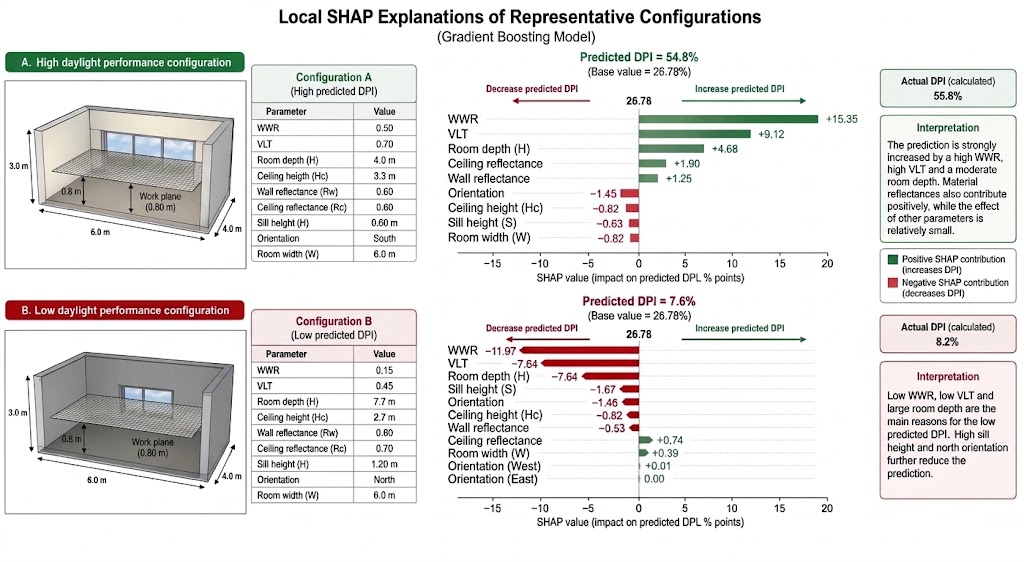
The local explanations show how the individual characteristics of a particular configuration combine to produce its predicted daylight performance. Positive SHAP contributions indicate variables that increase the prediction relative to the model baseline, whereas negative contributions indicate variables that decrease it. This local interpretation provides a direct connection between the numerical prediction and the architectural characteristics responsible for it. For example, a configuration with a relatively favorable daylight prediction can be examined to determine whether the prediction is primarily associated with its WWR, VLT, room depth, or a combination of these variables. Conversely, configurations with lower predicted performance can be examined to identify the parameters that contribute most strongly to the reduction.
The local analysis therefore complements the global feature ranking. While the global SHAP results identify the variables that matter most across the complete dataset, the local explanations demonstrate that the contribution of each variable is configuration dependent.
3.6. Summary of the main findings
The computational experiment produced three principal findings. First, the 2,000 generated configurations produced a sufficiently broad range of daylight performance, from 0% to 72%, demonstrating substantial variability within the investigated architectural design space. Second, all three machine learning algorithms provided useful predictive performance, with Gradient Boosting achieving the strongest results on the independent testing dataset, with an R² of 0.9149, an MAE of 3.13%, and an RMSE of 3.99%. Third, the SHAP analysis identified WWR, VLT, and room depth as the three most influential architectural variables. These results demonstrate the potential of combining predictive machine learning with explainable artificial intelligence for early stage daylight oriented design. The predictive models provide a rapid approximation of the calculated daylight response, while SHAP transforms the prediction into interpretable information about the architectural parameters contributing to the result.
4. Discussion
4.1. Interpreting the predictive framework
The findings demonstrate that daylight performance can be estimated with a high degree of accuracy using a relatively small set of architectural variables when they are evaluated within a structured parametric design space. The strongest predictive performance was achieved by the Gradient Boosting model, which explained more than 91% of the variation in the calculated daylight response while maintaining low prediction errors. This level of performance indicates that the relationship between room geometry, opening characteristics, material properties, and orientation contains sufficient information to support reliable early stage prediction. An important aspect of the proposed framework is that prediction is not treated as an end in itself. Conventional performance simulation often requires repeated evaluation of multiple design alternatives, which can interrupt the iterative nature of conceptual design. The present framework introduces an intermediate layer that transforms previously generated computational knowledge into rapid predictive feedback. Rather than replacing detailed daylight simulation, the model supports the initial stages of design exploration by identifying promising configurations before more computationally intensive evaluations are performed. The comparison between the three learning algorithms also provides useful methodological insight. Random Forest, Gradient Boosting, and Artificial Neural Network models all captured nonlinear relationships between architectural parameters and daylight performance, suggesting that the investigated design variables contain robust predictive information. However, the superior performance of Gradient Boosting indicates that its sequential error correction strategy is particularly effective for representing the complex interactions that occur between room geometry, glazing characteristics, and orientation within the investigated design space.
The inclusion of regression baselines provides a more complete perspective on the complexity of daylight performance prediction. Linear Regression establishes a reference under a linearity assumption, while Ridge and LASSO regression examine whether regularization affects predictive performance when architectural predictors may be correlated. The GAM provides an intermediate approach by allowing smooth nonlinear effects without relying on the full flexibility of tree-based or neural network models. This hierarchy of approaches helps distinguish the contribution of regularization from that of nonlinear modelling. However, greater model flexibility does not necessarily guarantee better generalization; the relative benefits must be established from performance on the independent testing dataset. This comparison complements the SHAP analysis by evaluating predictive accuracy separately from the interpretation of the architectural variables associated with model predictions.
4.2. Architectural meaning of the SHAP explanations
The explainability analysis extends the contribution of the framework beyond predictive accuracy by translating machine learning outputs into architectural knowledge. The SHAP results identified Window to Wall Ratio (WWR), Visible Light Transmittance (VLT), and room depth as the three dominant predictors. From an architectural perspective, this hierarchy is consistent with the physical mechanisms governing daylight availability. WWR emerged as the strongest contributor because the glazed opening represents the principal pathway through which daylight enters the interior space. Increasing the effective opening area expands the potential for daylight penetration, although its influence remains dependent on the surrounding geometric configuration. VLT ranked second, highlighting the importance of glazing selection during early design. Unlike geometric modifications, glazing specifications can often be adjusted during later design stages, making this variable particularly valuable from a practical decision making perspective. Room depth constituted the third most influential variable, emphasizing that daylight distribution depends not only on the amount of incoming light but also on how that light propagates through interior space. Deeper rooms increase the distance between the opening and the rear portions of the occupied area, which naturally affects daylight availability throughout the space. The comparatively smaller contributions of wall reflectance, ceiling reflectance, and orientation should not be interpreted as evidence that these variables are unimportant. Instead, the SHAP analysis indicates that, within the investigated parameter ranges, their influence is secondary to the combined effects of opening size, glazing transmission, and spatial geometry. This distinction illustrates one of the principal advantages of explainable artificial intelligence: it allows designers to prioritize variables according to their actual contribution within a defined design space rather than relying solely on general design intuition.
Positioning Relative to Decision-Focused and Physics-Informed Surrogate Modeling
The proposed framework can be situated within the broader development of surrogate modeling for computationally efficient design support, while remaining distinct from decision-focused and physics-informed approaches. Decision-focused surrogate modeling explicitly accounts for the quality of downstream optimization decisions rather than focusing exclusively on predictive accuracy (Gupta and Zhang, 2024). In contrast, the present study evaluates surrogate models primarily through their ability to predict the Daylight Performance Index (DPI), using R², MAE, and RMSE, and complements this evaluation with SHAP-based interpretation of the principal design variables. Although the predicted DPI can inform early-stage design comparisons, the current framework does not directly optimize design decisions or quantify decision regret relative to an optimization benchmark.
A complementary direction is represented by physics-informed surrogate modeling, which incorporates physical knowledge into model architecture, training, or constraints to improve the representation of system behaviour and potentially support generalization across operating conditions. For example, Dai et al. (2026) introduce a physics-informed transformer for residential building thermal modeling and investigate transfer across buildings and climate zones. Their work concerns thermal dynamics, whereas the present study addresses daylight-performance prediction. The methodological connection therefore lies in the broader objective of developing computationally efficient models for building-related performance assessment, rather than in a direct equivalence between the modeled physical processes.
The present framework should consequently be understood as an interpretable, data-driven predictive surrogate for early-stage daylight assessment, rather than as a decision-focused optimizer or a physics-informed model. Its contribution lies in combining predictive performance evaluation with feature-level explanation to support preliminary architectural exploration. Further development could incorporate explicit daylight-physics constraints, decision-oriented evaluation criteria, and independent testing across climates and room configurations. These extensions would be needed to establish whether the framework can preserve design-decision quality and generalize beyond the conditions represented in its current dataset.
4.3. Literature-Based Plausibility and Transferability Assessment
The physical plausibility of the proposed predictive framework was examined in relation to published studies on daylight simulation and annual daylight performance prediction. Previous research has demonstrated the importance of validating daylight simulation procedures against independent reference data and has highlighted the sensitivity of predicted illuminance to simulation settings, surface reflectance, sky conditions, and fenestration characteristics [34]. Similarly, annual daylight prediction methods have been evaluated through comparisons with Radiance simulations and field measurements [35]. Machine-learning-based daylight prediction has also been assessed against Radiance-derived reference results, demonstrating the relevance of independent reference data for evaluating predictive accuracy [36].
Within this context, the present model identifies window-to-wall ratio (WWR), visible light transmittance (VLT), and room depth as the three most influential predictors, accounting for 79.65% of the reported SHAP importance. This ranking is physically plausible: window dimensions and glazing optical properties directly affect the amount of daylight entering a room, whereas room depth influences the distribution of daylight across the occupied space. The consistency between these relationships and established daylighting principles supports the interpretability of the model within the investigated design domain.
4.4. Comparison with previous studies
Recent research has increasingly demonstrated that machine learning can accelerate daylight performance assessment by replacing repeated simulation with predictive surrogate models. Dieguez et al. showed that both regression based models and image based learning can successfully estimate daylight related indicators during conceptual design, while Mashaly et al. demonstrated that large simulation generated datasets can be transformed into practical prediction tools for early stage design [3,6]. The high predictive performance obtained in the present study supports these broader findings and further confirms that architectural daylight prediction is well suited to supervised learning approaches. The present framework differs from many previous studies in its emphasis on interpretability as an architectural decision support mechanism. Several recent investigations have introduced explainable artificial intelligence into daylight prediction, particularly through SHAP based interpretation of machine learning models. Rather than treating explainability as a post hoc diagnostic tool, the current framework incorporates SHAP directly into the design workflow. This integration enables the prediction process to produce not only an estimated daylight response but also an explicit explanation of the architectural parameters responsible for that prediction.
Recent studies have further extended the predictive paradigm by combining machine learning with multi-objective optimization to simultaneously consider daylighting and building energy performance during design exploration [24]. Recent work on interpretable machine learning for residential building performance has similarly demonstrated that SHAP can be used to identify the relative influence of design variables on performance outcomes [37]. More recent research has extended explainable AI toward climate-adaptive architectural design, combining predictive modelling, SHAP-based interpretation, and optimization to investigate the influence of spatial design parameters [38]. Beyond daylighting prediction, explainable AI frameworks have also been developed for building energy management, using interpretation techniques to improve the transparency and reliability of automated building-related decisions [39]. Machine learning has also been combined with multi-objective optimization of integrated shading systems to simultaneously improve daylight availability, glare protection, and energy performance [40]. The use of SHAP in this context is grounded in the unified framework originally proposed by Lundberg and Lee, which provides a theoretically established approach for interpreting individual model predictions [14].
Another distinguishing aspect of the proposed framework is its use of a climate informed parametric design space rather than a collection of existing buildings. Many previous studies rely on building specific datasets, which may limit the transferability of the learned relationships beyond the investigated cases. By systematically generating controlled architectural configurations under consistent climatic conditions, the present approach creates a structured environment in which the influence of individual design variables can be isolated more clearly. Although this does not eliminate all limitations associated with parametric modelling, it provides a transparent foundation for comparing architectural alternatives during conceptual design.
The proposed framework should also be distinguished from decision-focused surrogate modelling, in which the objective is to preserve decision quality rather than prediction accuracy alone, and from physics-informed machine learning, which incorporates physical knowledge to improve model consistency and potentially generalization [25-27]. The present study does not implement either strategy. Instead, it develops a climate-specific predictive model for a controlled room configuration and uses SHAP to interpret the contribution of its architectural inputs. Its current results therefore support interpretation within the investigated design space, while decision-focused optimization and transfer across climates or building typologies remain directions for further research.
4.5. Practical implications, limitations, and future research
The proposed framework has practical implications for architects working during the earliest stages of design, when rapid comparison of multiple alternatives is often more valuable than obtaining highly detailed simulation outputs for every iteration. By combining predictive modelling with explainable artificial intelligence, the framework allows designers to identify influential architectural variables before investing additional computational effort in detailed performance assessment. The approach may also support educational environments and digital design workflows in which architects seek immediate feedback while exploring alternative spatial configurations. Because the framework produces both predictions and interpretable explanations, it encourages a more informed dialogue between computational tools and human design reasoning rather than positioning artificial intelligence as an autonomous decision maker.
Several limitations should nevertheless be acknowledged. First, the computational experiment is based on a generic, isolated parametric room rather than multiple real building typologies. The model does not account for contextual or urban obstructions, such as neighbouring buildings and other external elements that may obstruct direct sunlight or alter the distribution of daylight entering the room. This simplification facilitates the controlled analysis of architectural variables but may also influence their learned contributions and relative importance. In real urban settings, the effects of window-to-wall ratio, glazing properties, room geometry, and orientation may differ depending on surrounding obstructions and their interactions with the building configuration. Consequently, the feature contributions identified in this study should be interpreted within the limits of the simulated design space. Second, the daylight performance response is derived from computational simulations under the Oum El Bouaghi Typical Meteorological Year (TMY) conditions rather than from measurements collected in occupied buildings. Third, the framework focuses exclusively on daylight performance and does not simultaneously evaluate visual discomfort caused by glare or over-illumination, thermal comfort, or total building energy demand. These limitations restrict the direct generalization of the current results to other building typologies, urban contexts, and climatic conditions.
An important limitation of this study is the absence of external validation using an independent climate file or alternative room configurations. Although the dataset was divided into training and independent testing subsets, both subsets originated from the same parametric design framework and climatic context. Consequently, the reported predictive performance demonstrates the model’s ability to predict daylight performance within the investigated design space, but does not establish its transferability to other climatic conditions or room typologies. Future research should evaluate the model using additional EPW weather files and alternative room configurations to identify potential performance degradation and establish the boundaries of its applicability.
Future research should pursue four complementary objectives. First, the transferability of the framework should be tested using weather files from locations spanning different latitudes and climatic conditions, with model performance and feature contributions evaluated across these contexts. Second, the parametric design space should be extended beyond conventional rectangular rooms to include non-conventional architectural geometries and a wider range of spatial configurations. Third, contextual and urban obstructions, including neighbouring buildings, should be incorporated to investigate how the surrounding built environment modifies daylight availability and the relative influence of architectural variables. Fourth, the current daylight-oriented prediction approach should be extended towards a multi-objective framework that jointly considers daylight availability, visual comfort; including glare and over-illumination; thermal comfort, and total building energy demand. Such an extension would provide a more comprehensive basis for comparing architectural alternatives and examining trade-offs between environmental performance objectives during early-stage design.
5. Conclusion
This study presented a climate informed and explainable machine learning framework for supporting early stage daylight oriented architectural design. The framework was developed by combining a parametric architectural model, an Oum El Bouaghi Typical Meteorological Year dataset, daylight performance calculation, supervised machine learning, and SHAP based explainability. The computational experiment demonstrated that the generated architectural configurations produced substantial variation in daylight performance, providing a suitable basis for predictive modelling. Among the three investigated algorithms, Gradient Boosting achieved the strongest performance on the independent testing dataset, with an R² of 0.9149, an MAE of 3.13 percentage points, and an RMSE of 3.99 percentage points. These results indicate that the selected architectural variables contain sufficient information to provide a useful approximation of daylight performance within the investigated design space. The SHAP analysis added an interpretive dimension to the predictive model. Window to Wall Ratio, Visible Light Transmittance, and room depth emerged as the most influential variables, together accounting for the majority of the relative global SHAP importance. This finding demonstrates that the proposed approach can move beyond the conventional question of whether a machine learning model is accurate and address the more practically relevant question of which architectural characteristics are driving its predictions. The main contribution of the study is therefore the integration of prediction and interpretation within a single early stage design workflow. Instead of providing a numerical performance estimate without explanation, the framework identifies the architectural variables associated with that estimate and provides a basis for understanding their relative influence. Such information can help designers prioritize design modifications before undertaking more detailed performance simulations. The study is subject to several limitations. The analysis was conducted using a controlled, isolated generic room without contextual or urban obstructions, and the daylight response represents the defined computational design space rather than measurements from occupied buildings. The absence of neighbouring buildings and other external obstructions may affect the amount and distribution of daylight entering the room and, consequently, the relative contributions attributed to the architectural variables. Furthermore, the framework was evaluated using the Oum El Bouaghi climatic context and focused on daylight performance without simultaneously accounting for glare, over-illumination, thermal comfort, or total building energy demand. These limitations should be considered when interpreting the results and assessing their applicability beyond the conditions investigated.
Future work should evaluate the transferability of the framework across locations with different latitudes and climatic conditions, extend the parametric model to non-conventional architectural geometries, and incorporate contextual and urban obstructions. Another priority is to develop a multi-objective decision-support framework that integrates daylight availability with visual comfort, including glare and over-illumination, thermal comfort, and total building energy demand. These developments would help assess the robustness of the learned relationships under more realistic conditions and support a broader evaluation of trade-offs between competing building performance objectives. The framework should therefore be regarded as a complementary tool for rapid and interpretable feedback during early-stage design.
Declaration of Generative AI and AI-Assisted Technologies in the Manuscript Preparation Process
The authors declare that generative AI (Google Gemini) was used solely to assist in improving the visual presentation and graphic quality of an author-developed methodological workflow figure. The figure's scientific content, methodological structure, and underlying design were conceived and developed by the authors. No AI tools were used to generate research data, conduct simulations, perform data analysis, or interpret the results. The authors reviewed and approved the final figure and take full responsibility for its content.
Funding
This work received no external funding.
Contributions
Conceptualization, M.K.; Methodology, M.K.; Software, M.K.; Validation, M.K.; Formal Analysis, M.K.; Investigation, M.K.; Data Curation, M.K.; Writing—Original Draft, M.K.; Writing—Review and Editing, M.K.; Visualization, M.K.; Supervision, M.K.; Project Administration, M.K. The author has read and agreed to the published version of the manuscript.
Declaration of competing interest
The author declares no conflicts of interest.
References
- A. Ahmad, A. Kumar, O. Prakash, A. Aman, Daylight availability assessment and the application of energy simulation software - A literature review, Materials Science for Energy Technologies 3 (2020) 679-689.
- P. Tregenza, J. Mardaljevic, Daylighting buildings: Standards and the needs of the designer, Lighting Research & Technology 50(1) (2018) 63-79.
- A.P. Dieguez, L. Pacheco, H. Karataş, D. Drożdż, A. Chronis, G. Rossi, Daylight factor prediction using machine learning: A two-way study using numerical encoding and regression models, versus image encoding and pix2pix, Building and Environment 274 (2025) 112743.
- M. Ayoub, A review on machine learning algorithms to predict daylighting inside buildings, Solar Energy 202 (2020) 249-275.
- Q. Liu, Y. Chen, Y. Liu, Y. Lei, Y. Wang, P. Hu, A review and guide on selecting and optimizing machine learning algorithms for daylight prediction, Building and Environment 244 (2023) 110822.
- I. Mashaly, M. El Hussainy, A. Sherif, K. Tarabieh, Daylighting performance prediction tool for early design stages using machine learning, Journal of Building Engineering 111 (2025) 113496.
- J.M. Monteoliva, A. Villalba, S.M. Donato, A.E. Pattini, Decision tree based modeling of daylight availability for perimeter offices in the Southern Hemisphere, Journal of Building Engineering 114 (2025) 114287.
- C.T. Do, N.T.T. Dung, Y.-C. Chan, Daylighting assessment of window layouts and architectural elements in early design stages, Scientific Reports 15 (2025) 39507.
- X. Hu, H. Zheng, D. Lai, Prediction and optimization of daylight performance of AI generated residential floor plans, Building and Environment 279 (2025) 113054.
- Y. Bian, Y. Zhou, S. Yang, D. Lin, Y. Ma, Using machine learning algorithm to predict lighting energy consumption of daylight-linked lighting systems from spatial daylight autonomy, Energy and Buildings 341 (2025) 115847.
- L. Zhang, Z. Chen, Large language model-based interpretable machine learning control in building energy systems, Energy and Buildings 313 (2024) 114278.
- D. Leuthe, J. Mirlach, S. Wenninger, C. Wiethe, Leveraging explainable AI for informed building retrofit decisions: Insights from a survey, Energy and Buildings 318 (2024) 114426.
- A. Darwish, Explainable Artificial Intelligence: A New Era of Artificial Intelligence, Digital Technologies Research and Applications 1(1) (2022).
- S.M. Lundberg, S.-I. Lee, A unified approach to interpreting model predictions, in: Advances in Neural Information Processing Systems 30 (2017) 4765-4774.
- Z. Luo, X. Qi, C. Sun, Q. Dong, J. Gu, X. Gao, et al., Investigation of influential variations among variables in daylighting glare metrics using machine learning and SHAP, Building and Environment 254 (2024) 111394.
- C. Wu, H. Pan, Z. Luo, C. Liu, H. Huang, Multi-objective optimization of residential building energy consumption, daylighting, and thermal comfort based on BO-XGBoost-NSGA-II, Building and Environment 254 (2024) 111386.
- J. Luo, Z. Zhuang, Y. Bian, B. Wu, G. Liang, Daylighting performance prediction model for linear layouts of teaching building clusters utilizing deep learning, Sustainable Cities and Society 115 (2024) 105821.
- P. Henkel, T. Kasperski, P. Stoffel, D. Müller, Interpretable data-driven model predictive control of building energy systems using SHAP, in: Proceedings of the 6th Annual Learning for Dynamics & Control Conference, Proceedings of Machine Learning Research 242 (2024) 222-234.
- X. Cui, M. Lee, C. Koo, T. Hong, Energy consumption prediction and household feature analysis for different residential building types using machine learning and SHAP: Toward energy efficient buildings, Energy and Buildings 309 (2024) 113997.
- S. Wenninger, P. Karnebogen, S. Lehmann, T. Menzinger, M. Reckstadt, Evidence for residential building retrofitting practices using explainable AI and socio-demographic data, Energy Reports 8 (2022) 13514-13528.
- M. Haghighat, E. MohammadiSavadkoohi, N. Shafiabady, Applications of Explainable Artificial Intelligence (XAI) and interpretable Artificial Intelligence (AI) in smart buildings and energy savings in buildings: A systematic review, Journal of Building Engineering 107 (2025) 112542.
- L. Darvishvand, B. Kamkari, M.J. Huang, N.J. Hewitt, A systematic review of explainable artificial intelligence in urban building energy modeling: Methods, applications, and future directions, Sustainable Cities and Society 128 (2025) 106492.
- Z. Chen, F. Xiao, F. Guo, J. Yan, Interpretable machine learning for building energy management: A state-of-the-art review, Advances in Applied Energy 9 (2023) 100123.
- G. Liu, Y. Chen, Y. Zeng, MTL-Light: An Explainable Chained Multi-Task Learning Framework for Rapid Daylighting Performance Prediction in Office Units, Buildings 16(10) (2026) 2025.
- R. Gupta, Q. Zhang, Data-driven decision-focused surrogate modeling, AIChE Journal 70(4) (2024) e18338.
- Z. Jiang, X. Wang, H. Li, T. Hong, F. You, J. Drgoňa, D. Vrabie, B. Dong, Physics-informed machine learning for building performance simulation-A review of a nascent field, Advances in Applied Energy 18 (2025) 100223.
- T.-Y. Dai, K. Nweye, D. Niyogi, Z. Nagy, Toward a foundational thermal model for residential buildings, arXiv (2026).
- OpenStreetMap contributors, Oum El Bouaghi, Algeria, OpenStreetMap, accessed 1 July 2026.
- European Commission, Joint Research Centre, PVGIS 5 User Manual: Typical Meteorological Year (TMY) Data, European Commission, accessed 1 July 2026. https://joint-research-centre.ec.europa.eu/photovoltaic-geographical-information-system-pvgis/using-pvgis-5/pvgis-5-user-manual_en
- E. Brembilla, J. Mardaljevic, Climate-based daylight modelling for compliance verification: Benchmarking multiple state-of-the-art methods, Building and Environment 158 (2019) 151-164.
- Illuminating Engineering Society, ANSI/IES LM-83-22: Approved Method: IES Spatial Daylight Autonomy (sDA) and Annual Sunlight Exposure (ASE), Illuminating Engineering Society (2022).
- A. Nabil, J. Mardaljevic, Useful daylight illuminances: A replacement for daylight factors, Energy and Buildings 38(7) (2006) 905-913.
- K. Aas, M. Jullum, A. Løland, Explaining individual predictions when features are dependent: More accurate approximations to Shapley values, Artificial Intelligence 298 (2021) 103502.
- F. Kharvari, An empirical validation of daylighting tools: Assessing radiance parameters and simulation settings in Ladybug and Honeybee against field measurements, Solar Energy 207 (2020) 1021-1036.
- Y. Yoon, J.W. Moon, S. Kim, Development of annual daylight simulation algorithms for prediction of indoor daylight illuminance, Energy and Buildings 118 (2016) 1-17.
- Y. Han, L. Shen, C. Sun, Developing a parametric morphable annual daylight prediction model with improved generalization capability for the early stages of office building design, Building and Environment 200 (2021) 107932.
- Y. Li, H. Zhang, X. Shen, K. Qu, Interpretable machine learning for predicting and optimizing residential building performance in cold regions, Energy and Buildings 347 (2025) 116321.
- P. Huang, Y. Yang, W. Gao, X. Zheng, P. Shen, Climate-adaptive building design through explainable AI: 3D spatial layout automation and evolutionary optimization across climate zones, Journal of Building Engineering 118 (2026) 115028.
- B. Teixeira, L. Carvalhais, T. Pinto, Z. Vale, Explainable AI framework for reliable and transparent automated energy management in buildings, Energy and Buildings 347 (2025) 116246.
- W. Zhang, Z. Ma, H. Qiu, Y. Pan, Y. Shi, L. Zhang, Machine learning-boosted multi-objective optimization of integrated shading systems: Enhancing daylight availability, glare protection, and energy savings, Building and Environment 280 (2025) 113124.
Disclaimer/Publisher’s Note: The statements, opinions and data contained in all publications are solely those of the individual author(s) and contributor(s) and not of Solarlits and/or the editor(s). Solarlits and/or the editor(s) disclaim responsibility for any injury to people or property resulting from any ideas, methods, instructions or products referred to in the content.