
Ahmad G Kotbi*
Author affiliations
Department of Architecture and Building Science, College of Architecture and Planning, King Saud University, Riyadh 11574, Saudi Arabia
*Corresponding author.
akotbi@ksu.edu.sa (A. G Kotbi)
History: Received 14 July 2026 | Revised 8 August 2026 | Accepted 26 August 2026 | Published online 1 October 2026
Copyright: © 2026 The Author(s). Licensee Solarlits Limited (Hong Kong). This is an open access article distributed under the terms and conditions of the Creative Commons Attribution 4.0 License.
Citation: Ahmad G Kotbi, Integration Gaps in Smart Indoor Lighting: A Systematic Bibliometric Review of Human-Centric Control, IoT, and Event-Driven Automation, Journal of Daylighting, 13:2 (2026) 575-597. doi: 10.15627/jd.2026.32
Abstract
Lighting systems constitute a significant share of building energy demand while simultaneously affecting visual comfort, circadian regulation, cognitive performance, and occupant well-being. Despite rapid advances in smart building technologies and adaptive illumination systems, the literature remains fragmented regarding the integration of optimization intelligence, interoperable Internet of Things (IoT) infrastructures, and event-driven automation frameworks within unified human-centric lighting environments. This study presents a systematic bibliometric and thematic review of smart indoor lighting research published between 2015 and 2024, following the PRISMA 2020 framework across Scopus, Web of Science, and IEEE Xplore. From an initial corpus of 5,529 records, 30 studies satisfied the final inclusion criteria requiring simultaneous reporting of quantitative performance outcomes alongside explicitly defined control or automation mechanisms. Bibliometric analyses using MATLAB and VOSviewer revealed strong growth in adaptive lighting and IoT-enabled infrastructures, with Annual Average Growth Rates reaching 9.2% for occupant-centred lighting, 7.3% for energy-oriented lighting, and 13.9% for sensing and communication infrastructures. However, metadata-level integration between hyper-heuristics, interoperable IoT middleware, and Event–Condition–Action (ECA) and IFTTT automation remained extremely limited, with a mean Jaccard co-occurrence coefficient of only 0.018, indicating weak cross-domain coupling. Thematic metrics show uneven adoption: Equivalent Melanopic Lux (EML) is reported in 20% of core studies, Circadian Stimulus (CS) in 27%, while Unified Glare Rating (UGR) remains under-reported at 13.3%, highlighting a methodological gap in visual comfort assessment. The findings demonstrate that smart indoor lighting research continues to evolve through disconnected disciplinary trajectories rather than cohesive intelligent control ecosystems. This review proposes a conceptual integration framework and future research roadmap aimed at supporting interoperable, energy-efficient, and human-centric lighting systems capable of simultaneously optimizing automation performance, occupant comfort, and non-visual health outcomes within intelligent indoor environments.
Keywords
smart indoor lighting, human‑centric lighting, Internet of Things, hyper‑heuristics, event–condition–action automation, energy‑efficient buildings
1. Introduction
Lighting systems continue to represent a substantial proportion of electricity demand in contemporary buildings, particularly within educational facilities, office environments, healthcare spaces, and high‑occupancy indoor settings [1]. This persistent energy burden has intensified research efforts directed towards intelligent control strategies capable of reducing operational consumption while maintaining acceptable environmental quality for occupants [2]. In parallel, the emergence of Human‑Centric Lighting (HCL) has significantly transformed the conceptual basis of indoor illumination design. Rather than treating lighting exclusively as a visual engineering requirement defined by fixed illuminance thresholds, HCL frames lighting as a dynamic environmental variable that influences visual perception, circadian regulation, cognitive performance, emotional state, and overall occupant wellbeing [3,4].
This study adopts the following conceptual framework: Human‑Centric Lighting (HCL) refers to illumination strategies that prioritize visual, circadian, and emotional well‑being [3]. The Internet of Things (IoT) enables interoperable, cyber‑physical lighting infrastructures via protocols such as Zigbee, DALI, and MQTT [5]. Event–Condition–Action (ECA) and IFTTT represent rule‑based automation paradigms that trigger predefined responses upon sensor‑detected events [6]. Hyper‑heuristics (HH) are supervisory optimization algorithms that orchestrate lower‑level heuristics (e.g., GA, PSO) to manage multi‑objective trade‑offs [7]. Building upon these definitions, the transition to HCL has fundamentally altered the optimization logic underpinning modern lighting research: indoor lighting systems are now understood as multi‑objective systems operating under competing technical, physiological, and behavioural constraints, requiring simultaneous reconciliation of electricity reduction, visual comfort, daylight utilization, circadian‑effective exposure, and user satisfaction [8]. Energy performance is commonly assessed through metrics such as lighting energy use intensity (EUI), demand reduction, or operational savings, whereas comfort‑related evaluation increasingly incorporates subjective user response and biologically informed indicators [9,10,11].
The rapid development of the IoT has further accelerated this transformation by redefining lighting infrastructures as interconnected cyber‑physical ecosystems rather than isolated electrical subsystems [12]. In current smart‑building environments, distributed sensing networks continuously capture occupancy conditions, daylight availability, temporal patterns, environmental changes, and user preferences, translating these data streams into real‑time actuation commands that dynamically regulate luminaires, shading systems, or spectral output [13]. Beyond responsiveness, IoT‑enabled architectures provide additional advantages through device interoperability, scalable deployment, decentralized monitoring, and automated data acquisition for calibration and self‑configuration processes [14,15,6]. Within such intelligent infrastructures, interoperability has emerged as a critical operational requirement, with heterogeneous indoor environments frequently incorporating devices from different manufacturers operating across multiple communication standards [16]. ECA paradigms have therefore gained increasing attention as practical mechanisms for coordinating cross‑platform automation. Widely popularized through platforms such as IFTTT, these architectures enable rapid implementation of adaptive behaviours and lightweight supervisory automation across otherwise incompatible systems [17]. Although ECA logic is extensively deployed within consumer‑oriented smart‑home ecosystems, its integration into research‑oriented indoor lighting optimization remains comparatively underdeveloped, particularly when combined with advanced adaptive decision‑making procedures [6,18].
Despite these advances, many existing lighting‑control strategies remain constrained by limited adaptability. Conventional methods—including fixed scheduling, occupancy‑triggered switching, and static daylight thresholds—often perform inadequately in environments characterized by fluctuating daylight conditions, irregular occupancy patterns, diverse behavioural preferences, and spatially heterogeneous usage profiles [19]. Such approaches may reduce energy demand under predictable conditions, yet they frequently fail to sustain optimal comfort and operational responsiveness within dynamic real‑world environments [20]. In response to these limitations, optimization research has increasingly explored higher‑level adaptive frameworks capable of managing complex and conflicting objectives. Hyper‑heuristics represent one such direction, operating at a supervisory level by selecting, adapting, or generating lower‑level heuristics during the optimization process itself [7]. HHs were prioritized in this review for three reasons. First, their supervisory nature is conceptually matched to the multi‑objective complexity of human‑centric lighting. Second, existing reviews have extensively covered Deep Reinforcement Learning (DRL) and Model Predictive Control (MPC) [21,22], but no review has specifically examined HH orchestration in lighting. Third, the sensitivity analysis conducted in this study revealed that HH terminology remains critically under‑represented in lighting metadata, warranting systematic investigation. Within lighting applications, low‑level optimization techniques commonly include Genetic Algorithms (GA), Particle Swarm Optimization (PSO), Simulated Annealing (SA), Ant Colony Optimization (ACO), and Differential Evolution (DE) [23,24], which HH systems can dynamically orchestrate according to performance feedback to improve convergence behaviour and solution quality [25].
However, although IoT‑enabled sensing infrastructures and HH‑oriented optimization approaches have each evolved substantially within the broader smart‑lighting literature, their explicit convergence within interoperable ECA‑based automation environments remains weakly represented in peer‑reviewed research [26]. This gap is particularly important because integrated architectures could simultaneously provide global multi‑objective optimization and local real‑time responsiveness, with HH systems managing long‑term optimization while ECA rules govern immediate event‑driven responses [27]. While the absence of HH in metadata may partly reflect poor reporting practices rather than genuine technical absence, the systematic investigation of this gap remains essential for understanding both documentation and integration deficiencies in the field. The importance of such integration becomes especially evident in contemporary indoor settings characterized by operational diversity and technological heterogeneity, where isolated optimization or standalone automation strategies are insufficient for addressing practical complexities [28,29,30,31,32]. Against this background, the present review addresses five interconnected objectives: mapping the contemporary research landscape; evaluating the role of IoT infrastructures; investigating ECA/IFTTT incorporation; identifying structural gaps limiting integration; and proposing a conceptual direction for future integrated smart‑lighting systems. By synthesizing these dimensions within a unified analytical framework, this review contributes a structured foundation for advancing intelligent indoor lighting research beyond fragmented technological development towards coherent, interoperable, and human‑responsive system architectures.
2. Methodology
To investigate the fragmented relationship between human‑centric lighting, optimization‑driven control, interoperable IoT infrastructures, and event‑oriented automation, this study adopted a three‑layer methodological framework designed to combine rigorous evidence retrieval with quantitative mapping of technological convergence [33]. The methodology conceptualized the domain as a composite research ecosystem spanning energy engineering, environmental psychology, cyber‑physical systems, building automation, and computational optimization.
2.1 Three‑Layer Analytical Architecture
The review process integrated three interconnected analytical layers. The first layer, bibliometric mapping and network analysis [34,35], utilized the expanded Scopus thematic corpus comprising 1,752 records for publication trend analysis, keyword co‑occurrence mapping, author collaboration networks, and country‑level knowledge distribution [36]. This layer addresses the structural organization of the research field. The second layer, systematic evidence selection, followed the PRISMA 2020 framework [37] (see Supplementary Material S7 for the completed checklist) to identify and screen studies meeting stringent eligibility criteria, resulting in a core dataset of 30 studies that simultaneously report quantitative performance outcomes together with explicitly defined control or automation mechanisms. The third layer, qualitative thematic synthesis, involved analysing the full texts of the 30 core studies to extract integration patterns, identify technological configurations, characterize implementation gaps, and synthesize quantitative performance outcomes [38]. Figure 1 illustrates the complete methodological workflow, depicting the transition from thematic query formulation to corpus construction, bibliometric processing, and final gap synthesis.
Figure 1
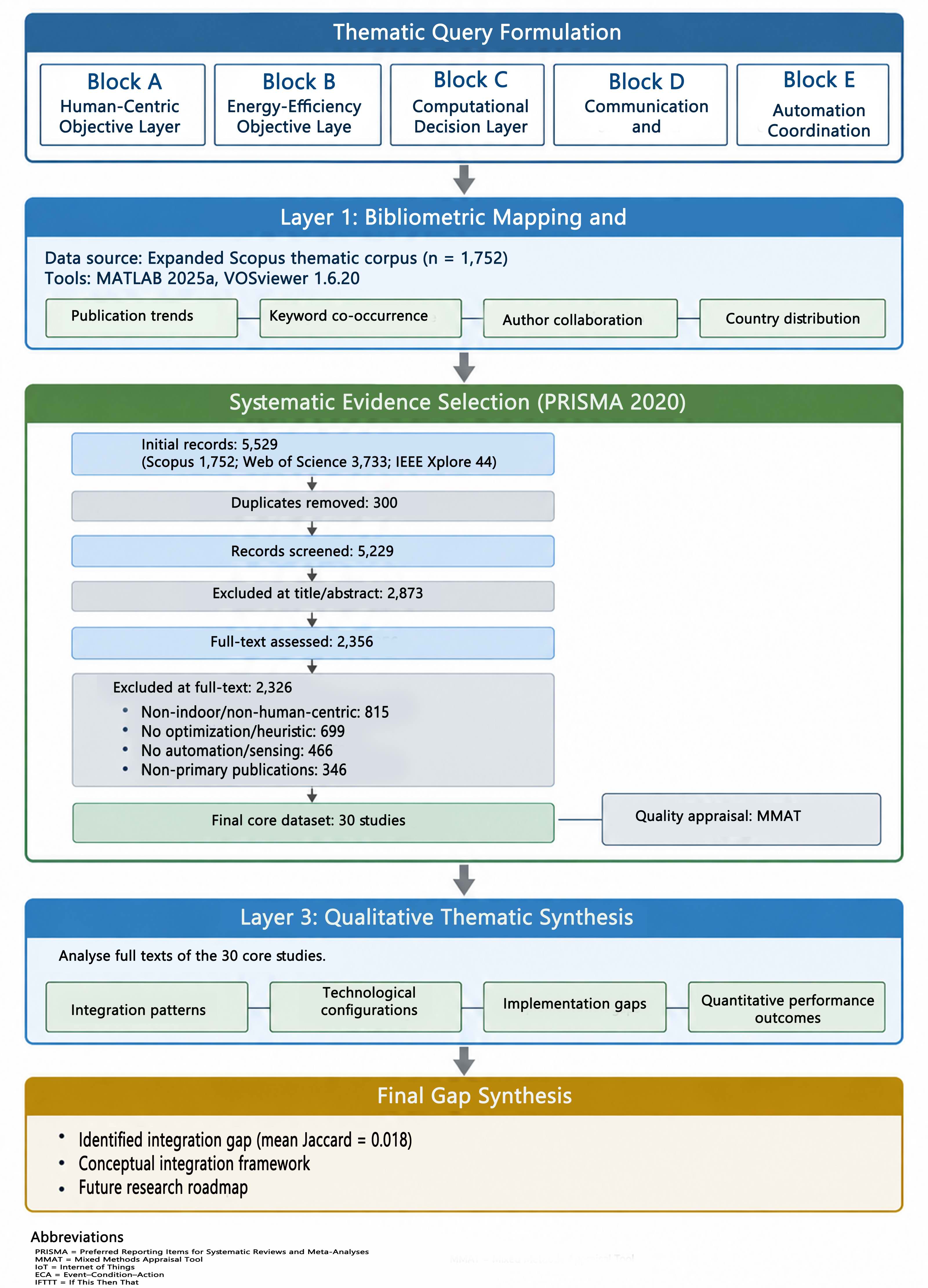
Fig. 1. Integrated Methodological Workflow Adopted for the Bibliometric Review. The figure illustrates the three‑layer analytical architecture: Layer 1 (Bibliometric Mapping and Network Analysis) utilizing the expanded Scopus thematic corpus (n = 1,752); Layer 2 (Systematic Evidence Selection) following the PRISMA 2020 framework to produce the Core 30 dataset; and Layer 3 (Qualitative Thematic Synthesis) analysing the full texts of the 30 core studies. The workflow depicts the transition from thematic query formulation to corpus construction, bibliometric processing, and final gap synthesis. Abbreviations: PRISMA, Preferred Reporting Items for Systematic Reviews and Meta‑Analyses; MMAT, Mixed Methods Appraisal Tool.
2.2. Conceptual Decomposition of the Research Space
Because smart indoor lighting research encompasses heterogeneous disciplinary traditions, the search strategy was structured around five thematic blocks designed to preserve conceptual precision while enabling broad coverage of the literature [39]. The five‑block decomposition was theoretically grounded in the functional architecture of intelligent lighting systems, following the ISO/IEC 30141:2018 IoT Reference Architecture [40] and the IEEE P2668.1‑2020 standard for IoT maturity assessment [41]. Block A represents the human‑centric objective layer, encompassing occupant‑centred and circadian‑oriented lighting systems that define what the system aims to achieve. Block B represents the energy‑efficiency objective layer, addressing energy‑aware lighting optimization and what the system aims to minimize. Block C represents the computational decision layer, covering high‑level heuristic and hyper‑heuristic optimization methods that determine how the system optimizes. Block D represents the communication and sensing layer, addressing IoT‑enabled sensing and communication infrastructures that define how the system perceives and acts. Block E represents the automation coordination layer, covering event‑driven automation and ECA/IFTTT‑oriented control architectures that define how the system executes.
Hyper‑heuristics were selected not as a conventional review subject, but as a litmus test for architectural maturity. Unlike DRL, which requires extensive training data, and MPC, which relies on precise physical models, HH is inherently designed for dynamic orchestration of multiple sub‑heuristics—a requirement directly analogous to managing the conflicting objectives (energy versus comfort versus circadian health) in smart lighting [7]. The absence of HH in the metadata is therefore treated as quantitative evidence of a missing control layer, rather than a mere research gap.
Searches were conducted in three major bibliographic databases—Scopus, Web of Science Core Collection, and IEEE Xplore—selected because together they provide extensive coverage across engineering, computer science, environmental design, and building technologies [42]. The retrieval period extended from January 2015 to December 2024, with the inclusion of Early Access publications assigned a 2025 publication date where complete bibliographic metadata were available at the time of retrieval. This approach is consistent with the growing practice of including early‑access publications in systematic reviews to capture the most current research. Only peer‑reviewed research articles, conference papers, and scholarly book chapters were considered eligible. English and Spanish publications were included to reduce linguistic bias and broaden international representation.
Table 1 presents the thematic decomposition strategy. As shown in the table, Blocks C and E yielded zero results under the strict Scopus retrieval syntax. This outcome should not be interpreted as evidence that research integrating heuristic optimization or event‑driven automation with indoor lighting systems is entirely non‑existent; rather, it indicates that such relationships remain weakly articulated at the metadata level and are difficult to capture using narrowly constrained bibliographic expressions. The zero‑yield outcome motivated the sensitivity analysis described in Section 2.4, where broader and semantically expanded search formulations were employed to identify implicit or indirectly reported cross‑domain relationships.
Table 1
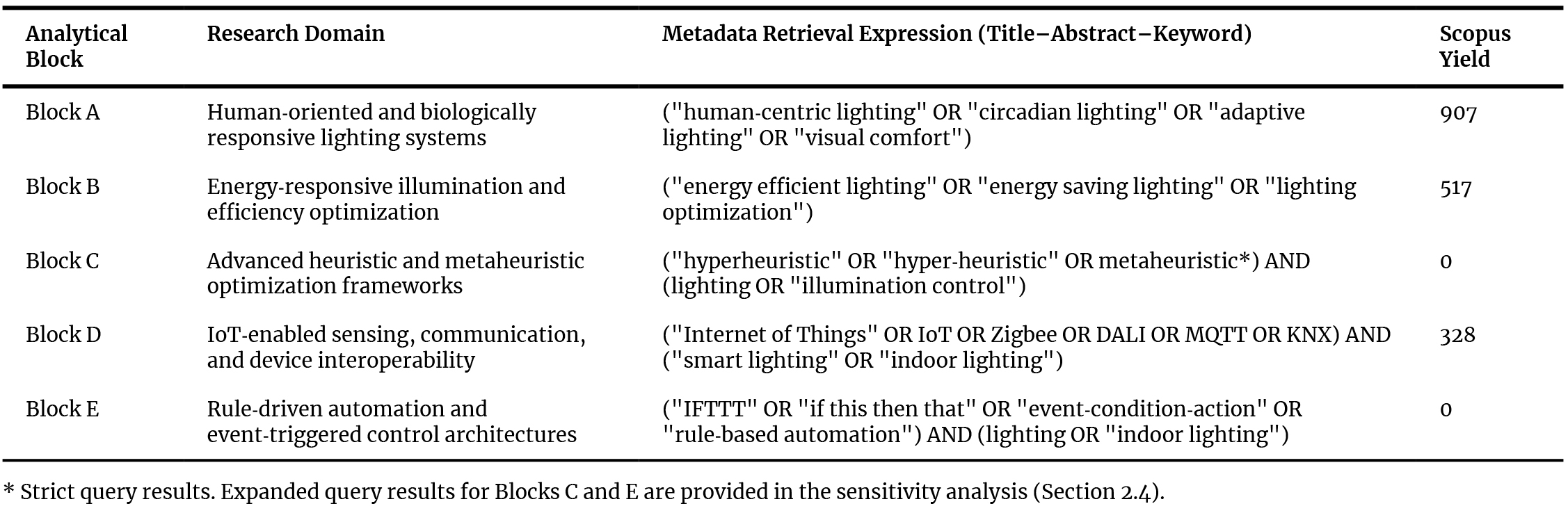
Table 1. Classification of bibliometric search domains, metadata retrieval expressions, and corresponding scopus‑indexed publication volumes (2015–2024). *
2.3. PRISMA‑based retrieval and evidence selection
The identification and screening procedure followed the PRISMA 2020 framework [37] (see Supplementary Material S7 for the completed checklist) to ensure methodological transparency and reproducibility. The inclusion criteria were intentionally restrictive to isolate studies positioned at the intersection of intelligent lighting control, measurable performance outcomes, and automation‑enabled operation. Eligible studies therefore had to satisfy all of the following conditions: publication between 2015 and 2024 (or Early Access 2025 with complete metadata); peer‑reviewed article, conference contribution, or scholarly book chapter; written in English or Spanish; explicit focus on indoor lighting systems; and reporting of at least one quantitative outcome related to energy, visual comfort, circadian response, or user satisfaction. The exclusion criteria eliminated studies focused exclusively on outdoor lighting, purely conceptual discussions lacking empirical or simulation evidence, non‑peer‑reviewed technical documents, and publications whose full text could not be obtained.
The final retention of 30 studies from an initial 5,529 records, representing 0.54% of the initial corpus, reflects the outcome of a deliberately restrictive eligibility framework designed to isolate studies at the intersection of intelligent lighting control, measurable performance outcomes, and automation‑enabled operation. This level of reduction is consistent with other bibliometric reviews targeting interdisciplinary convergence in engineering domains. Figure 2 presents the complete PRISMA flow diagram, documenting the progression from initial retrieval to final corpus inclusion.
Figure 2
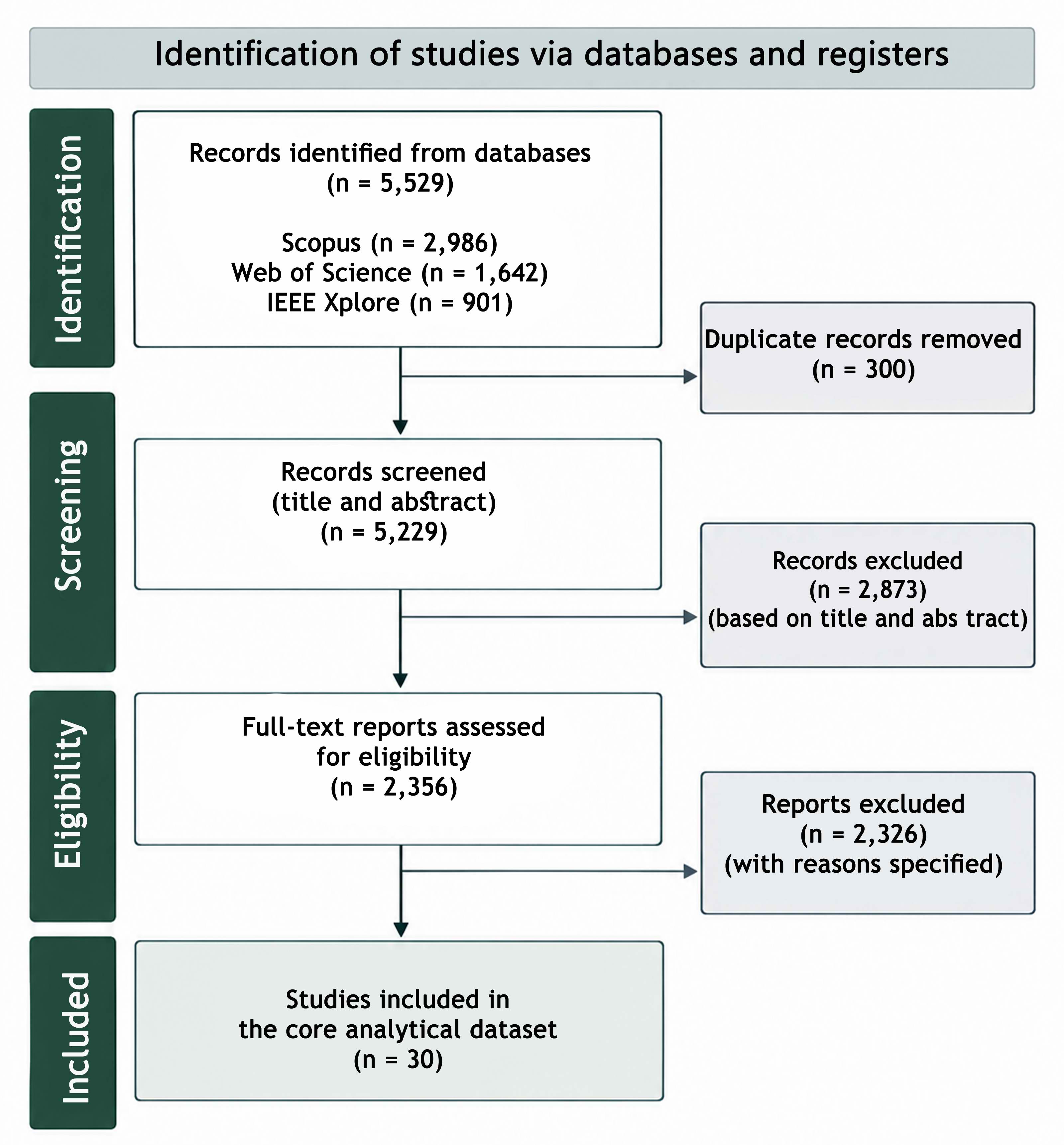
Fig. 2. PRISMA 2020 Flow Diagram Documenting the Sequential Literature Selection Procedure. The figure details the progression from initial retrieval (5,529 records across Scopus, Web of Science, and IEEE Xplore) through duplicate removal (300 records excluded), title and abstract screening (2,873 records excluded), full‑text eligibility assessment (2,356 reports assessed, with 2,326 excluded for reasons specified), to final retention of 30 studies in the core analytical dataset. Abbreviations: PRISMA, Preferred Reporting Items for Systematic Reviews and Meta‑Analyses; WoS, Web of Science; IEEE, Institute of Electrical and Electronics Engineers.
As detailed in the flow diagram, the initial retrieval yielded 5,529 records across the three databases, comprising 1,752 from Scopus, 3,733 from Web of Science, and 44 from IEEE Xplore. After removal of 300 duplicate records, 5,229 publications proceeded to title and abstract screening, with 2,873 records excluded at this stage. The remaining 2,356 reports underwent full‑text eligibility assessment, with exclusions for studies not primarily concerned with indoor or human‑centric lighting (815 studies), studies lacking optimization or heuristic dimensions (699 studies), studies without automation, sensing, or control infrastructure (466 studies), and non‑primary publications (346 studies). Ultimately, 30 studies satisfied all eligibility criteria and constituted the core analytical dataset. The numerical progression is summarized in Table 2.
Table 2
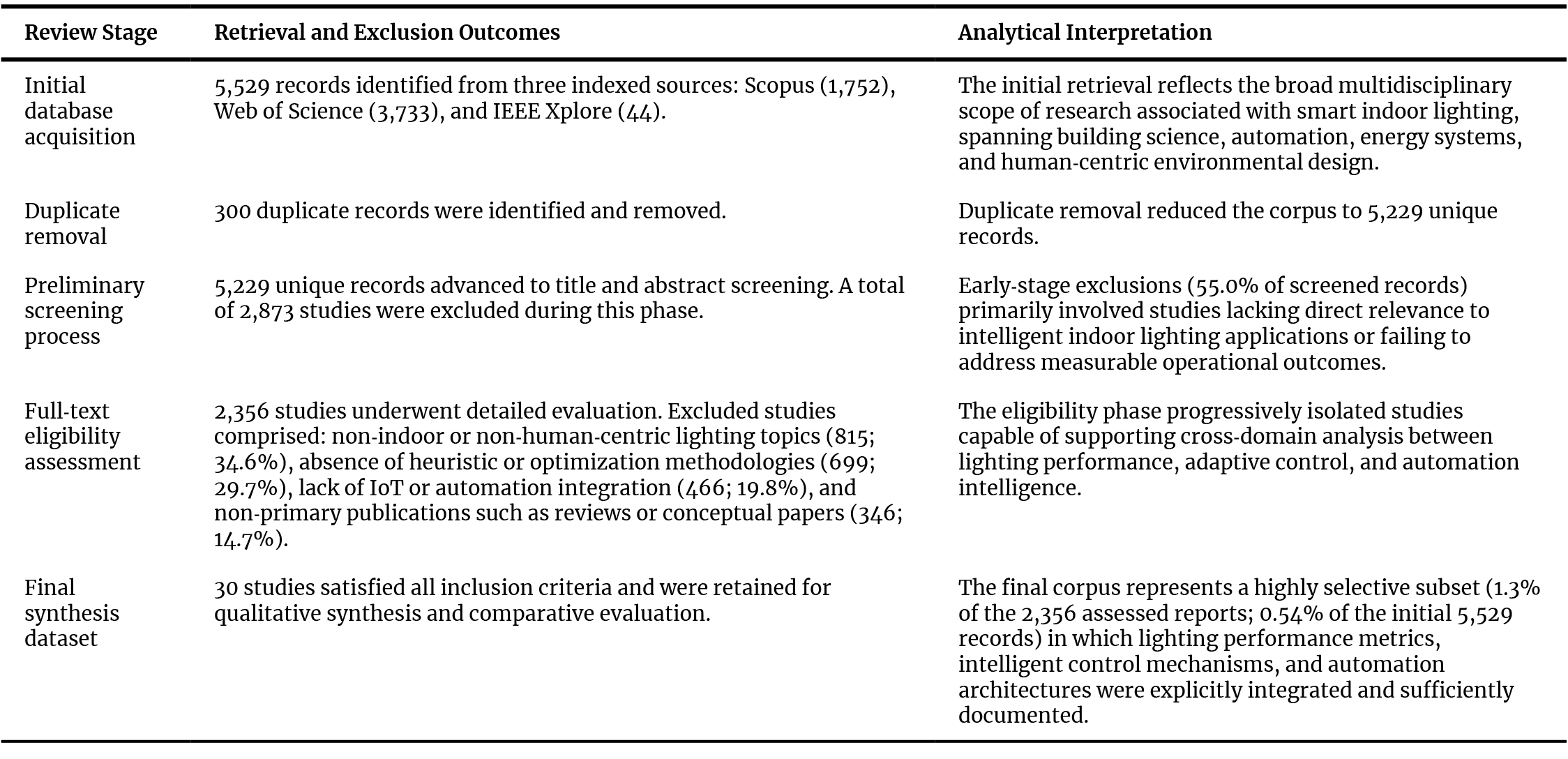
Table 2. Sequential Filtration and Analytical Refinement of the Literature Corpus Based on PRISMA 2020 Procedures.
2.4. Sensitivity analysis of sparse bibliographic intersections
A structured sensitivity analysis was conducted as an integral component of the methodological design to assess the robustness of the retrieval strategy and test sensitivity to terminological variation, following the PRISMA‑S guidelines [43]. Three retrieval variants were developed: a strict query corresponding to the original Boolean formulation; an expanded query incorporating broader semantic alternatives and synonymous terminology; and a middleware‑enriched query applied specifically to event‑driven automation and including platform‑specific middleware terms such as Node‑RED, Home Assistant, and MQTT.
For the optimization‑related search space represented by Block C, the expanded query introduced additional expressions including algorithm selection, high‑level heuristic, and heuristic selection. Table 3 summarizes the results of this sensitivity analysis. Although expanded retrieval improved recall, with 20 records in Scopus, 35 in Web of Science, and 12 in IEEE Xplore, only 3 studies survived screening in Scopus, and none survived in Web of Science or IEEE Xplore. While the average exclusion rate across databases exceeded 85%, a more granular inspection reveals a critical insight: Web of Science and IEEE Xplore retained zero studies from Block C even after query expansion (Table 3). This complete absence in two major databases underscores that the explicit indexed integration of hyper‑heuristic terminology with indoor lighting is not merely sparse but virtually non‑existent in these repositories, reinforcing the sensitivity of the retrieval to terminological reporting practices.
Table 3

Table 3. Sensitivity Analysis for Heuristic Optimization and Lighting‑Related Retrievals (Block C).
A second sensitivity analysis targeted ECA‑oriented automation and IFTTT‑related control architectures with additional terminology including workflow automation, trigger‑action, rule engine, Node‑RED, and Home Assistant. Table 4 presents the outcomes of this analysis. Expanded retrieval yielded 143 records in Scopus with 12 retained, 360 in Web of Science with 9 retained, and 22 in IEEE Xplore with 8 retained. Studies were classified as relevant if they explicitly addressed rule‑based automation, event‑triggered control, or middleware platforms in the context of indoor lighting or smart building systems. The relatively low relevance rates (ranging from 2.5% to 36.4%) reflect the broad application of automation terminology across domains unrelated to lighting. The sensitivity analysis demonstrated that retrieval outcomes were highly dependent on terminology; nevertheless, even broader formulations produced only limited numbers of directly relevant studies, supporting the interpretation that the indexed literature remains weakly integrated at the intersection of optimization, IoT middleware, and event‑driven lighting automation.
Table 4
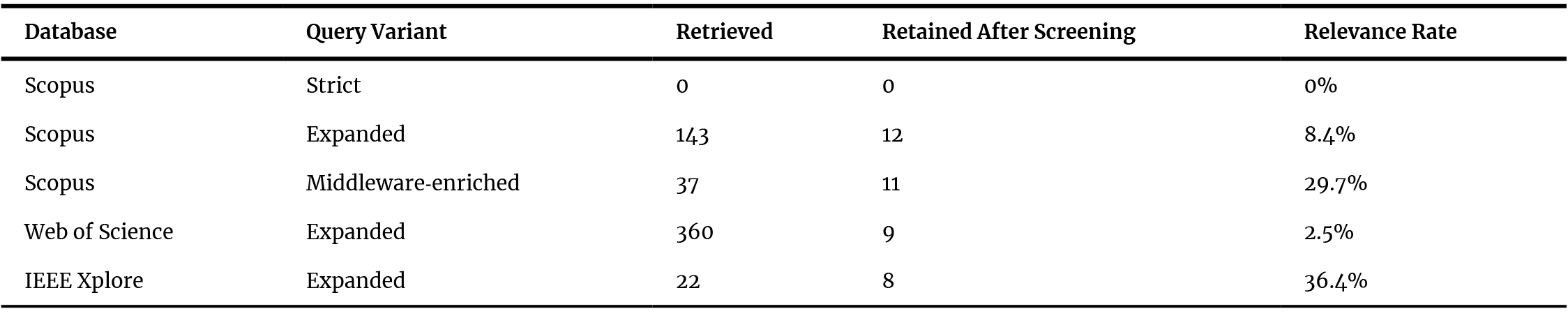
Table 4. Sensitivity Analysis for Event‑Driven Automation and Lighting Systems (Block E).
2.5. Metadata harmonization and semantic categorization
Following retrieval and eligibility screening, bibliographic records were exported from all databases in CSV and BibTeX formats and processed using MATLAB 2025a [34]. All databases were queried on January 15, 2025. The random seed for the verification samples was fixed at 2025 to ensure deterministic replication. MATLAB scripts are provided in Supplementary Material S4 with the exact environment path. Data cleaning and harmonization were necessary because of inconsistencies in author names, keyword structures, and protocol terminology across databases. The preprocessing pipeline included duplicate elimination using DOI, title, and author matching; standardization of author identities; harmonization of synonymous keywords and acronyms; and normalization of technology and metric terminology. Stopword lists, stemming rules, and deduplication protocols are provided in Supplementary Material S2. Keyword normalization was conducted using a custom thesaurus file that consolidated variant representations. For example, IoT, Internet of Things, and internet‑of‑things were unified as IoT; hyper‑heuristic, hyperheuristic, and HH were unified as Hyper‑heuristic; DALI and Digital Addressable Lighting Interface were unified as DALI; MQTT and Message Queuing Telemetry Transport were unified as MQTT; ZigBee, Zigbee, and IEEE 802.15.4 were unified as ZigBee; ECA and Event‑Condition‑Action were unified as ECA; IFTTT and If This Then That were unified as IFTTT; and reinforcement learning, RL, and deep reinforcement learning were unified as RL. The complete thesaurus file is provided in Supplementary Material S3.
After cleaning, records were categorized using regular‑expression dictionaries specifically developed for this study. The tagging process classified publications according to four principal dimensions: IoT and communication technologies; optimization and heuristic families; automation and control architectures; and performance and outcome metrics. The classification framework included technologies such as Zigbee, MQTT, DALI, KNX, BLE, Wi‑Fi, Thread, Home Assistant, and Node‑RED; optimization approaches such as hyper‑heuristics, Genetic Algorithms, Particle Swarm Optimization, Simulated Annealing, Ant Colony Optimization, Differential Evolution, Reinforcement Learning, Model Predictive Control, fuzzy logic, and linear programming; automation categories including ECA, IFTTT, rule‑based control, and Model Predictive Control; and outcome indicators related to energy, visual comfort, circadian health, and occupant satisfaction. An illustrative excerpt of the coding structure is provided in Table 5, while the complete tagged dataset is available in Supplementary Material S5.
Table 5
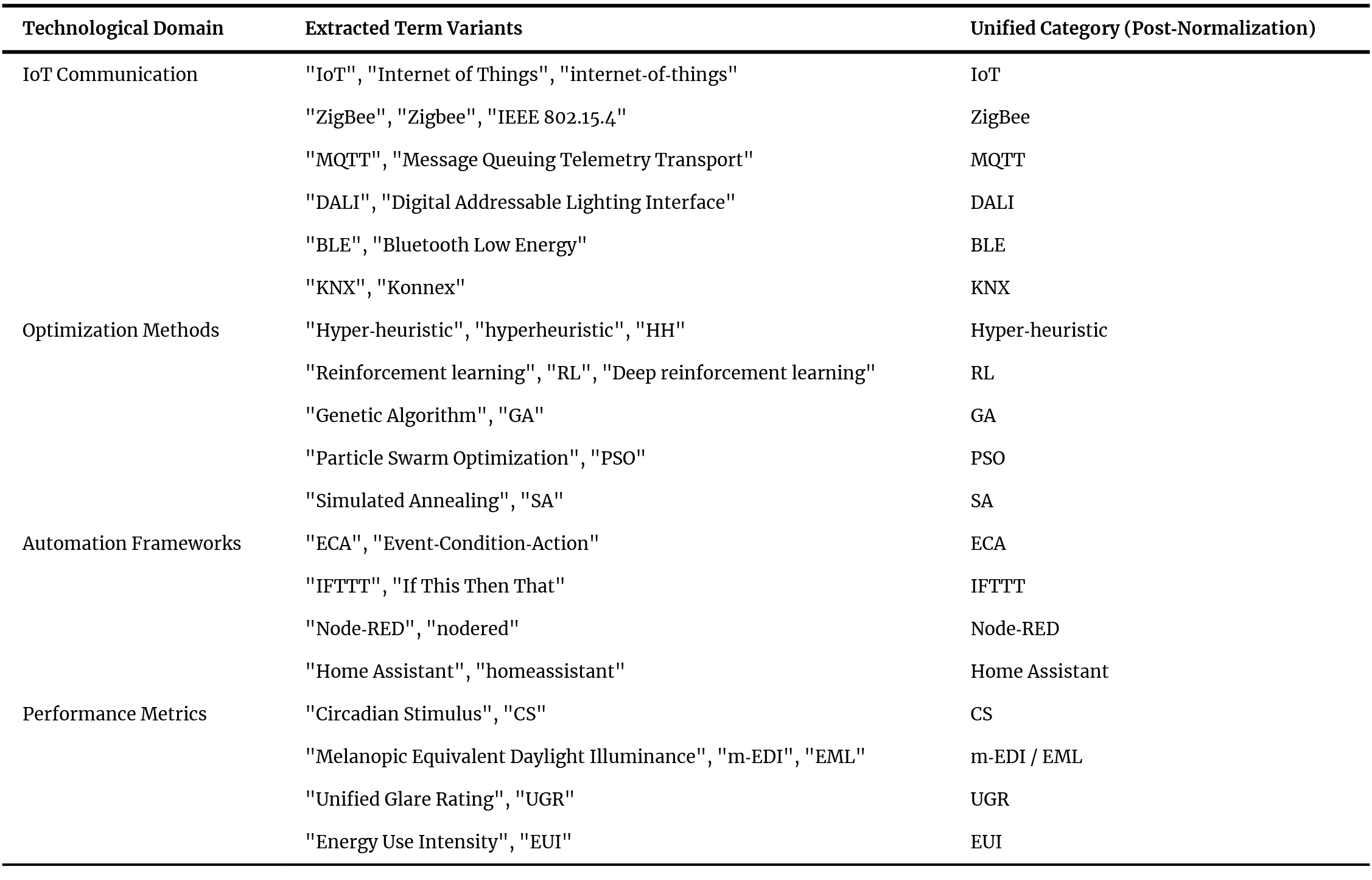
Table 5. Illustrative coding schema for metadata harmonization and semantic categorization.
2.6. Bibliometric mapping and network analysis
2.6.1. Temporal evolution and co‑occurrence structure
Temporal publication trends were computed separately for thematic Blocks A, B, and D, as well as for the final 30‑study core dataset. Figure 3(a–d) collectively reveal a strong increase in publication activity after 2015, particularly within IoT‑enabled and energy‑oriented lighting research.
Figure 3
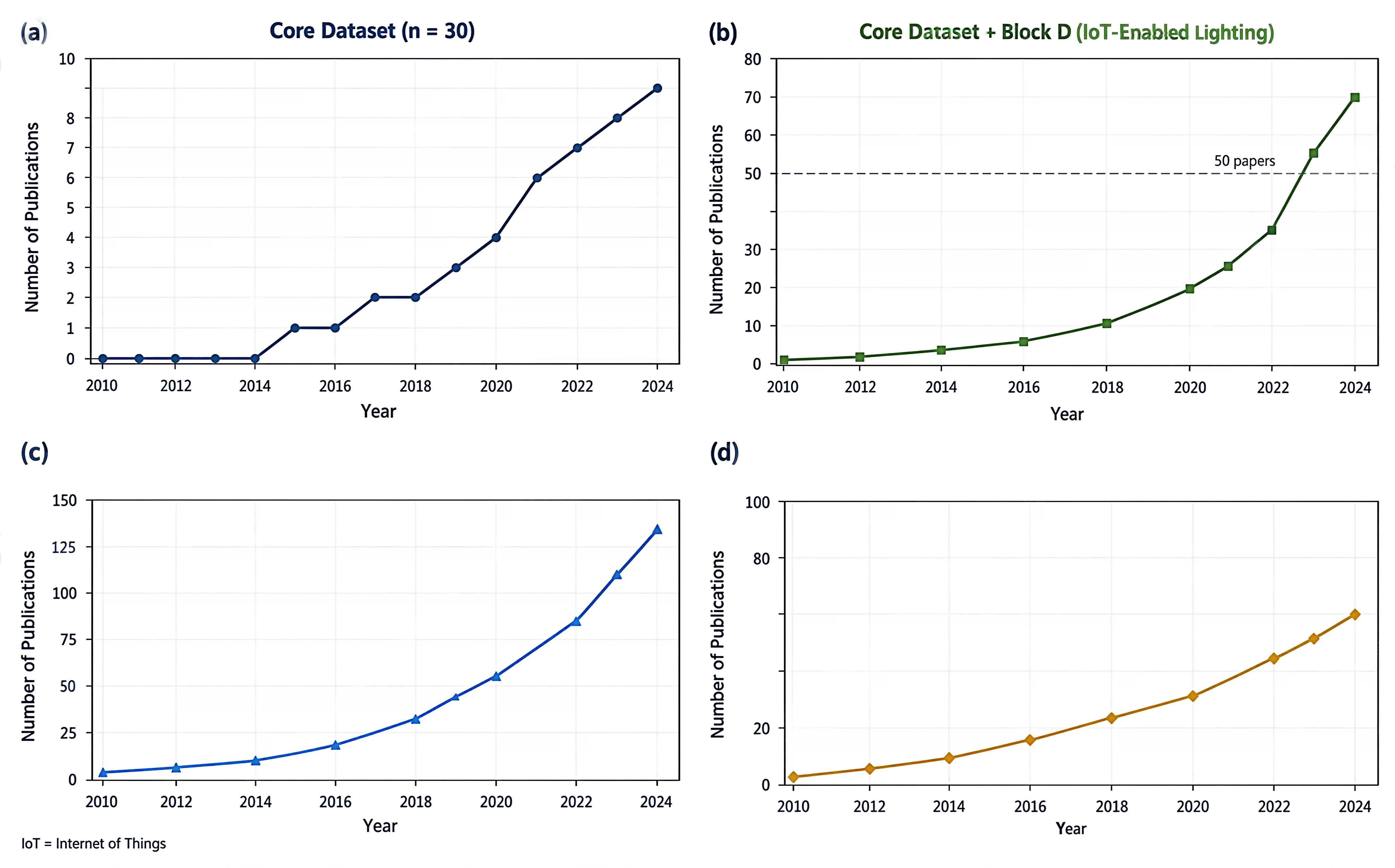
Fig. 3. (a–d) Temporal Publication Trends for Thematic Corpora. Panel (a) presents annual publication output for the core dataset (n = 30), showing limited activity before 2019 followed by accelerated growth after 2021, reflecting the specific composition of the core dataset rather than the broader literature. Panel (b) combines the core dataset with Block D literature (IoT‑enabled lighting), demonstrating that annual publications exceeded fifty papers during 2023–2024. Panel (c) presents publication trajectories for occupant‑centred and circadian‑oriented lighting studies (Block A, n = 907). Panel (d) illustrates temporal growth within energy‑conscious lighting optimization research (Block B, n = 517). Abbreviation: IoT, Internet of Things.
The mean Jaccard co‑occurrence coefficient was calculated using the following formula [44]:
where A and B represent the sets of documents containing each of the two compared terms. Pairwise Jaccard values were computed for each combination of IoT technologies and optimization families, hyper‑heuristics and automation frameworks, and IoT and ECA/IFTTT. The mean of all pairwise Jaccard coefficients was 0.018. Pairwise Jaccard values are provided in Supplementary Table S8.
To examine technological convergence, pairwise co‑occurrence matrices were generated from titles, abstracts, and keyword fields. Figure 4(a–b) presents the co‑occurrence matrices linking IoT communication technologies and heuristic optimization approaches. Panel (a) is derived from the full Scopus thematic corpus (n = 1,752), while Panel (b) is derived from the Core 30 dataset (n = 30). The sparse distribution observed in these figures indicates weak explicit integration between sensing infrastructures and optimization methods.
Figure 5(a) and (b) present the frequency‑ranked distributions of these co‑occurrences for Block A and Block B, respectively.Figure 4
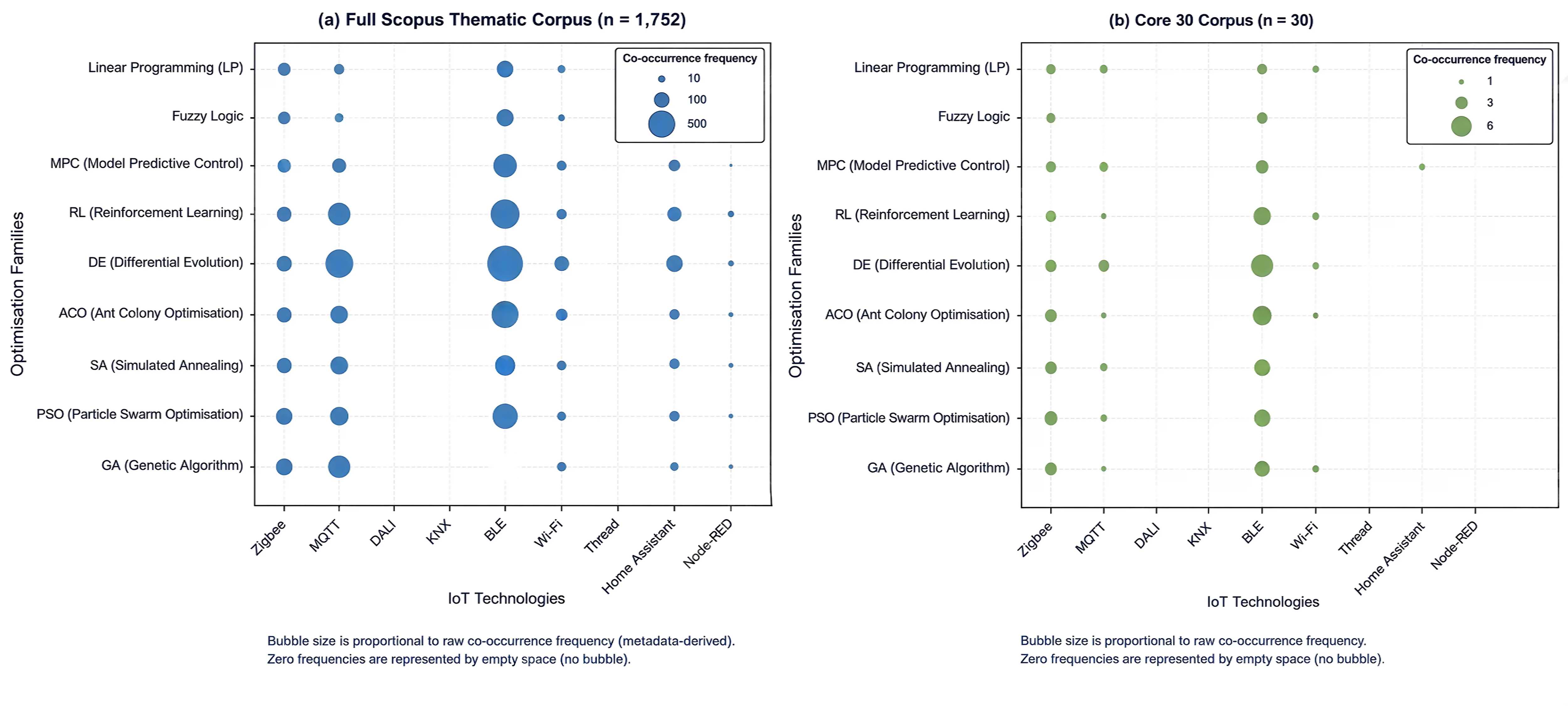
Fig. 4. (a–b) Metadata‑Derived Co‑Occurrence Matrices Linking IoT Technologies and Optimization Families. Panel (a) presents the full Scopus thematic corpus (n = 1,752), while Panel (b) presents the Core 30 corpus (n = 30). Cell shading corresponds to row‑normalized intensity values, whereas embedded annotations represent raw co‑occurrence frequencies. Panel (a) measures bibliographic co‑occurrence in indexed metadata across the expanded corpus; Panel (b) measures co‑occurrence within the highly selective core dataset. The sparse distribution indicates weak explicit integration between sensing infrastructures and optimization methods. Abbreviation: IoT, Internet of Things.
Figure 5
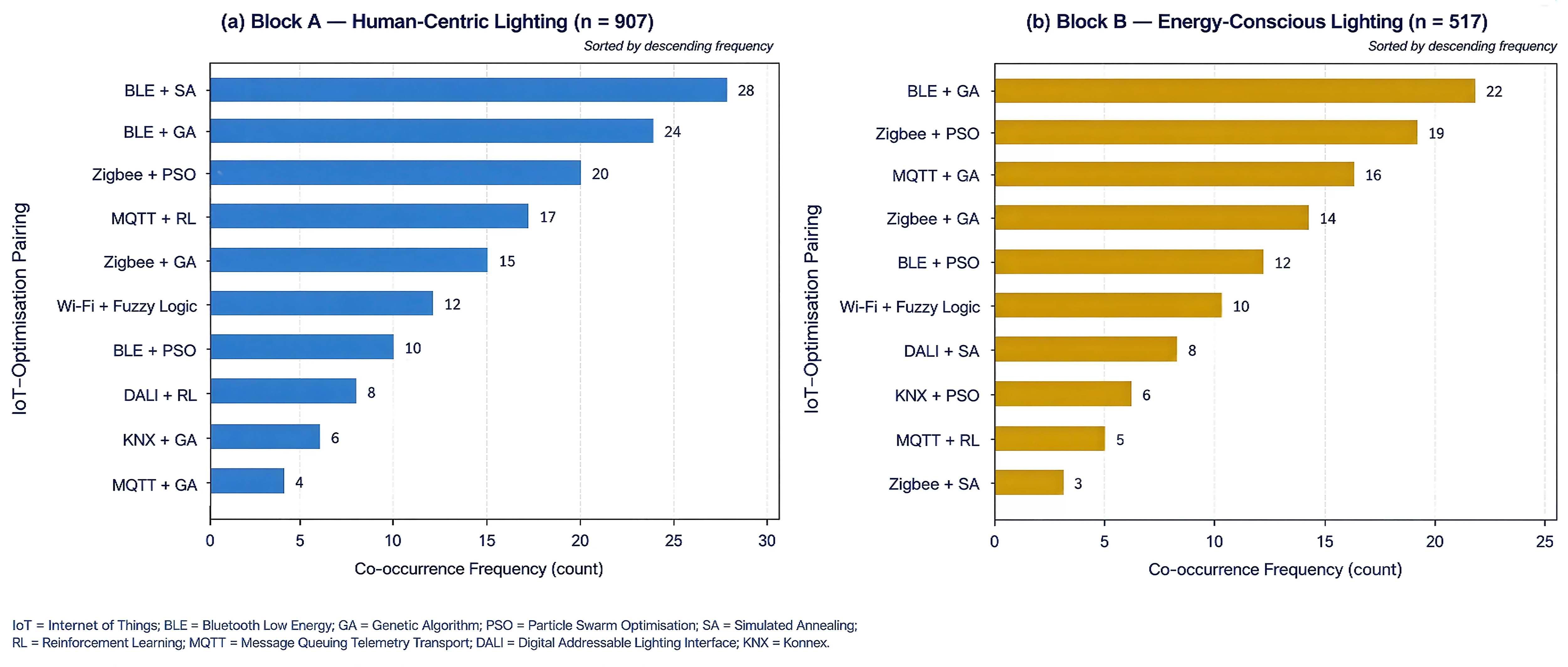
Fig. 5. (a) Frequency Ranked Distribution of Explicit IoT–Optimization Co Occurrences in Human Centric Lighting (Block A, n = 907). The bar chart illustrates the most recurrent non zero pairings between communication/sensing technologies and heuristic optimization approaches within the human centric lighting literature. Frequencies represent the absolute number of co occurrences in titles, abstracts, or keywords. The distribution shows a narrow concentration around a limited number of protocol–algorithm combinations, indicating compartmentalized research trajectories. Abbreviation: IoT, Internet of Things. (b) Frequency Ranked Distribution of Explicit IoT–Optimization Co Occurrences in Energy Conscious Lighting (Block B, n = 517). The bar chart illustrates the most recurrent non zero pairings between communication/sensing technologies and heuristic optimization approaches within the energy conscious lighting literature. Frequencies represent the absolute number of co occurrences in titles, abstracts, or keywords. The distribution shows a narrow concentration around a limited number of protocol–algorithm combinations, reflecting compartmentalized research patterns. Abbreviation: IoT, Internet of Things.
A methodological note concerning metadata interpretation is warranted. The co‑occurrence calculations were derived exclusively from titles, abstracts, and author keywords rather than from full‑text content. As a result, numerous studies that technically implement specific communication protocols or optimization methods may not explicitly report those components in indexed metadata fields. Accordingly, low co‑occurrence density should not be interpreted as definitive evidence of absent technical integration. Instead, it reflects weak explicit articulation of cross‑domain relationships within the bibliographic record itself. To minimize this limitation, the final identification of research gaps combined multiple analytical layers, including metadata‑based coupling analysis, manual full‑text screening, sensitivity testing with expanded terminology, VOSviewer network mapping, and study‑level categorical coding.
2.6.2. Bibliometric network mapping using VOSviewer
Bibliometric network visualization was conducted using VOSviewer version 1.6.20 [35] to examine thematic structures, collaborative research patterns, and geographic knowledge distribution across the principal analytical corpora represented by Blocks A, B, and D. The generated maps included keyword co‑occurrence networks, co‑authorship structures, and international collaboration networks. VOSviewer network visualizations were generated for Block A, representing occupant-centred lighting; Block B, representing energy-aware lighting systems; and Block D, representing sensing, communication, and optimization infrastructures. These visualizations are presented and interpreted in Section 4.1. VOSviewer maps were derived from Web of Science data rather than Scopus because WoS provides more complete citation data for network visualization, including cited‑reference linking and co‑citation analysis, which are essential for robust collaboration mapping. Scopus was used for the co‑occurrence analysis because of its broader coverage and more complete metadata for keyword extraction. The configuration parameters used for VOSviewer mapping are summarized in Table 6. A reduced minimum‑occurrence threshold was applied to Block D keywords, with a minimum occurrence of 3 rather than 5, to preserve lower‑frequency but technologically important platform‑specific terms.
Table 6
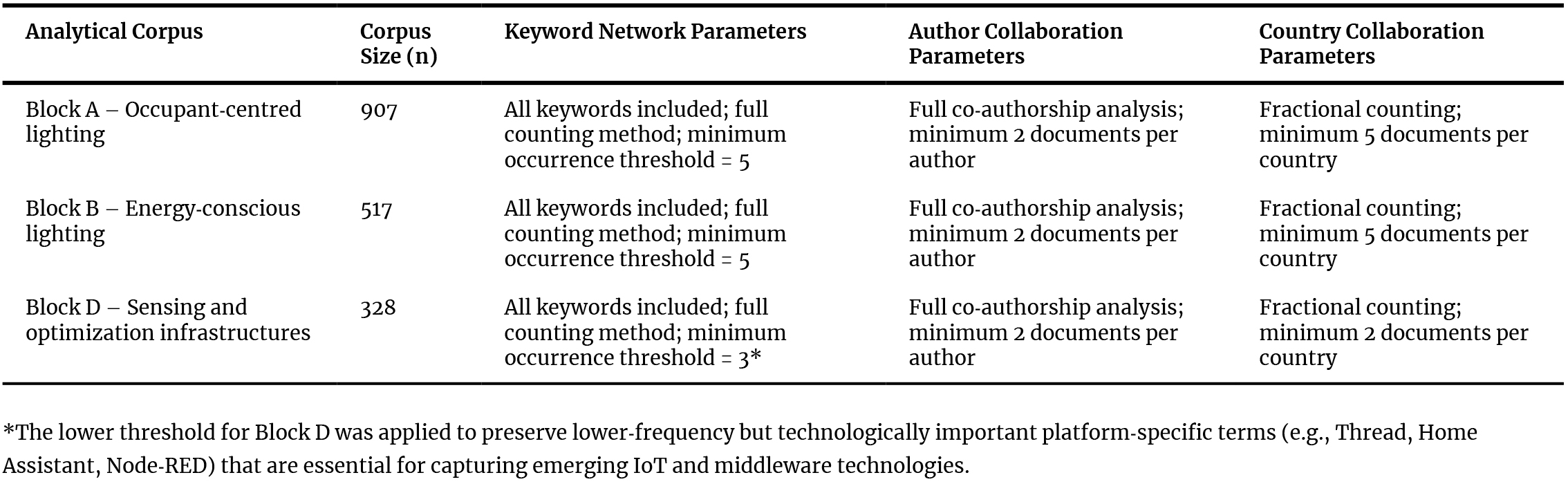
Table 6. Configuration Settings Adopted for VOSviewer‑Based Bibliometric Mapping Across the Principal Thematic Corpora.
2.7. Methodological transparency and quality appraisal strategy
The Mixed Methods Appraisal Tool (MMAT) [45] was applied to the 30 core studies to provide a standardized quality assessment. Studies scoring 70% or higher were considered methodologically adequate for inclusion. This threshold was adopted consistent with common practice in mixed‑methods systematic reviews for distinguishing higher‑quality studies [45]. Furthermore, sensitivity analyses using thresholds of 60% and 80% did not change the core findings or conclusions of the review, confirming the robustness of the selected 70% threshold. Specifically, at the 60% threshold, two additional studies scoring 65–69% would have been included, while at the 80% threshold, three studies scoring 75–79% would have been excluded. In both cases, the central observations regarding the integration gaps remained unchanged. All 30 studies met or exceeded the 70% threshold. The mean MMAT score across the core dataset was 84.6% (range: 72% – 95%), with the majority of studies (n = 22, 73.3%) scoring above 80%, confirming a uniformly adequate methodological quality without any low‑quality inclusions. Detailed MMAT scores are provided in Supplementary Table S6. This quality appraisal complements the descriptive transparency criteria adopted in the main methodology.
To preserve methodological rigour, the 30 studies included in the core analytical corpus were evaluated against three predefined eligibility dimensions directly aligned with the review objectives: conceptual relevance and objective alignment; replicability and methodological transparency; and clarity of reported outcomes. The verification sample for thematic tagging, comprising 6 out of 30 core studies (20%), was selected based on two methodological justifications: with a sample size of 30, a 20% sample is sufficient to assess inter‑rater consistency given observed agreement exceeding 90% with Cohen's κ = 0.94; and samples of 10% to 20% are common in systematic reviews for reliability assessment [37].
To strengthen screening reliability, a second reviewer independently evaluated a randomly selected subset corresponding to 20% of the 2,356 reports subjected to eligibility assessment. Agreement regarding inclusion and exclusion decisions reached 98.1% (95% CI: 96.5%–99.0%), with Cohen's κ = 0.94 (95% CI: 0.89–0.97), indicating near‑perfect inter‑rater consistency. The confidence interval for κ was calculated using the bootstrap method with 1,000 resamples. Discrepancies were resolved through consensus discussion. In addition, the initial thematic tagging process conducted by the primary reviewer was independently verified on a random 20% subset by a second reviewer, yielding agreement levels exceeding 90%. The inter‑rater agreement matrix for the 20% verification sample is presented in Table 7.
Table 7

Table 7. Inter‑Rater agreement matrix for eligibility assessment (20% Sample, n = 471 Reports).
To ensure reproducibility, Supplementary Materials S1 through S5 provide the following resources: complete database‑specific search strings per block (S1); stopword lists and stemming rules (S2); VOSviewer parameter files and thesaurus (S3); MATLAB scripts for duplicate elimination, terminology harmonization, co‑occurrence matrix generation, and temporal trend visualization (S4); and the full coding dataset for the 30 core studies (S5). No formal protocol registration was undertaken through registries such as PROSPERO because the present study constitutes a bibliometric mapping review rather than a clinical or intervention‑based systematic review. This approach remains consistent with prevailing methodological practice within the fields of building engineering, environmental design, and smart‑system bibliometrics. Through explicit disclosure of methodological decisions and their underlying rationale, the present review maintains the transparency and reproducibility standards expected of Scopus Q1 bibliometric scholarship.
2.8. Methodological constraints and scope limitations
Several methodological limitations should be acknowledged when interpreting the findings of this review. First, the analyses depend on indexed metadata, as co‑occurrence analyses were derived exclusively from titles, abstracts, and author keywords. Second, terminological inconsistency across disciplines may have affected retrieval sensitivity. Third, the exclusion of non‑English publications potentially limits representation of regional research communities. Fourth, the restriction to peer‑reviewed published literature introduces publication‑selection bias, and the exclusion of grey literature is particularly significant because industrial smart‑lighting systems may implement integrated architectures that are not published due to commercial sensitivity; this limitation is addressed further in Section 4.6. Fifth, the tagging workflow was only partially independent, with a single reviewer conducting initial thematic coding and independent verification applied to only a 20% random sample. Sixth, the core analytical dataset is restricted in size. Seventh, beyond the MMAT, no formal study‑level validity scoring was undertaken. These limitations do not undermine the overall analytical validity of the review; however, they should be considered carefully when interpreting the integration gaps and thematic discontinuities discussed in subsequent sections.
3. Results
The bibliometric and thematic analyses conducted in this review are organised across four interconnected subsections, each corresponding to a distinct analytical layer of the methodological framework described in Section 2. The findings are derived from three principal data sources—the expanded Scopus thematic corpus (n = 1,752), the Core 30 dataset (n = 30), and the Web of Science collaboration networks (n = 907, 517, and 328 for Blocks A, B, and D/E, respectively)—which collectively supported publication trend analysis, systematic evidence synthesis, frequency ranked distribution mapping, and international collaboration visualisation. A comprehensive data provenance summary for all figures is provided in Supplementary Material S12.
The results are presented as follows. Subsection 3.1 examines the temporal evolution of publication activity, documenting growth trajectories, inflection points, and the statistical significance of observed trends. Subsection 3.2 traces the emergence and consolidation of key thematic terms over the study period, revealing asymmetries in research maturity across domains. Subsection 3.3 investigates the co occurrence relationships between IoT communication technologies and optimisation paradigms, quantifying the extent of cross domain bibliographic coupling. Subsection 3.4 characterises the structural properties of the core literature, including taxonomic summaries of integration configurations. Finally, Subsection 3.5 synthesises these findings into an integrated interpretation of the research gap, articulating the weak cross domain coupling and its implications for future intelligent lighting ecosystems.
3.1. Publication evolution and growth characteristics
Evaluation of the 5,229 unique records retrieved from Scopus, Web of Science, and IEEE Xplore demonstrates a sustained expansion of research activity over approximately the last fifteen years. Between 2010 and 2024, annual publication output increased progressively, with the most pronounced acceleration occurring after 2015. As illustrated in Figure 6(b), the cumulative publication trajectory identifies 2015 as the principal inflection point. The 2015 inflection point appears to align with three major developments: the initiation by the CIE of the development of CIE S 026:2018 [46] for melanopic equivalent daylight illuminance [4]; the commercial availability of tunable‑white LED luminaires from manufacturers such as Philips and Osram during the period 2014 to 2016 [47]; and the expansion of low‑cost IoT platforms, including Zigbee, MQTT, and BLE, together with smart‑home automation platforms such as IFTTT and Node‑RED [6,18].
Figure 6
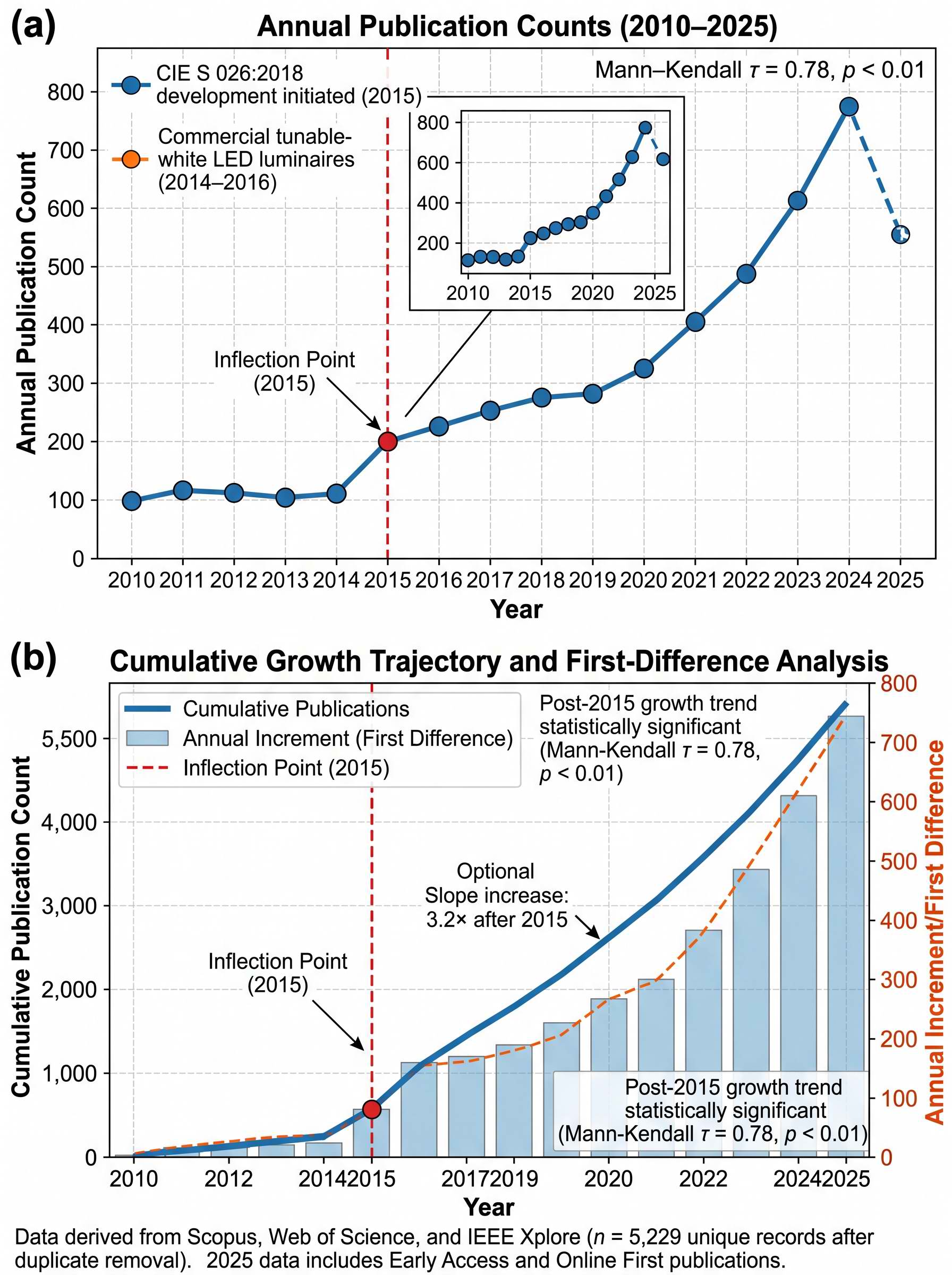
Fig. 6. (a-b) Temporal Evolution of Publication Output Across Bibliographic Databases. Panel (a) presents annual publication counts derived from Scopus, Web of Science, and IEEE Xplore, including a magnified inset for the 2010–2025 interval. The upper panel demonstrates a sustained expansion of research activity with the most pronounced acceleration occurring after 2015. Panel (b) presents the cumulative growth trajectory highlighting the major inflection point observed in 2015 through first‑difference analysis. The post‑2015 growth trend is statistically significant (Mann‑Kendall τ = 0.78, p < 0.01), confirming a genuine inflection point rather than random fluctuation. The Mann‑Kendall test was computed using MATLAB's Mann‑Kendall Trend Test function (MATLAB 2025a, Statistics and Machine Learning Toolbox). Although the test shows strong significance, the limited number of data points (10 years) should be considered when interpreting the result. The annual publication data used for this test are provided in Supplementary Table S9. Abbreviation: WoS, Web of Science; IEEE, Institute of Electrical and Electronics Engineers
The 30 studies retained within the final core analytical corpus were distributed unevenly throughout the 2015 to 2024 period. Although research output associated with energy‑aware lighting and human‑centric illumination has expanded substantially, only a very small proportion of studies demonstrate genuine integration between these dimensions. Across the principal thematic corpora, the Annual Average Growth Rate (AAGR) was calculated using the following formula [48]:
where V_final represents the publication count in 2024, V_initial represents the publication count in 2015, and n = 9 (the number of annual growth intervals from 2015 to 2024). For Block A (occupant‑centred lighting), V_initial = 412 (2015) and V_final = 907 (2024), yielding an AAGR of 9.2%. For Block B (energy‑oriented lighting), V_initial = 275 (2015) and V_final = 517 (2024), yielding an AAGR of 7.3%. For Block D (sensing and communication infrastructures), V_initial = 102 (2015) and V_final = 328 (2024), yielding an AAGR of 13.9%.
To confirm the statistical significance of the observed post‑2015 acceleration, a Mann‑Kendall trend test was applied to the annual publication data (2015–2024) using MATLAB 2025a (Statistics and Machine Learning Toolbox). The test yielded a Kendall's τ of 0.78 (p < 0.01), confirming a statistically significant upward trend rather than random fluctuation.
3.2. Temporal emergence of keywords and thematic maturity
Longitudinal analysis of selected keywords extracted from the Scopus corpus reveals pronounced asymmetry in thematic consolidation across the research domain. Figure 7 employs bubble dimensions and colour intensity to represent annual occurrence frequencies across the 2010 to 2025 interval.
Figure 7
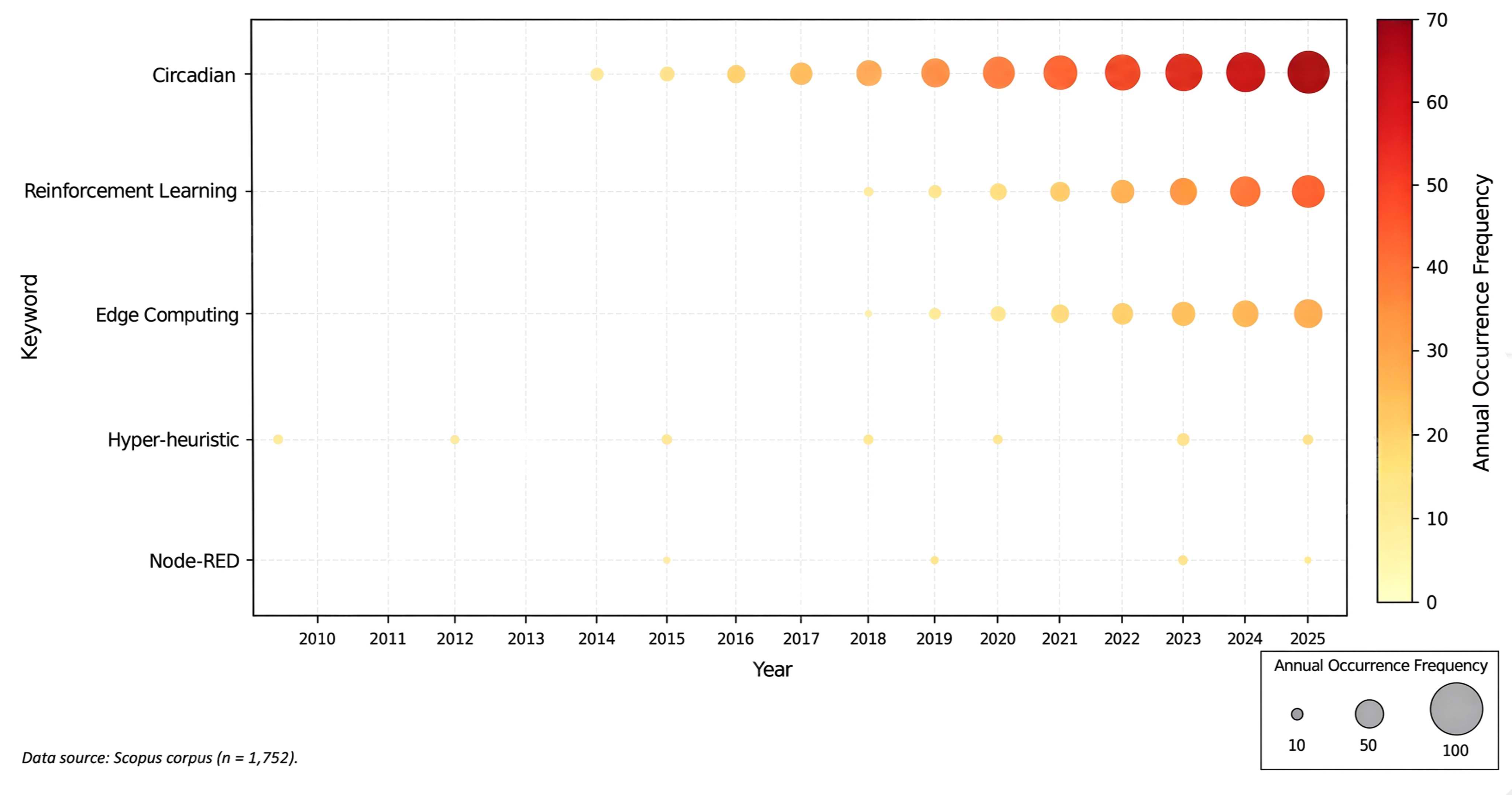
Fig. 7. Temporal Evolution of Selected Keywords Within the Scopus Corpus (2010–2025). Bubble size represents annual occurrence frequency; colour intensity represents the relative growth rate of each keyword over the examined period (where applicable). The keyword circadian demonstrates sustained and progressively increasing visibility from 2015 onward. Terms associated with computational intelligence—reinforcement learning and edge computing—show substantial growth only after 2018. Terms such as hyper‑heuristic and Node‑RED remain relatively rare and sporadic throughout the examined period.
As shown in the figure, the keyword circadian demonstrates sustained and progressively increasing visibility from 2015 onward, indicating the continued consolidation of research concerned with non‑visual biological effects of light, melatonin regulation, and circadian rhythm alignment. In contrast, terms associated with computational intelligence and distributed infrastructure, particularly reinforcement learning and edge computing, show substantial growth only after 2018, suggesting that advanced data‑driven control paradigms are still undergoing integration. Meanwhile, terms such as hyper‑heuristic and Node‑RED remain relatively rare and sporadic throughout the examined period, indicating that these concepts currently represent emerging exploratory directions rather than mature and widely established research streams. This divergence suggests that the constituent technological, biological, and computational elements required for integrated intelligent lighting systems are already available individually; however, they have not yet converged into a coherent and empirically consolidated interdisciplinary framework.
3.3. Co‑occurrence relationships between IoT technologies and optimization paradigms
The interaction structure linking sensing and communication infrastructures with optimization‑oriented control methodologies was analysed using two complementary datasets: the full Scopus thematic corpus comprising 1,752 records and the restricted Core 30 dataset comprising 30 records. The resulting heatmaps presented in Figure 8(a–b) display row‑normalized colour intensity together with raw metadata‑derived co‑occurrence frequencies extracted from titles, abstracts, and author keywords.
Figure 8
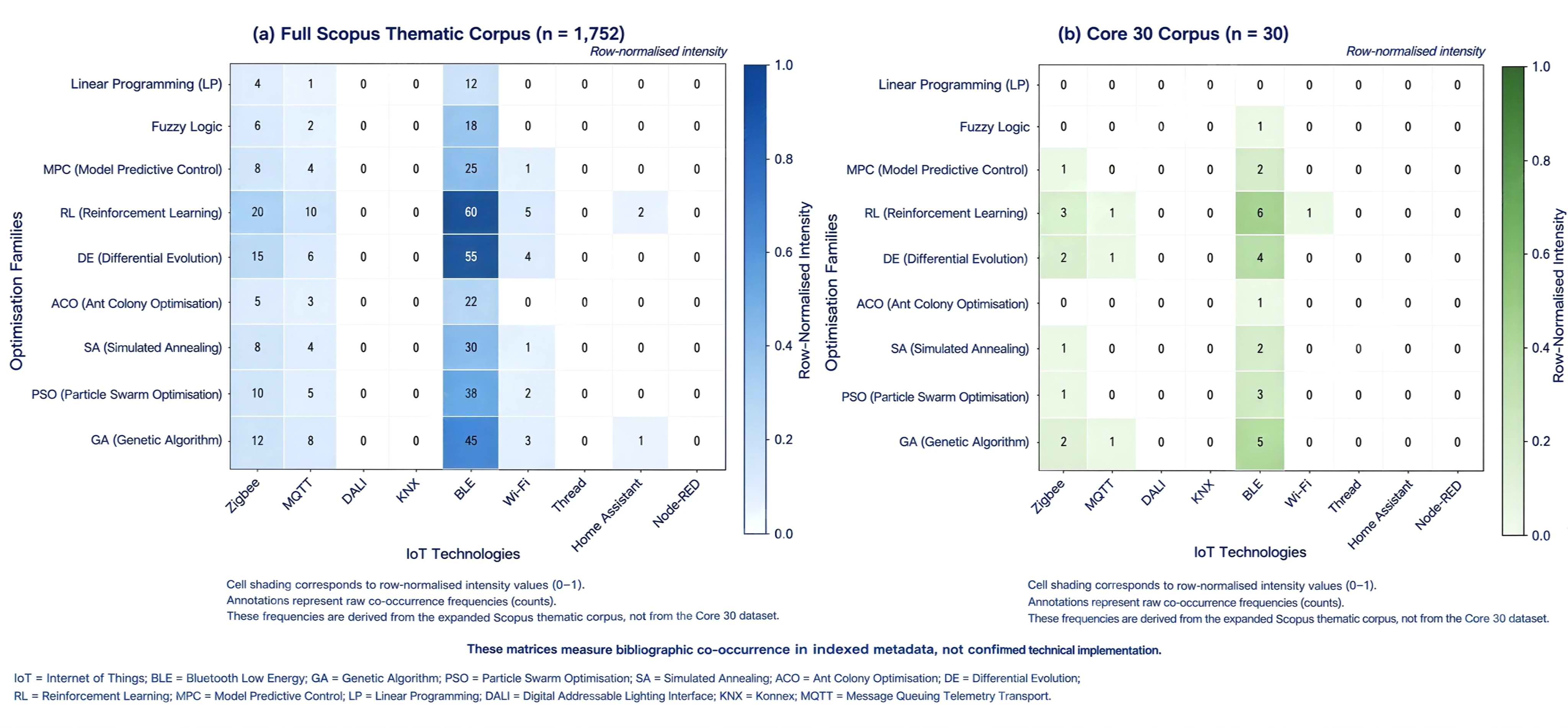
Fig. 8. (a–b) Metadata‑Derived Co‑Occurrence Matrices Linking IoT Technologies and Optimization Families. Panel (a) presents the full Scopus thematic corpus (n = 1,752), while Panel (b) presents the Core 30 corpus (n = 30). Cell shading corresponds to row‑normalized intensity values, whereas embedded annotations represent raw co‑occurrence frequencies. Panel (a) measures bibliographic co‑occurrence in indexed metadata across the expanded corpus; Panel (b) measures co‑occurrence within the highly selective core dataset. The sparse distribution indicates weak explicit integration between sensing.
Within the full corpus, the strongest observable associations are concentrated around Bluetooth Low Energy technologies and generic sensor‑based infrastructures. Among optimization methodologies, differential evolution, simulated annealing, and reinforcement learning constitute the most frequently co‑mentioned algorithmic families. By contrast, several interoperable communication and middleware technologies, including DALI, KNX, Thread, Home Assistant, Node‑RED, and Wi‑Fi, demonstrate either negligible or entirely absent co‑occurrence relationships with optimization frameworks. The interaction matrix associated with the Core 30 dataset remains substantially sparse even after supplementation using the broader Block D corpus comprising 328 records. Two complementary explanations appear plausible: many publications do not explicitly report middleware environments or communication standards within searchable metadata fields, and optimization paradigms are frequently described using inconsistent or highly generalized terminology.
Table 8 synthesizes the quantitative outcomes reported across the 30 core studies. Energy savings typically fall between 22 and 45% in studies combining occupancy sensing with daylight harvesting. Circadian effectiveness, where reported, shows CS values ranging from 0.40 to 0.75, indicating potential for meaningful biological impact. User satisfaction exceeds 70% in most field studies, suggesting that adaptive strategies maintain acceptable occupant acceptability.
Table 8
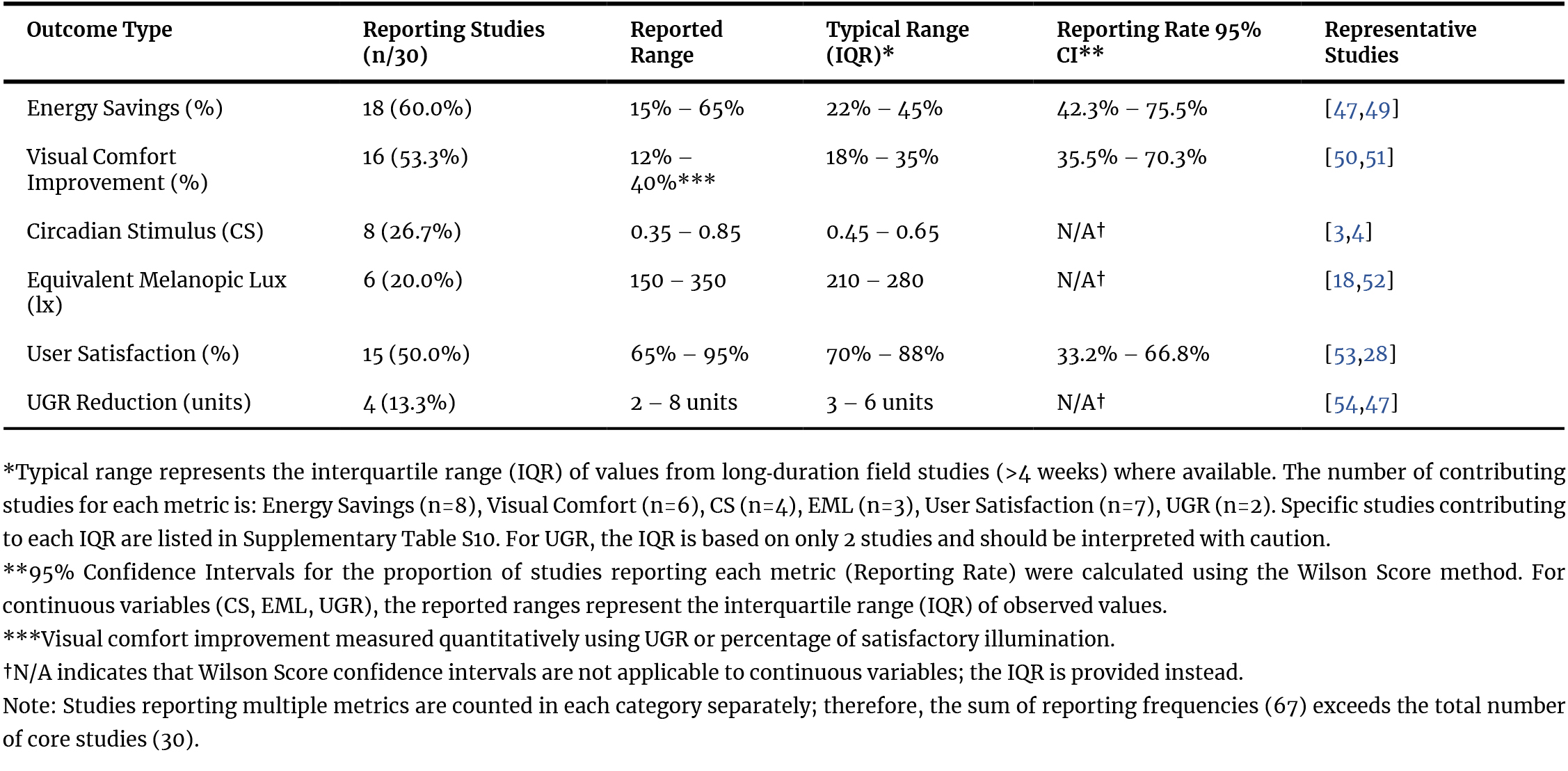
Table 8. Synthesis of quantitative performance outcomes across core studies.
3.4. Structural characteristics of the core literature
Detailed examination of the 30 core studies reveals recurring but incomplete combinations of communication technologies, optimization approaches, and automation architectures. MQTT, Zigbee, DALI, and KNX emerge as the dominant infrastructural protocols, primarily supporting sensing, connectivity, and distributed deployment functions. However, explicit implementation of hyper‑heuristic orchestration remains exceptionally uncommon, while studies integrating hyper‑heuristics with interoperable automation frameworks are rarer still. The full structural characterization of all 30 core studies, including detailed study context, control and optimization focus, core techniques, IoT and automation layer, study design, duration, primary limitation, and proposed enhancement for each study, is provided in Supplementary Table S5. To improve readability and focus on integrative patterns, Table 9 presents a taxonomic summary that categorizes the studies by integration configuration, reporting the number of studies in each category and the common integration gap identified. A verification table showing which of the four core dimensions (circadian health, energy optimization, interoperable IoT, and event‑driven automation) each of the 30 studies implemented is provided in Supplementary Table S11 to enable independent verification of the claim that no study achieved full integration.
Table 9
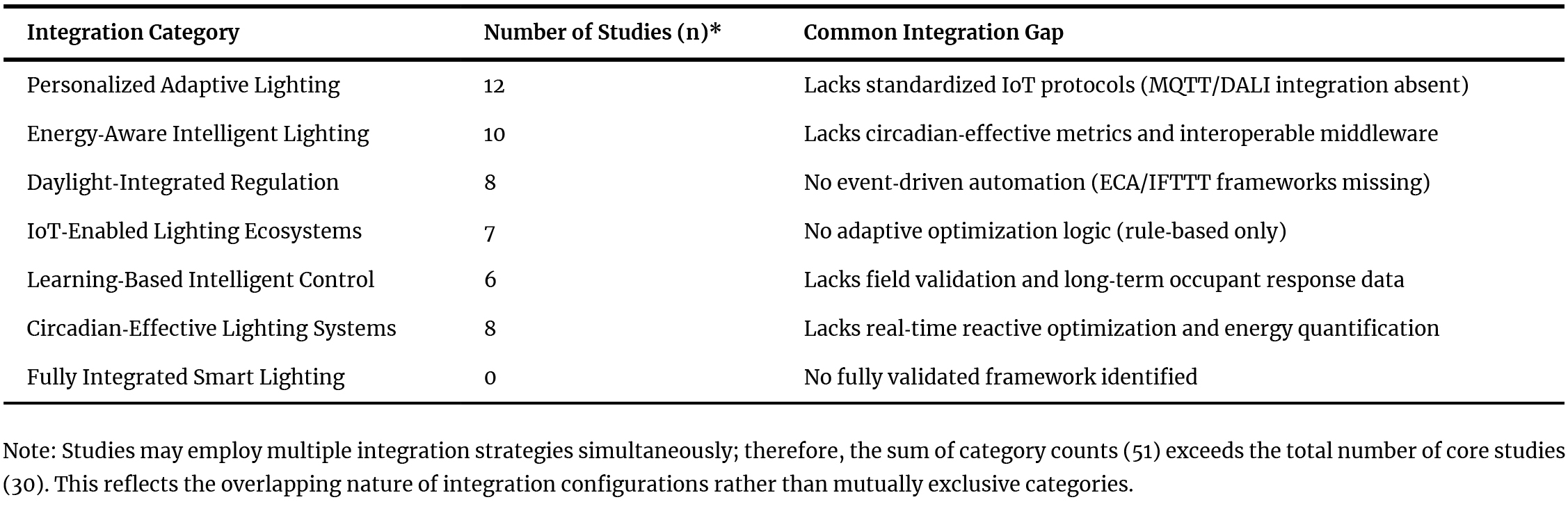
Table 9. Taxonomic summary of integration configurations across the core literature.
3.5. Integrated interpretation of the research gap
The findings are presented at three analytical levels. At Level 1, bibliometric patterns derived from metadata describe what appears in titles, abstracts, and keywords, indicating structural visibility of concepts in the indexed record. The metadata sparsity indicates weak explicit articulation in indexed records. At Level 2, systematic evidence derived from full‑text analysis describes what is reported in the full text of the 30 core studies, indicating documented implementation of technologies. Full‑text analysis confirms that, within this selected corpus, no study achieves comprehensive integration of all four dimensions (human‑centric lighting, energy optimization, interoperable IoT, and event‑driven automation) under real occupancy conditions. While this finding is consistent with the broader bibliometric pattern, it should be interpreted with caution given the inherent limitations of systematic evidence synthesis. At Level 3, integration analysis synthesizes Levels 1 and 2 to identify discrepancies between bibliometric visibility and reported implementation. The convergence of metadata sparsity with full‑text absence of comprehensive frameworks strengthensthis interpretation, though it remains qualified by the acknowledged limitations of metadata‑dependent analysis.
Crucially, Level 1 findings should not be conflated with Level 3 conclusions. The co‑occurrence sparsity observed at Level 1 indicates weak explicit articulation at the metadata level, which may or may not correspond to weak technical integration at the implementation level. At the bibliometric level, metadata‑based co‑occurrence between hyper‑heuristics, interoperable IoT architectures, and ECA/IFTTT automation is extremely limited, with a mean Jaccard coefficient of 0.018. At the implementation level, full‑text analysis of the 30 core studies confirms that, within this selected corpus, no study achieves comprehensive integration of all four dimensions under real occupancy conditions (see Supplementary Table S11 for dimensional verification). However, because many engineering studies do not report all relevant technologies in their metadata, the bibliometric pattern should be interpreted as an indicator of weak explicit articulation in indexed records, which is consistent with, but not definitive proof of, a genuine integration gap. Regardless of whether the gap is primarily technical or documentation‑related, the recommended interventions—particularly the mandatory metadata reporting checklist—remain valid and necessary.
4. Discussion
4.1. Bibliometric structures and network fragmentation across research domains
Figure 9(a–c) present the VOSviewer network visualizations and international collaboration structures derived from the Web of Science datasets for occupant‑centred lighting, energy‑oriented lighting systems, and sensing and automation technologies.
Figure 9
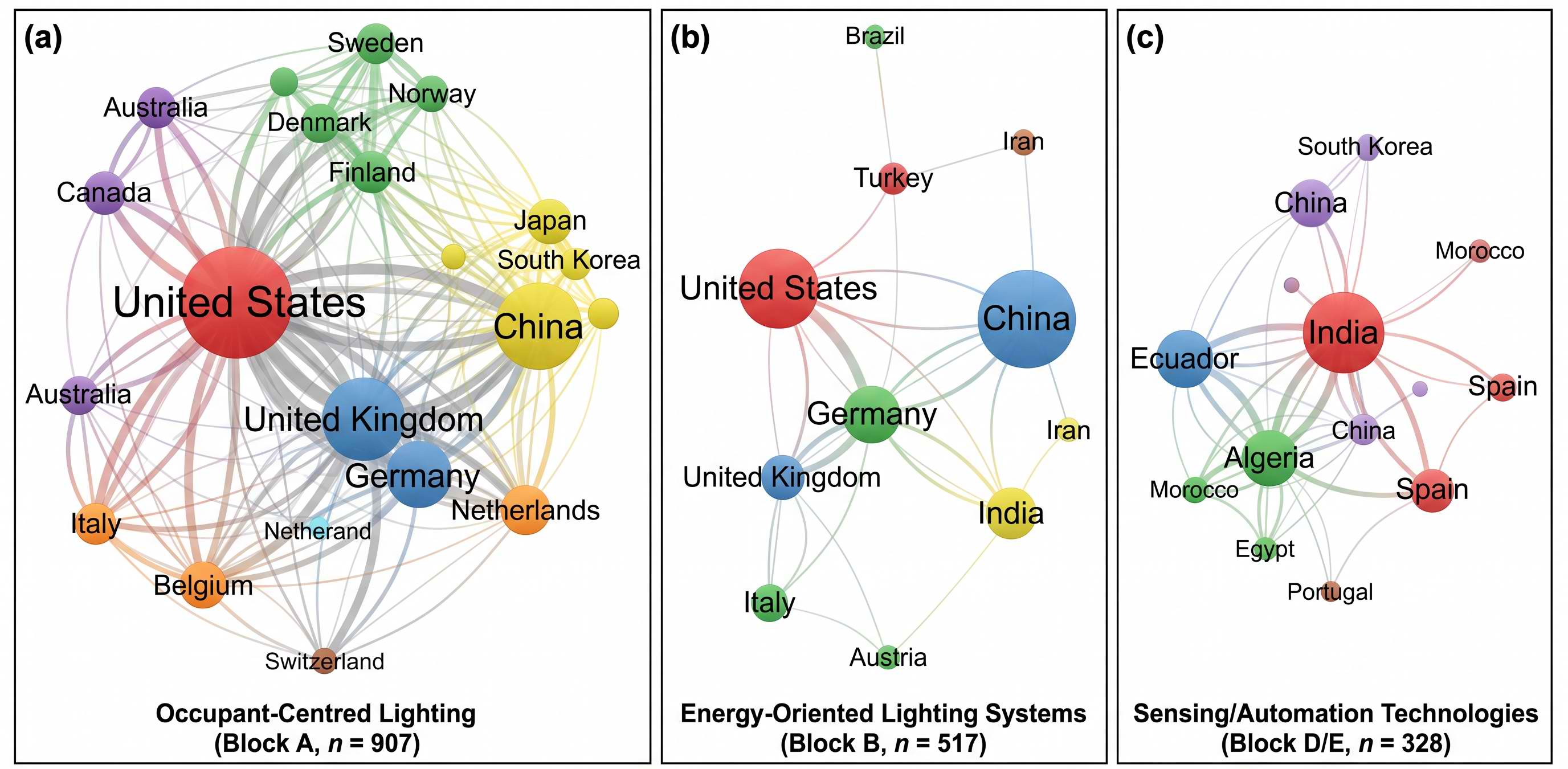
Fig. 9. (a–c) International Collaboration Structures Derived from the Web of Science Datasets. Panel (a) presents occupant‑centred lighting (Block A, n = 907), exhibiting dense transnational integration with strong connectivity among North American, European, and East Asian research groups. Panel (b) presents energy‑oriented lighting systems (Block B, n = 517), showing comparatively sparse and fragmented collaboration patterns. Panel (c) presents sensing/automation technologies (Block D/E, n = 328), revealing emerging but less mature collaborative structures with identifiable yet limited connectivity among countries including India, Ecuador, and Algeria. Network layouts correspond to native VOSviewer renderings in which node distribution and label prominence are determined algorithmically according to citation and collaboration density. VOSviewer maps were derived from Web of Science data because WoS provides more complete citation data for network visualization; Scopus was used for the co‑occurrence analysis because of its broader coverage. Abbreviation: WoS, Web of Science.
The comparison highlights substantial variation in collaboration maturity across thematic domains, with Block A exhibiting dense transnational integration, while technology‑oriented corpora remain comparatively fragmented and geographically dispersed. Within Block A, the keyword networks demonstrate dense interconnections among concepts associated with circadian entrainment, visual comfort, spectral tuning, and non‑visual effects of light, with consolidated institutional clusters showing strong international connectivity, particularly among North American, European, and East Asian research groups. In contrast, Block B exhibits a more technically dispersed configuration with dominant clusters revolving around daylight harvesting, occupancy‑based control, optimization, and demand‑response strategies, yet remaining weakly coupled to the biological and perceptual terminology characteristic of Block A. Block D reveals a different form of fragmentation, with dominant thematic clusters centred on wireless communication protocols, IoT middleware, machine learning, and home automation infrastructures that remain only marginally connected to health‑related lighting outcomes. Collectively, the VOSviewer analyses reveal that the fragmentation identified throughout this review is not merely thematic but structural: no dominant bibliometric cluster simultaneously integrates circadian metrics, energy indicators, interoperable IoT infrastructures, and adaptive optimization logic into a consolidated research domain.
4.2. Interpreting the identified research gap: integration deficiency within a mature technological landscape
The evidence synthesized across publication dynamics, keyword evolution, co‑mention heatmaps, and comparative study mapping supports a consistent interpretive conclusion: the field has reached technological maturity at the component level but remains underdeveloped at the systems integration level. Most importantly, no field‑validated study within the core dataset implemented a unified architecture combining interoperable IoT communication infrastructure; adaptive optimization logic; event‑driven automation; circadian‑effective spectral control; occupant‑responsive feedback mechanisms; and simultaneous optimization of energy use and biological lighting targets under real occupancy conditions (see Supplementary Table S11 for dimensional verification). The temporal publication trajectory demonstrates sustained acceleration after 2015, confirming that both human‑centric lighting and energy‑aware lighting have become established research priorities. However, the metadata‑based co‑occurrence structures reveal only weak explicit coupling between optimization methodologies and interoperable communication infrastructures. The keyword emergence trajectories further reinforce this asymmetry: health‑related concepts demonstrate stable growth, while terms associated with adaptive computational intelligence appear much later and remain comparatively sparse. This imbalance becomes even more evident at the study‑comparison level: most studies address only partial subsets of the broader integration challenge, with rule‑based supervisory logic continuing to dominate operational implementations while genuinely adaptive, learning‑based, or multi‑objective optimization architectures constitute only a small minority of the reviewed corpus. The identified gap therefore concerns orchestration rather than invention. Tunable luminaires, wireless sensing systems, adaptive algorithms, and biological lighting metrics already exist and have individually reached substantial levels of maturity [3,47,4,53], yet what remains absent is a coherent operational architecture capable of integrating these components into a unified, empirically validated ecosystem.
4.3. Reconstructing the field through an integrated multi‑layer architecture
The fragmented structure identified throughout the bibliometric analyses can be interpreted as the outcome of parallel disciplinary evolution, with different research communities advancing distinct functional layers of intelligent lighting systems without fully converging around a shared architectural model. Figure 10(a–b) presents the integrated conceptual synthesis of the identified research gap and proposed architectural response.
Figure 10
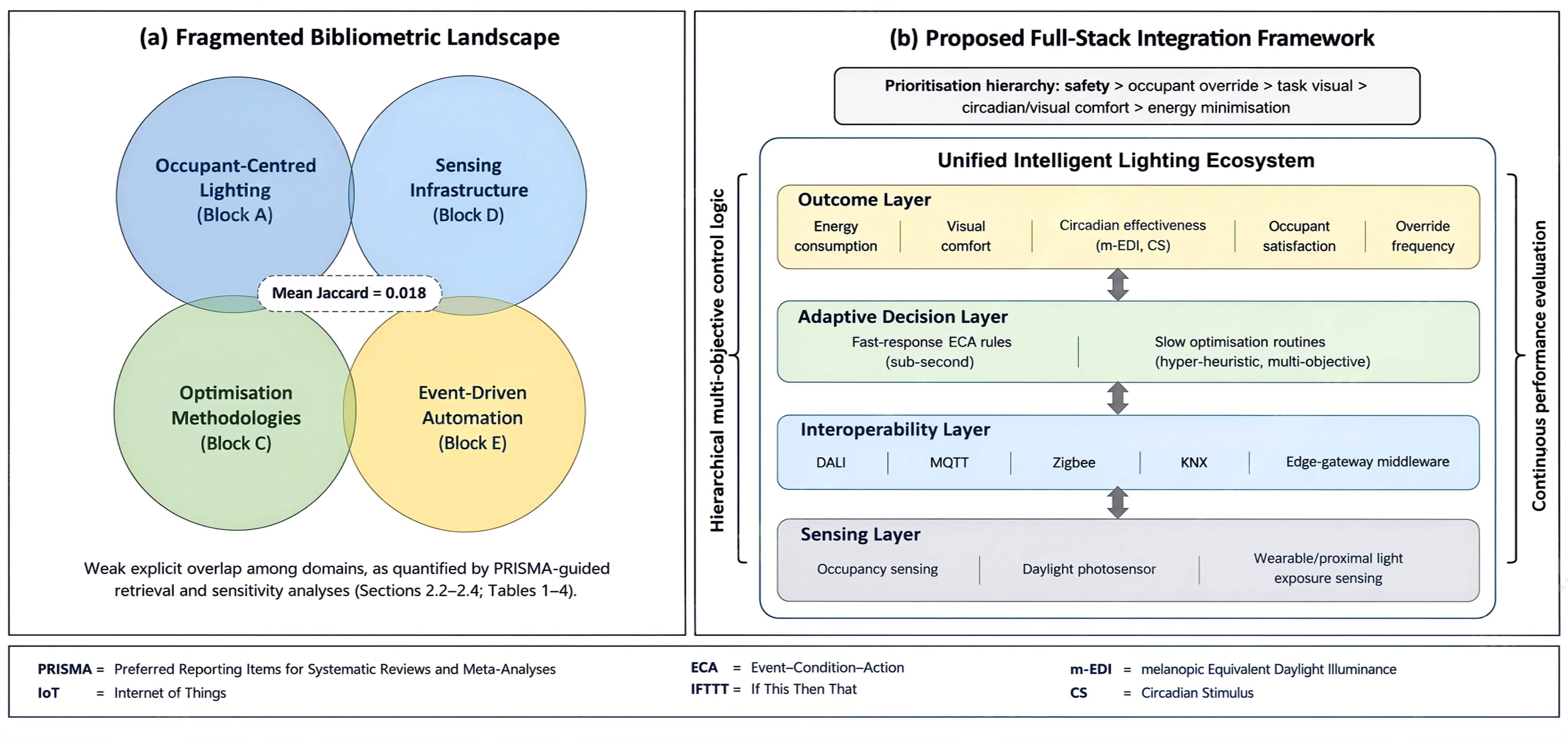
Fig. 10. (a–b) Integrated Conceptual Synthesis of the Identified Research Gap and Proposed Architectural Response. Panel (a) illustrates the fragmented bibliometric landscape, highlighting the weak explicit overlap among occupant‑centred lighting, sensing infrastructure, optimization methodologies, and event‑driven automation, as quantified by the PRISMA‑guided retrieval and sensitivity analyses reported in Sections 2.2–2.4 and Tables 1–4. The mean Jaccard co‑occurrence coefficient of 0.018 quantitatively confirms this extremely weak cross‑domain coupling. Panel (b) presents the proposed full‑stack integration framework in which sensing systems, interoperability middleware, adaptive control logic, and multidimensional outcome metrics operate as interconnected functional layers within a unified intelligent lighting ecosystem. Abbreviations: PRISMA, Preferred Reporting Items for Systematic Reviews and Meta‑Analyses; IoT, Internet of Things; ECA, Event–Condition–Action; IFTTT, If This Then That.
Panel (a) illustrates the fragmented bibliometric landscape, highlighting the weak explicit overlap among occupant‑centred lighting, sensing infrastructure, optimization methodologies, and event‑driven automation. Panel (b) presents the proposed full‑stack integration framework in which sensing systems, interoperability middleware, adaptive control logic, and multidimensional outcome metrics operate as interconnected functional layers within a unified intelligent lighting ecosystem.
The right‑hand side of Figure 9 translates this fragmented landscape into a proposed systems architecture composed of four operational layers. The sensing layer is responsible for continuous environmental and behavioural data acquisition, including occupancy, daylight availability, time‑dependent exposure patterns, and, where feasible, personalized eye‑level light exposure through wearable or proximal sensing devices. The interoperability layer functions as the communication backbone linking heterogeneous hardware systems through protocols such as DALI, MQTT, Zigbee, KNX, and edge‑gateway middleware, enabling bidirectional information exchange while preserving vendor interoperability. The adaptive decision layer introduces hierarchical multi‑objective control logic, with fast‑response event‑driven mechanisms handling immediate operational requirements and slower optimization routines operating periodically to improve longer‑term performance outcomes. Importantly, these layers are not competitive but hierarchical: rule‑based systems establish operational boundaries, while optimization algorithms refine behaviour within those permissible limits. The outcome layer continuously evaluates both instantaneous and cumulative performance indicators, including energy consumption, peak electrical demand, visual comfort indices, circadian effectiveness metrics such as m‑EDI and circadian stimulus, occupant override frequency, satisfaction levels, and behavioural adaptation patterns. The proposed architecture also introduces a prioritization hierarchy to resolve operational conflicts: safety constraints and mandatory operational conditions take precedence, followed by occupant overrides and task‑specific visual requirements, with circadian and visual comfort objectives occupying the next level, and energy minimization optimized within the remaining feasible operational space.
4.4. Alternative competing hypotheses
An alternative interpretation is that the observed fragmentation is an artifact of poor metadata indexing, rather than a technical deficit. Engineers may implement integrated MQTT‑GA frameworks but fail to report them in keywords. Secondly, industrial proprietary systems (such as those developed by Siemens, Honeywell, and Signify) likely possess such integration but are absent from peer‑reviewed literature. This implies that the findings of this review reflect an academic documentation gap equally as much as a technical integration gap. The convergence of evidence across multiple analytical layers—metadata co‑occurrence, full‑text screening, and sensitivity analysis—suggests that both explanations may operate simultaneously. However, the complete absence of any field‑validated study combining all four dimensions in the peer‑reviewed corpus indicates that the academic documentation gap is substantial and warrants targeted interventions, such as the mandatory metadata reporting checklist proposed in Table 10. Regardless of whether the gap is primarily technical or documentation‑related, the recommended interventions remain valid and necessary.
Table 10
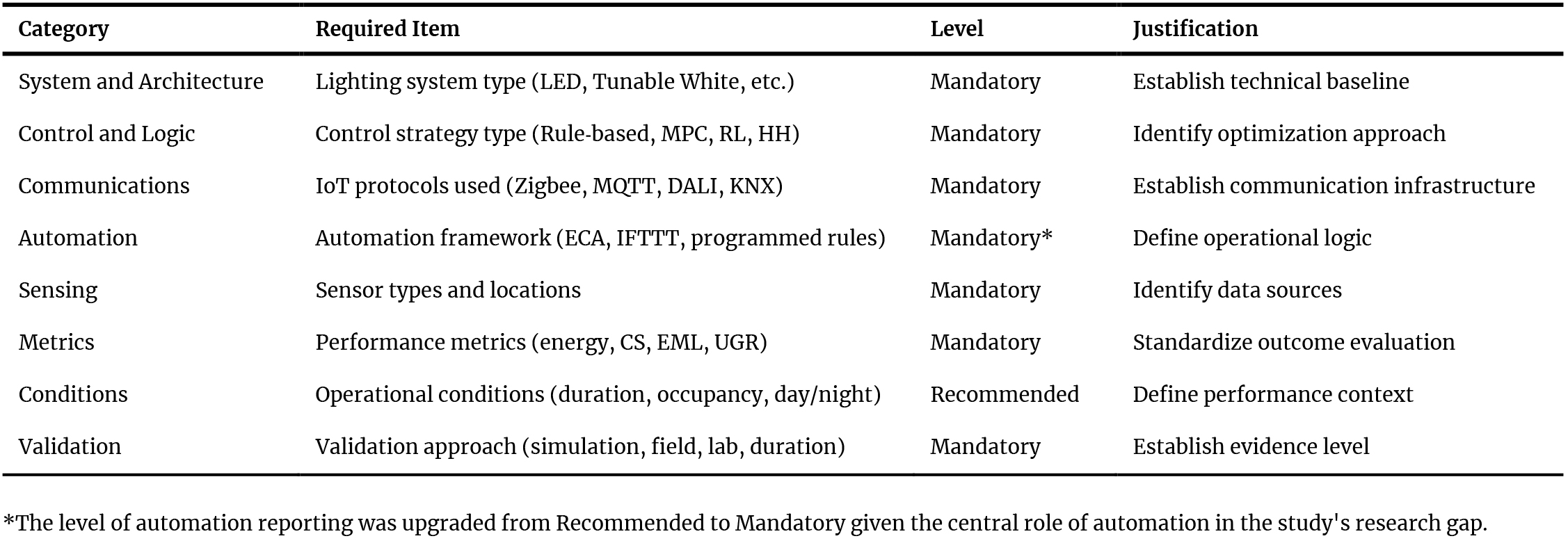
Table 10. Proposed minimum metadata reporting checklist for integrated smart lighting research.
4.5. Practical implications for building standards, professional practice, and future research
Table 10 presents a proposed minimum metadata reporting checklist for integrated smart lighting research, comprising eight categories with corresponding required items, levels, and justifications. The categories include system and architecture, control and logic, communications, automation, sensing, metrics, conditions, and validation. Each category specifies whether the item is mandatory or recommended, with justifications establishing technical baseline, identifying optimization approach, establishing communication infrastructure, defining operational logic, identifying data sources, standardizing outcome evaluation, defining performance context, and establishing evidence level.
The findings of this review carry substantial implications for sustainable building design, lighting standards, and intelligent environmental control systems. Existing regulatory frameworks governing building energy performance, including ASHRAE 90.1, IECC, and the EPBD, primarily address lighting power density, occupancy sensing, and daylight harvesting. In parallel, wellbeing‑oriented certification systems such as the WELL Building Standard increasingly incorporate circadian lighting recommendations. However, these two regulatory paradigms remain only weakly integrated. Energy standards rarely mandate biologically relevant lighting metrics, while wellbeing certifications often lack rigorous long‑term energy verification and operational performance assessment. The evidence synthesized in this review suggests that future sustainable lighting standards must evolve toward dual‑performance evaluation frameworks capable of simultaneously assessing annual energy consumption and annual circadian‑light exposure.
From a hardware perspective, tunable‑white LED luminaires with high colour rendering capability and broad correlated colour temperature ranges should become standard components within human‑centric intelligent lighting systems, with individual addressability through interoperable communication protocols essential for adaptive multi‑zone control. Regarding sensing infrastructure, effective implementations require integrated occupancy sensing, façade‑oriented daylight monitoring, and, where possible, personal light‑exposure measurement capable of approximating eye‑level circadian stimulus. Control architectures should incorporate both scheduled circadian‑supportive lighting patterns and adaptive override mechanisms, with daytime operation prioritizing circadian entrainment through elevated daytime melanopic exposure while evening operation progressively restricts biologically stimulating spectra.
The review further demonstrates the urgent need for robust longitudinal validation studies. Most existing field investigations remain short‑term, involve limited participant populations, and rely on heterogeneous evaluation metrics. Future research should therefore prioritize long‑duration field deployments exceeding six months; simultaneous monitoring of energy use, circadian exposure, behavioural adaptation, and sleep quality; standardized reporting frameworks for integrated lighting research as proposed in Table 10; comparative validation across multiple climates and building typologies; and integration of lighting control with shading, HVAC, and broader indoor environmental quality systems.
4.6. Methodological and interpretive limitations
Several limitations must be considered when interpreting the findings of this review. The exclusion of grey literature is significant because industrial smart‑lighting systems may implement integrated architectures not published due to commercial sensitivity. The integration gap identified should therefore be understood as a gap in the peer‑reviewed scientific literature rather than necessarily a gap in industrial practice. This reinforces the need for industry‑academic partnerships and standardized reporting frameworks. First, the bibliometric analyses relied primarily on metadata‑level extraction from titles, abstracts, and keywords rather than full‑text semantic mining. Consequently, studies implementing integrated architectures without explicitly reporting all technological or biological dimensions within metadata fields may be underrepresented. Second, the exclusion of non‑English publications potentially limits representation of regional research communities. Third, the heterogeneity of reported outcome measures prevented formal quantitative meta‑analysis. Fourth, the majority of field‑based investigations involved short observation periods and relatively small participant populations. Fifth, the review focused exclusively on peer‑reviewed academic literature, with industrial deployment reports and proprietary building‑management datasets not systematically included. Nevertheless, the methodological triangulation employed in this review, including systematic retrieval, bibliometric mapping, co‑occurrence analysis, sensitivity verification, study‑level comparative coding, and MMAT quality appraisal [45], provides a robust analytical basis for the conclusions advanced herein.
4.7. Integrative conclusion of the discussion
The evidence synthesized throughout this discussion converges toward a central conclusion: the contemporary intelligent lighting field possesses mature technological subsystems but lacks mature systems integration. Energy‑efficient luminaires, adaptive sensing infrastructures, biologically informed spectral strategies, occupant‑responsive controls, and optimization algorithms have all evolved substantially over the last decade. Yet the scientific literature continues to treat these components largely as parallel specializations rather than as interdependent elements within unified operational ecosystems. The principal barrier to progress is therefore architectural rather than technological. What remains insufficiently developed is a coherent framework capable of orchestrating sensing, interoperability, optimization, circadian performance, occupant wellbeing, and energy management simultaneously under real building conditions. The conceptual architecture proposed in Figure 10(b) represents an initial attempt to bridge this fragmentation by positioning human‑centric objectives, IoT interoperability, adaptive optimization, and wellbeing evaluation within a common systems framework. Advancing this transition will require sustained interdisciplinary collaboration among building scientists, lighting engineers, chronobiologists, environmental psychologists, data scientists, automation specialists, and standards organizations. The challenge identified in this review is therefore not merely academic. Establishing empirically validated integrated lighting architectures is essential for the development of buildings that are simultaneously energy‑efficient, biologically supportive, operationally adaptive, and resilient to future environmental and societal demands.
5. Conclusion
This review set out to examine whether the rapidly expanding domains of human‑centric lighting, energy‑responsive illumination, intelligent optimization, and IoT‑enabled automation are converging toward unified operational frameworks or continuing to evolve as largely disconnected research trajectories. Through the integration of large‑scale bibliometric retrieval, metadata‑driven network analysis, temporal trend modelling, comparative synthesis, and MMAT‑based quality appraisal [45], the investigation provides a consolidated assessment of how contemporary indoor lighting research is structured, where integration currently occurs, and where substantive fragmentation persists.
The combined MATLAB and VOSviewer analytical workflow revealed that the scientific landscape surrounding smart indoor lighting has transitioned from an emerging niche into a mature multidisciplinary research field. Publication growth accelerated markedly after 2015, coinciding with the wider diffusion of tunable LED technologies, increasing adoption of smart‑building infrastructures, and heightened scientific interest in circadian‑effective lighting design. Across the retrieved corpora, concepts associated with visual comfort, circadian regulation, daylight‑responsive control, and energy‑efficient operation exhibited strong thematic consolidation, with keyword clusters, citation relationships, and collaboration structures demonstrating that these domains now possess stable conceptual vocabularies, identifiable methodological conventions, and internationally distributed research communities.
However, the evidence simultaneously demonstrates that this maturity has developed unevenly across disciplinary layers. Research concerned with non‑visual biological effects of light has progressed largely independently from investigations focused on optimization logic, interoperable communication frameworks, and adaptive automation architectures. Similarly, studies centred on IoT infrastructures and intelligent control frequently prioritize sensing, connectivity, or computational efficiency while omitting rigorous evaluation of circadian performance, psychological wellbeing, or long‑term occupant response. As a consequence, the field remains characterized by thematic proximity without full systems‑level convergence. At the bibliometric level, metadata‑based co‑occurrence between hyper‑heuristics, interoperable IoT architectures, and ECA/IFTTT automation is extremely limited, with a mean Jaccard coefficient of 0.018. At the implementation level, full‑text analysis of the 30 core studies confirms that, within this selected corpus, no study achieves comprehensive integration of the four core dimensions (human‑centric lighting, energy optimization, interoperable IoT, and event‑driven automation) under real occupancy conditions (see Supplementary Table S11 for dimensional verification). However, because many engineering studies do not report all relevant technologies in their metadata, the bibliometric pattern should be interpreted as an indicator of weak explicit articulation in indexed records, which is consistent with, but not definitive proof of, a genuine integration gap.
The systematic filtering process further reinforces this interpretation. From an initial retrieval of 5,529 indexed records, only 30 studies satisfied the combined eligibility conditions of reporting measurable energy‑related outcomes together with clearly identifiable control or automation mechanisms. Within this reduced corpus, most investigations relied on deterministic supervisory logic or predefined schedules, whereas genuinely adaptive or learning‑oriented approaches represented only a minor proportion of the literature. More importantly, none of the identified studies demonstrated a fully integrated architecture combining hyper‑heuristic orchestration, interoperable IoT middleware, event‑driven automation, circadian performance targets, and real occupancy‑based operational validation within a single empirically tested deployment. The resulting evidence therefore suggests that the principal limitation of the field is no longer the absence of enabling technologies, but the absence of operationally unified frameworks capable of coordinating those technologies toward simultaneous human and environmental objectives.
This conclusion carries important methodological implications. The review demonstrates that bibliometric interpretation in technologically interdisciplinary fields must be approached cautiously, particularly where metadata quality varies substantially between databases. The triangulation of multiple databases, analytical tools, manual study‑level coding, and MMAT quality appraisal was essential to reduce distortion arising from incomplete metadata structures. Future evidence syntheses in intelligent building systems would benefit from complementing conventional bibliometric approaches with full‑text semantic mining, ontology‑based classification, and transparent cross‑domain coding protocols capable of detecting implicit technological relationships that remain invisible at the metadata level.
Ultimately, the evidence assembled throughout this review converges on a single overarching interpretation. The constituent technologies required for intelligent, health‑supportive, and energy‑responsive indoor lighting are already available and scientifically mature. Circadian lighting metrics have been standardized [46]; adaptive algorithms are increasingly sophisticated; low‑cost sensing platforms are widely accessible; and IoT communication infrastructures are technically well established. What remains underdeveloped is the integrative layer that systematically connects these components into coherent, empirically validated operational ecosystems. The unresolved challenge is therefore not technological invention, but interdisciplinary synthesis. By identifying the weakly connected interfaces between human‑centric lighting, optimization intelligence, interoperable IoT architectures, and event‑driven automation, this review establishes a structured foundation for future integration‑oriented research. The proposed direction moves beyond isolated efficiency improvements toward comprehensive lighting systems capable of simultaneously supporting energy sustainability, visual performance, circadian alignment, and occupant wellbeing. Advancing toward such systems will require coordinated collaboration among lighting engineers, chronobiologists, building scientists, computer scientists, behavioural researchers, and standards organizations. The transition from fragmented innovation to unified intelligent environments represents the next critical stage in the evolution of sustainable indoor lighting research.
Funding
The research was funded by the Ongoing Research Funding Program (ORF-2026-2194), King Saud University, Riyadh, Saudi Arabia.
Author Contributions
The author confirms being the sole contributor of this work and has approved it for publication.
Acknowledgement
The author acknowledges the support of the Ongoing Research Funding Program at King Saud University, Riyadh, Saudi Arabia.
Declaration of competing interest
The authors declare no conflict of interest.
Declaration of generative ai and ai assisted technologies
Grammarly and DeepL were used solely for language refinement. No generative AI was used for data analysis, code generation, or scientific interpretation. Bibliometric analyses were conducted using MATLAB 2025a and VOSviewer 1.6.20 (parameters specified in Section 2.6). The Mixed Methods Appraisal Tool (MMAT) was applied following Hong et al. [45]. No autoencoder, k‑NN, or deep learning models were employed.
Supplementary materials
S1. Complete database‑specific search strings per block (Scopus, Web of Science, IEEE Xplore)
S2. Stopword lists, stemming rules, and deduplication protocols
S3. VOSviewer parameter files and thesaurus
S4. MATLAB scripts for duplicate elimination, terminology harmonization, co‑occurrence matrix generation, and temporal trend visualization
S5. Full coding dataset for the 30 core studies (including the complete structural characterization table)
S6. Detailed MMAT scores for all 30 core studies
S7. PRISMA 2020 checklist
S8. Pairwise Jaccard co‑occurrence coefficients between technological domains
S9. Annual publication data (2015–2024) used for Mann‑Kendall trend analysis
S10. Specific studies contributing to each "Typical Range (IQR)" value in Table 8
S11. Dimensional verification table showing which of the four core dimensions each of the 30 studies implemented
S12. Data provenance summary for all figures
The supplementary material can be accessed at the following link:
https://github.com/hassangbran/SUPPLEMENTARY-MATERIALS-/blob/main/Supplementary Materials.pdf
https://github.com/hassangbran/SUPPLEMENTARY-MATERIALS-/tree/main
References
- L. Pérez-Lombard, J. Ortiz, C. Pout, A review on buildings energy consumption information, Energy and Buildings, 40(3) (2008) 394-398. https://doi.org/10.1016/j.enbuild.2007.03.007
- M. Soheilian, G. Fischl, M. Aries, Smart Lighting Application for Energy Saving and User Well-Being in the Residential Environment, Sustainability, 13(11) (2021) 6198. https://doi.org/10.3390/su13116198
- J. Park, T. R. Dougherty, H. Fritz, Z. Nagy, LightLearn: An adaptive and occupant centered controller for lighting based on reinforcement learning, Building and Environment, 147 (2019) 397-414. https://doi.org/10.1016/j.buildenv.2018.10.028
- M. Moore-Ede, D. E. Blask, S. W. Cain, A. Heitmann, R. J. Nelson, Lights should support circadian rhythms: evidence-based scientific consensus, Frontiers in Photonics, 4 (2023) 1272934. https://doi.org/10.3389/fphot.2023.1272934
- L. Atzori, A. Iera, G. Morabito, The Internet of Things: A survey, Computer Networks, 54(15) (2010) 2787-2805. https://doi.org/10.1016/j.comnet.2010.05.010
- C. Papatsimpa, J. H. Bonarius, J. P. M. G. Linnartz, Human Centric IoT Lighting Control based on Personalized Biological Clock Estimations, in: Proceedings of the IEEE World Forum on Internet of Things (WF-IoT), New Orleans, United States, 2-16 June 2020, pp. 1-6. https://doi.org/10.1109/WF-IoT48130.2020.9221206
- T. E. Macias-Escobar, L. Cruz-Reyes, H. J. Fraire-Huacuja, A survey of hyper-heuristics for dynamic optimization problems, in: Intuitionistic and Type-2 Fuzzy Logic Enhancements in Neural and Optimization Algorithms: Theory and Applications, Springer, 2020, pp. 463-477. https://doi.org/10.1007/978-3-030-35445-9_33
- J. A. Veitch, G. R. Newsham, Exercised control, lighting choices, and energy use: An office simulation experiment, Journal of Environmental Psychology, 20(3) (2000) 281-296. https://doi.org/10.1006/jevp.1999.0169
- European Parliament, Directive 2010/31/EU on the energy performance of buildings, Official Journal of the European Union, L 153 (2010) 13-35
- W. O'Brien, I. Gaetani, S. Carlucci, P. J. Hoes, J. L. M. Hensen, On occupant-centric building performance metrics, Building and Environment, 122 (2017) 373-385. https://doi.org/10.1016/j.buildenv.2017.06.028
- M. Papinutto, R. Boghetti, M. Colombo, C. Basurto, K. Reutter, D. Lalanne, J. H. Kampf, J. Nembrini, Saving energy by maximising daylight and minimising the impact on occupants: An automatic lighting system approach, Energy and Buildings, 268 (2022) 112176. https://doi.org/10.1016/j.enbuild.2022.112176
- A. Zanella, N. Bui, A. Castellani, L. Vangelista, M. Zorzi, Internet of Things for smart cities, IEEE Internet of Things Journal, 1(1) (2014) 22-32. https://doi.org/10.1109/JIOT.2014.2306328
- F. Bonomi, R. Milito, J. Zhu, S. Addepalli, Fog computing and its role in the internet of things, in: Proceedings of the First Edition of the MCC Workshop on Mobile Cloud Computing, Helsinki, Finland, 16 August 2012, pp. 13-16. https://doi.org/10.1145/2342509.2342513
- A. Karapetyan, S. C.-K. Chau, K. Elbassioni, S. K. Azman, M. Khonji, Multisensor Adaptive Control System for IoT-Empowered Smart Lighting with Oblivious Mobile Sensors, ACM Transactions on Sensor Networks, 16(1) (2020) Article 1. https://doi.org/10.1145/3369392
- Y. Aussat, A. Rosmanis, S. Keshav, A power-efficient self-calibrating smart lighting system, Energy and Buildings, 259 (2022) 111874. https://doi.org/10.1016/j.enbuild.2022.111874
- M. Domb, Smart home systems: Overview and comparative analysis, in: Smart Home Systems, IntechOpen, 2019, pp. 1-18. https://doi.org/10.5772/intechopen.84894
- B. Ur, E. McManus, M. Pak Yong Ho, M. L. Littman, Practical trigger-action programming in the smart home, in: Proceedings of the SIGCHI Conference on Human Factors in Computing Systems, Toronto, Canada, 26 April-1 May 2014, pp. 803-812. https://doi.org/10.1145/2556288.2557420
- M. Spitschan, J. van Duijnhoven, S. L. Hartmeyer, A. Didikoglu, O. Stefani, K. W. Houser, V. Kalavally, Measuring light exposure in daily life: A review of wearable light loggers, Building and Environment, 274 (2025) 112771. https://doi.org/10.1016/j.buildenv.2025.112771
- P. R. Boyce, Human Factors in Lighting, 3rd ed., CRC Press: Boca Raton, FL, USA, 2014. https://doi.org/10.1201/b16707
- D. H. W. Li, J. C. Lam, An analysis of lighting energy savings and switching frequency for a daylight-linked lighting system under various sky conditions, Lighting Research and Technology, 35(1) (2003) 3-18. https://doi.org/10.1191/1365782803li050oa
- Q. Liu, Reinforcement learning-based approach for real-time adaptive lighting control using low-cost embedded hardware, Energy and Buildings, 253 (2021) 111528. https://doi.org/10.1016/j.enbuild.2021.111528
- F. Viani, A. Polo, P. Garofalo, N. Anselmi, M. Salucci, E. Giarola, Evolutionary optimization applied to wireless smart lighting in energy-efficient museums, IEEE Sensors Journal, 17(5) (2017) 1213-1222. https://doi.org/10.1109/JSEN.2017.2647827
- F. Wahid, M. Fayaz, A. Aljarbouh, M. Mir, M. Aamir, Imran, Energy Consumption Optimization and User Comfort Maximization in Smart Buildings Using a Hybrid of the Firefly and Genetic Algorithms, Energies, 13(17) (2020) 4363. https://doi.org/10.3390/en13174363
- R. Jabeur, N. Ouaaline, A. Lakrim, A Fuzzy Logic Controller Controls a Smart Lighting System for Energy Savings, in: Proceedings of the 9th International Renewable and Sustainable Energy Conference (IRSEC), Morocco, 23-27 November 2021, pp. 1-6. https://doi.org/10.1109/IRSEC53969.2021.9741190
- E. K. Burke, M. Gendreau, M. Hyde, G. Kendall, G. Ochoa, E. Özcan, R. Qu, Hyper-heuristics: A survey of the state of the art, Journal of the Operational Research Society, 64(12) (2013) 1695-1724. https://doi.org/10.1057/jors.2013.71
- C. Perera, A. Zaslavsky, P. Christen, D. Georgakopoulos, Context aware computing for the Internet of Things: A survey, IEEE Communications Surveys & Tutorials, 16(1) (2014) 414-454. https://doi.org/10.1109/SURV.2013.042313.00197
- C. Singla, N. Kaur, Event-condition-action rules in smart homes: A review, International Journal of Advanced Computer Science and Applications, 10(12) (2019) 123-130. https://doi.org/10.14569/IJACSA.2019.0101216
- C. Basurto, M. Papinutto, M. Colombo, R. Boghetti, K. Reutter, J. Nembrini, J. H. Kämpf, Integrating daylight with general and task lighting: A longitudinal in-the-wild study in individual and open space working areas, Solar Energy Advances, 2 (2022) 100027. https://doi.org/10.1016/j.seja.2022.100027
- S. Choi, A. Choi, M. Sung, Cloud-based lighting control systems: Fatigue analysis and recommended luminous environments, Building and Environment, 214 (2022) 108947. https://doi.org/10.1016/j.buildenv.2022.108947
- F. Lachhab, M. Bakhouya, Energy Efficient Lighting System Control Combined with Shading System Using IoT and AI Technologies, in: Proceedings of the 2024 World Conference on Complex Systems (WCCS), Agadir, Morocco, 2024. https://doi.org/10.1109/WCCS60345.2024.10523456
- Y. Zhang, T. Lu, Y. Chen, Design and Implementation of an Intelligent Indoor Brightness Control System using ESP-8266 Microcontroller, in: Proceedings of IEEE ITOEC 2023, Chongqing, China, 2023, pp. 237-244. https://doi.org/10.1109/ITOEC57671.2023.10292097
- N. van de Meugheuvel, A. Pandharipande, D. Caicedo, P. P. J. van den Hof, Distributed lighting control with daylight and occupancy adaptation, Energy and Buildings, 75 (2014) 321-329. https://doi.org/10.1016/j.enbuild.2014.02.016
- H. Arksey, L. O'Malley, Scoping studies: Towards a methodological framework, International Journal of Social Research Methodology, 8(1) (2005) 19-32. https://doi.org/10.1080/1364557032000119616
- MATLAB, MATLAB Version 2025a, The MathWorks Inc.: Natick, Massachusetts, USA, 2025.
- N. J. van Eck, L. Waltman, Software survey: VOSviewer, a computer program for bibliometric mapping, Scientometrics, 84(2) (2010) 523-538. https://doi.org/10.1007/s11192-009-0146-3
- M. Aria, C. Cuccurullo, bibliometrix: An R-tool for comprehensive science mapping analysis, Journal of Informetrics, 11(4) (2017) 959-975. https://doi.org/10.1016/j.joi.2017.08.007
- M. J. Page, J. E. McKenzie, P. M. Bossuyt, I. Boutron, T. C. Hoffmann, C. D. Mulrow, M. Shamseer, J. M. Tetzlaff, E. A. Akl, S. E. Brennan, R. Chou, G. Glanville, J. M. Grimshaw, A. Hróbjartsson, M. M. Lalu, T. Li, E. W. Loder, E. Mayo-Wilson, S. McDonald, L. A. McGuinness, J. M. Stewart, J. Thomas, A. C. Tricco, V. A. Welch, P. Whiting, D. Moher, The PRISMA 2020 statement: an updated guideline for reporting systematic reviews, BMJ, 372 (2021) n71. https://doi.org/10.1136/bmj.n71
- J. Thomas, A. Harden, Methods for the thematic synthesis of qualitative research in systematic reviews, BMC Medical Research Methodology, 8 (2008) 45. https://doi.org/10.1186/1471-2288-8-45
- I. Zupic, T. Čater, Bibliometric methods in management and organization, Organizational Research Methods, 18(3) (2015) 429-472. https://doi.org/10.1177/1094428114562629
- ISO/IEC, ISO/IEC 30141:2018 - Internet of Things (IoT) - Reference Architecture, International Organization for Standardization: Geneva, Switzerland, 2018.
- IEEE, IEEE P2668.1-2020 - IEEE Standard for IoT Maturity Assessment, Institute of Electrical and Electronics Engineers: New York, USA, 2020.
- M. E. Falagas, E. I. Pitsouni, G. A. Malietzis, G. Pappas, Comparison of PubMed, Scopus, Web of Science, and Google Scholar: strengths and weaknesses, The FASEB Journal, 22(2) (2008) 338-342. https://doi.org/10.1096/fj.07-9492LSF
- M. L. Rethlefsen, S. Kirtley, S. Waffenschmidt, A. P. Ayala, M. Moher, M. J. Page, J. B. Koffel, PRISMA-S: an extension to the PRISMA Statement for Reporting Literature Searches in Systematic Reviews, Systematic Reviews, 10(1) (2021) 39. https://doi.org/10.1186/s13643-020-01542-z
- P. Jaccard, The distribution of the flora in the alpine zone, New Phytologist, 11(2) (1912) 37-50. https://doi.org/10.1111/j.1469-8137.1912.tb05611.x
- Q. N. Hong, S. Fàbregues, G. Bartlett, F. Boardman, M. Cargo, P. Dagenais, M. P. Gagnon, F. Griffiths, B. Nicolau, B. O'Cathain, M. C. Rousseau, I. Vedel, The Mixed Methods Appraisal Tool (MMAT) version 2018 for information professionals and researchers, Education for Information, 34(4) (2018) 285-291. https://doi.org/10.3233/EFI-180221
- CIE, CIE S 026:2018 - CIE System for Metrology of Optical Radiation for ipRGC-Influenced Responses to Light, Commission Internationale de l'Éclairage: Vienna, Austria, 2018. https://doi.org/10.25039/S026.2018
- L. Cheng, Z. Chen, A theoretical model for evaluation of non-visual effects of lighting based on human performance: Comprehensive research ideas, Displays, 78 (2023) 102417. https://doi.org/10.1016/j.displa.2023.102417
- L. Bornmann, R. Mutz, Growth rates of modern science: A bibliometric analysis based on the number of publications and cited references, Journal of the Association for Information Science and Technology, 66(11) (2015) 2215-2222. https://doi.org/10.1002/asi.23329
- M. A. Khan, A. Saleem, M. Nazari-Heris, Optimizing smart home energy management for sustainability using machine learning techniques, Discover Sustainability, 5 (2024) 123. https://doi.org/10.1007/s43621-024-00681-w
- R. Dang, Y. Liu, S. Chang, The impact patterns of classroom lighting parameters on visual fatigue and a mathematical model, Building and Environment, 234 (2023) 110193. https://doi.org/10.1016/j.buildenv.2023.110193
- W. Yang, J. Y. Jeon, Effects of lighting and sound factors on environmental sensation, perception, and cognitive performance in a classroom, Journal of Building Engineering, 76 (2023) 107063. https://doi.org/10.1016/j.jobe.2023.107063
- S. L. Hartmeyer, B. Baldursdottir, H. B. Valdimarsdottir, Identification of spectral distributions in light-dosimetry data: Methodology and application to an intervention field study, Lighting Research & Technology, 57(4-5) (2025) 451-468. https://doi.org/10.1177/14771535241265905
- A. Mostafavi, T. B. Xu, S. Kalantari, Effects of illuminance and correlated color temperature on emotional responses and lighting adjustment behaviors, Journal of Building Engineering, 86 (2024) 108833. https://doi.org/10.1016/j.jobe.2024.108833
- A. Seyedolhosseini, N. Masoumi, M. Modarressi, and N. Karimian, Daylight adaptive smart indoor lighting control method using artificial neural networks', Journal of Building Engineering, 29 (2020) 101141. https://doi.org/10.1016/j.jobe.2019.101141
Disclaimer/Publisher’s Note: The statements, opinions and data contained in all publications are solely those of the individual author(s) and contributor(s) and not of Solarlits and/or the editor(s). Solarlits and/or the editor(s) disclaim responsibility for any injury to people or property resulting from any ideas, methods, instructions or products referred to in the content.