To ensure top-tier academic standards, Solarlits guarantees a rigorous and transparent evaluation process, conducted entirely by active members of the scholarly community.
At Solarlits, we use a single-blind review process. This means that at least two independent experts in the field will check your paper. After they share their feedback, the Editor-in-Chief or an approved Academic Editor makes the final decision to accept or reject the work. The Editor-in-Chief is responsible for the overall scientific quality of the journal.
The flowchart below outlines our publishing process, followed by a brief description of each step.
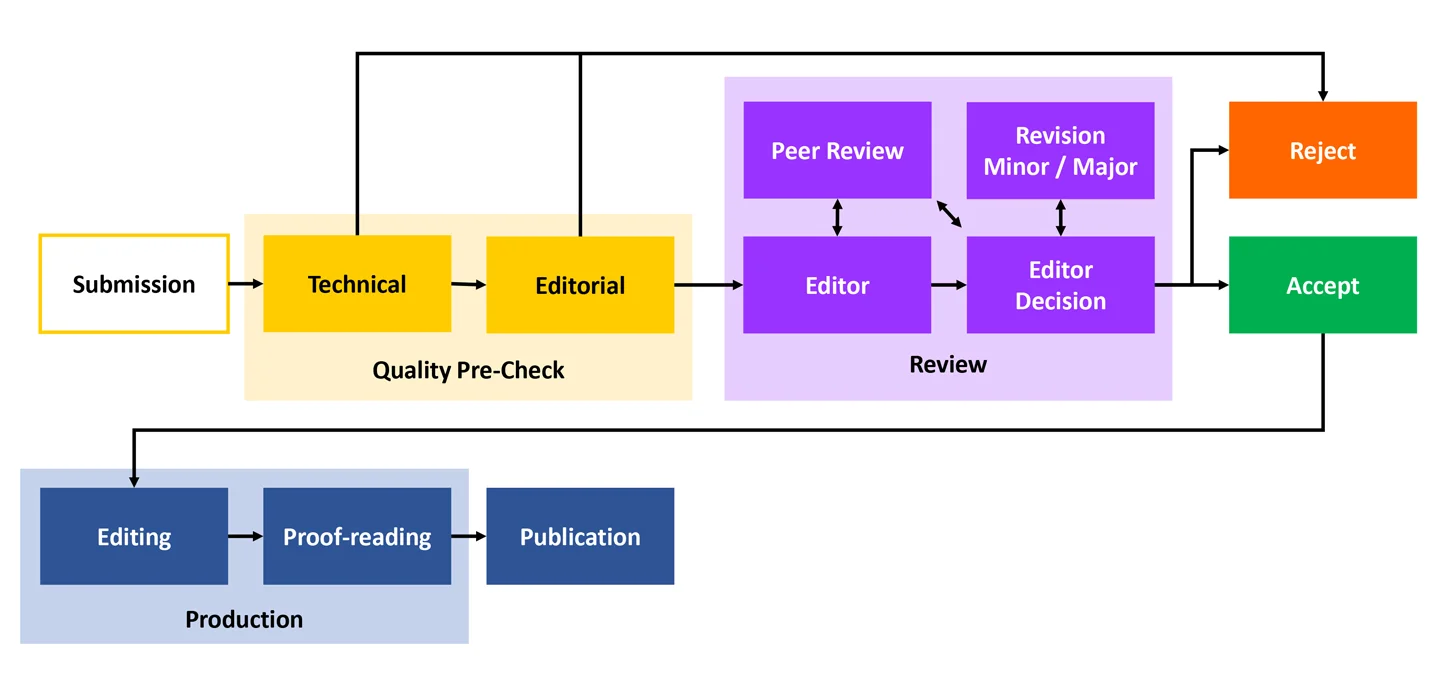
The Solarlits editorial process ensures a seamless transition from initial submission and pre-check, through rigorous peer review and editorial decision, to final production, proofreading, and global publication.
Manuscript Submission
Initial manuscript submission is processed exclusively through the TRACKLITS platform. Authors must provide all essential manuscript components, including a concise abstract, properly formatted text files, high-resolution figures, and comprehensive disclosures regarding funding and competing interests. Strict adherence to our Author Guidelines ensures a seamless transition into the editorial evaluation pipeline and prevents unnecessary processing delays.
Quality Pre-Check
Upon receipt, all submissions undergo a comprehensive technical screening by the editorial office to verify structural compliance and adherence to Author Guidelines. This includes a rigorous originality assessment via similarity detection software to uphold standards of scientific integrity. Manuscripts missing essential components, lacking proper formatting, or exhibiting unacceptable similarity scores are returned to the authors for correction prior to further consideration.
Once technical requirements are met, the manuscript is assigned to an Academic Editor with relevant domain expertise for an initial evaluation. The editor assesses the study's overall scientific merit, methodological soundness, novelty, and alignment with the scope of Solarlits. Manuscripts demonstrating sufficient potential impact advance to full peer review. Conversely, submissions with foundational flaws or those falling outside the journal's scope are promptly rejected without peer review (desk rejected) to allow authors to seek publication elsewhere in a timely manner.
Review
Solarlits operates a rigorous, single-blind peer review process to ensure an objective, equitable, and unbiased evaluation of all submitted research. Under strict confidentiality, the handling Academic Editor invites a minimum of two independent, external experts to critically evaluate the manuscript.
Reviewers are tasked with assessing the manuscript based on the following core criteria:
Originality and Significance: The novelty of the research, its contribution to the field, and its potential scientific impact.
Scientific Rigor: The robustness of the experimental design, the appropriateness of the methodology, and whether the framework robustly supports the authors' claims.
Reproducibility: The adequacy of methodological details and data availability to permit exact replication by other researchers.
Data and Conclusions: The accuracy of the data analysis and whether the conclusions are fully and logically supported by the results.
Literature and Context: The relevance, currency, and integration of cited research.
Presentation: The clarity of the prose, logical structure flow, and the technical quality of figures and tables.
Ultimately, reviewers are expected to provide constructive, actionable feedback to help authors refine and strengthen their work for publication.
Decision
Following peer review, the Academic Editor integrates expert recommendations with independent analysis to adjudicate the manuscript. Submissions may be accepted directly, returned for revision, or rejected due to critical scientific limitations. When revisions are mandated, authors are provided a timeframe to systematically address all feedback, after which the editor conducts a final evaluation to verify the issues are conclusively resolved.
Editorial decisions (revision, acceptance, or rejection) are made by the Academic Editor upon receipt of at least two peer-review reports. To avoid conflicts of interest, Editors are recused from evaluating their own submissions, which are instead managed by an alternative Editorial Board member.
Production and Publication
Upon formal acceptance, the manuscript enters production, where specialists handle language refinement, formatting standardization, and comprehensive proofreading prior to generating digital proofs. Following author approval, the definitive version is assigned a Digital Object Identifier (DOI) and immediately published open-access, maximizing global visibility and unrestricted availability.