
Fatemeh Baharlouei,1 Amirreza Ardekani,1 Hoda Homayouni,2,* Morteza Rahbar 3
Author affiliations
1 Department of Building, Faculty of Architecture and Urbanism, Shahid Beheshti University, Tehran, Iran
2 Department of Architecture, Faculty of Architecture and Urbanism, Shahid Beheshti University, Tehran, Iran
3 Department of Architecture, School of Architecture & Environmental Design, Iran University of Science and Technology, Tehran, Iran
*Corresponding author.
fa.baharlouei@gmail.com (F. Baharlouei)
a_ardakani@sbu.ac.ir (A. Ardekani)
h_homayouni@sbu.ac.ir (H. Homayouni)
rahbarm@iust.ac.ir (M. Rahbar)
History: Received 17 February 2026 | Revised 21 April 2026 | Accepted 26 April 2026 | Published online 26 June 2026
2383-8701/© 2026 The Author(s). Published by solarlits.com. This is an open access article distributed under the terms and conditions of the Creative Commons Attribution 4.0 License.
Citation: Fatemeh Baharlouei, Amirreza Ardekani, Hoda Homayouni, Morteza Rahbar, Intelligent Control Strategies for Kinetic Façades Using Artificial Neural Networks and Multi-Criteria Decision-Making: Achieving Energy Efficiency and Visual Comfort, Journal of Daylighting, 13:1 (2026) 347-362. doi: 10.15627/jd.2026.20
Abstract
Efficiently providing visual comfort and thermal performance in office buildings is critical for occupant well-being and environmental sustainability. Dynamic façade systems play a key role in regulating daylight, glare, and energy use, and numerous studies have investigated them. However, previous studies on dynamic façade control systems have primarily focused on either daylight optimization, glare prevention, or energy efficiency, often neglecting integrated solutions that address these objectives simultaneously. This study develops a hybrid framework that uses energy and lighting simulations, ANN-based surrogate modelling, and multi-criteria decision-making to optimize the hourly angles of external horizontal louvers in an office space in Yazd, Iran. A dataset of 3,200 daylighting samples and 25,740 hourly energy simulations is generated to train high-accuracy ANN models for real-time performance prediction. Furthermore, four intelligent control strategies, fuzzy logic, brute force search, weighted scoring, and Ev-based control, are implemented and compared against the conventional cut-off angle method. Results demonstrate that all AI-based strategies outperform the baseline in enhancing daylight availability, reducing glare, and improving energy efficiency. The weighted scoring system achieves the most consistent improvement across multiple performance indicators, improving daylight performance (sDA) by 10.6%, reducing glare by 55.9%, and lowering total annual energy consumption by 7.3%. The brute force search strategy maximizes daylight performance (48.4% sDA improvement) while maintaining effective glare control. These findings confirm that data-driven, multi-objective control strategies, supported by ANN surrogate models, enable real-time, adaptive façade operation, offering a scalable and energy-efficient solution for smart office buildings in challenging climates.
Keywords
kinetic façade, dynamic shading control, artificial neural networks, visual comfort, energy efficiency
Nomenclature
| AI | Artificial Intelligence |
| ANN | Artificial Neural Networks |
| DGP | Daylight Glare Probability |
| Ev | Vertical Eye Illuminance |
| Et | Task Illuminance |
| kWh | Kilowatt-Hours |
| LHS | Latin Hypercube Sampling |
| NSGA-II | Non-dominated Sorting Genetic Algorithm II |
| PCM | Phase Change Material |
| R2 | Coefficient of Determination |
| RBF | Radial Basis Function |
| rUDI | Ratio of Useful Daylight Illuminance |
| sDA | Spatial Daylight Autonomy |
| UDI | Useful Daylight Illuminance |
| WWR | Window-to-Wall Ratio |
1. Introduction
Human activities have significantly increased greenhouse gas emissions, driving substantial climate change impacts worldwide [1]. Rapid urbanization and population growth have further intensified global energy demand, underscoring the need to evaluate building energy use patterns to mitigate environmental degradation [2]. By 2050, energy consumption for heating and cooling in buildings is projected to rise by 7–40% relative to 2010 levels, highlighting the urgency of adopting energy-efficient design strategies [3].
A widely adopted strategy to reduce building energy demand involves regulating solar radiation through transparent façades.
In warm seasons, solar gains increase cooling loads, whereas in cold seasons, harnessing solar radiation reduces heating demand [4]. Beyond thermal performance, visual comfort is a critical aspect of occupant well-being and overall environmental quality, influenced by factors such as daylight availability, glare control, and light uniformity [5]. While solar radiation provides valuable natural lighting, the need for adequate daylight often conflicts with thermal performance goals [4]. This tension underscores the importance of kinetic shading systems capable of dynamically balancing solar heat gains with visual comfort requirements [6].
Solar shading devices, such as adjustable horizontal louvers, are commonly used to regulate solar heat gain and daylight penetration into buildings. However, manual operation of these systems frequently results in suboptimal performance due to inconsistent user behavior. Occupants may adjust blinds based on personal preferences, which may not align with energy-efficient or daylight-optimized solutions. To overcome these limitations, motorized shading systems are increasingly being integrated into smart building automation frameworks [7].
Across the literature, automatic shading control is generally classified into three major categories [8]:
- Open-loop control: Adjustments are made solely based on external data inputs (e.g., sun position, outdoor illuminance) and predefined thresholds, without real-time feedback from the indoor environment [9].
- Closed-loop control: Incorporates continuous sensor-based feedback from indoor conditions, such as illuminance, occupancy status, and perceived glare, enabling responsive, occupant-centred adjustments [10,11].
- Model-based control: Uses high-resolution simulations or surrogate models (such as ANNs) to anticipate future environmental conditions and optimize shading responses accordingly. This method can enable accurate estimation of indoor daylight and thermal conditions while maintaining adaptability to changing occupant needs [8].
The existing literature on dynamic façade control can be broadly categorized into three primary groups of strategies: (1) visual comfort–driven methods, which prioritize daylight availability and/or glare mitigation; (2) energy-focused approaches, which aim to reduce heating, cooling, and lighting loads; and (3) AI-driven and model-based control strategies, which employ predictive algorithms, surrogate models, or optimization frameworks to forecast indoor daylight, thermal loads, and glare, enabling the selection of shading configurations that can enhance comfort and energy performance.
1.1. Visual comfort–driven control strategies
A substantial body of research prioritizes glare mitigation and daylight quality in shading control, emphasizing occupant well-being. Toma et al. [12] implemented a cut-off–based strategy to mitigate glare, achieving a 26.1% reduction in energy use and removing the risk of glare. Conway et al. [13] applied an illuminance-threshold flowchart method that improved visual comfort while lowering cooling energy consumption by 25%. Fallahi et al. [14] used origami-inspired geometry to reduce glare significantly (DGP < 0.35) while maintaining adequate daylight. Sommese et al. [15] introduced a light-responsive smart polymer system inspired by the Gazania flower, which autonomously modulates façade openness to improve glare performance and enhance UDI/EUDI metrics. Brzezicki [16] tested a bi-sectional kinetic shading system across diverse climates, achieving a 61–148% improvement in visual comfort and validating the system with both simulations and physical mock-up testing. Yunitsyna and Sulaj [17] likewise used a biomimicry-based kinetic façade shading system to improve visual comfort and daylight performance of south-facing classrooms. Using ClimateStudio simulations and occupant survey data, they evaluated sixteen façade-operation scenarios and found that the best-performing options substantially reduced glare risk while maintaining adequate daylight availability for different studio activities. Their work further highlights the value of adaptive, activity-sensitive shading control in educational settings, where lighting needs vary across drawing, reading, writing, and computer-based tasks.
1.2. Energy-focused control strategies
Another group of studies places primary emphasis on reducing energy consumption, without considering glare risk or daylight quality. Kang et al. [18] developed a multi-objective strategy for reducing heating, cooling, and lighting energy loads, achieving nearly 30% energy savings in simulations. Nicoletti et al. [19] applied cut-off–based mechanisms to regulate solar transmittance even under diffuse conditions. In another study, Nicoletti et al. [20] investigated a solar shading control strategy based on IoT devices to reduce energy requirements. The proposed system reduced cooling energy demand by about 50%, and it can reduce lighting energy by up to approximately 30%. Ieracitano et al. [21] expanded on AI-based louver optimization but did not explicitly incorporate daylight or glare indicators into their model. More advanced optimization techniques have emerged in recent years. Zhang et al. [22] proposed an iterative, co-simulation-based approach integrating Python and EnergyPlus, resulting in 7.3–12.5% energy savings while still preserving acceptable visual comfort. Čekon et al. [23] introduced a PCM-integrated double-skin façade that reduced cooling loads by up to 20% and delayed peak temperatures by 2 hours, demonstrating the potential of envelope-integrated thermal storage systems. Fattah et al. [24] proposed a cactus-inspired multifunctional bio-kinetic façade assessed through a novel energy-simulation framework. Their results showed improvements in cooling energy efficiency, CO2 emissions, and operational cost, with reported reductions ranging from 25% to 67% depending on opening angle and climate conditions.
1.3. AI-driven and model-based control strategies
Model-based control has emerged as a transformative direction in adaptive façade management, enabling the simultaneous optimization of daylight, glare, and energy performance. Surrogate models replace computationally intensive simulations, enabling rapid and accurate prediction of daylighting and energy outcomes for real-time control. Nicoletti et al. [7] applied an ANN model to predict optimal louver configurations, achieving substantial reductions in heating and cooling loads while improving UDI performance. Yeon et al. [25] demonstrated that ANN-driven internal louvers can outperform fixed-angle configurations by 20–27% in total energy savings. Luo et al. [11] developed hybrid ANN–RBF models for predictive control. Their approach reduced discomfort glare to zero during test days, maintained acceptable daylight conditions at 96% of workstations, and reduced lighting demand by up to 77%. Experimental and comparative studies have provided additional insights. Luo et al. [26] also introduced a model-based control framework, integrating ANN models with RBF-based optimization techniques. This system adjusts blinds to improve visual comfort using a newly defined parameter, rUDI, to ensure effective daylight utilization and prevent excessive glare. Yi et al. [27] compared ANN-controlled louvers with SMA-driven passive mechanisms, showing that AI-based systems deliver superior responsiveness and thermal comfort compliance.
Recent studies have further extended model-based adaptive façade control through multi-objective optimization, physics-informed feature selection, and reinforcement learning. Manesh et al. [28] developed a multi-objective control framework for a non-conventional adaptive façade, using machine learning models such as Extra Trees to predict Et and Ev. This approach employed NSGA-II to balance glare reduction and daylight utilization in real-time, offering a significant improvement over prior approaches constrained to fixed geometries and single-objective control. Takhmasib et al. [29] combined a hexagonal kinetic façade with machine learning for real-time glare prediction using a dataset of 20,000 Radiance simulations. Other model-based approaches include Shen et al. [11], who used surrogate numerical optimization to achieve optimal façade states in under one minute, and Tabadkani et al. [30,31], who developed preference-based fuzzy–genetic systems and large-scale parametric evaluations exploring thermal and visual comfort across multiple climates. Luo et al. [32] further confirmed that solar altitude, azimuth, and direct illuminance are the most influential variables for predicting Ev, reinforcing the value of physics-aware feature selection for predictive shading control. Li et al. [33] introduced a self-learning, real-time reinforcement-learning control strategy that interacted with the environment to find an optimal state for each façade element. The proposed controller effectively maintained horizontal and vertical illuminance within comfort range in 72.92% of test points in occupied spaces, while keeping DGP below 0.35, a level generally considered imperceptible. Wang et al. [34] used a two-stage surrogate-based optimization framework, integrating machine learning-based surrogate models with optimization algorithms, to develop a kinetic façade system. Performance analyses showed improvements in daylight distribution, thermal regulation, and glare mitigation.
Most existing studies on adaptive façade control optimize daylighting, glare, or energy performance individually, with relatively few addressing these objectives simultaneously. This research presents an intelligent control framework that integrates ANN-based surrogate models with multi-criteria decision-making to jointly improve visual comfort, including daylighting and glare, and energy efficiency. The framework dynamically adjusts external horizontal louvers to enhance daylight availability, reduce glare, and minimize total building energy use. Using these surrogate models, four intelligent control strategies—fuzzy logic, brute force search, weighted scoring, and Ev-based control—are developed and tested for their ability to balance visual comfort and energy demand.
The remainder of this paper is organized as follows. Section 2 describes the research methodology, including the case study, simulation framework, and ANN modelling approach. Section 3 presents and discusses the results of the proposed control strategies. Section 4 provides a comparative analysis of the control methods. Finally, Section 5 concludes the paper and outlines directions for future research.
2. Methodology
The primary objective of this study is to propose a simulation-based platform for optimizing the orientation angles of external horizontal louvers in an office space in Yazd, Iran, with respect to two key performance indicators: visual comfort (including glare and daylighting) and energy consumption. This optimization occurs on an hourly basis throughout the annual occupancy period.
To achieve this goal, a hybrid methodology is adopted, integrating numerical simulations using Ladybug Tools, ANN-based surrogate models for predicting daylight and energy performance, and multi-criteria decision-making techniques to adjust louver angles for optimal façade performance dynamically. This integrated framework enables accurate, real-time control of the kinetic façade system while significantly reducing computational demands.
The overall research framework consists of four major stages:
- Simulation Setup: Defining the building geometry, shading system characteristics, climate data, and boundary conditions.
- Training AI Models: Developing two separate ANN models to predict: Daylight performance indices (rUDI and Ev) and Hourly total energy consumption (cooling, heating, and lighting).
- Designing Control Strategies: Implementing four intelligent control strategies to determine the optimal louver angle at each time step.
- Performance Evaluation: Comparing the visual comfort and energy efficiency outcomes of the proposed control strategies against each other and with the conventional cut-off angle control strategy.
An illustration of this framework is shown in Fig. 1.
Figure 1
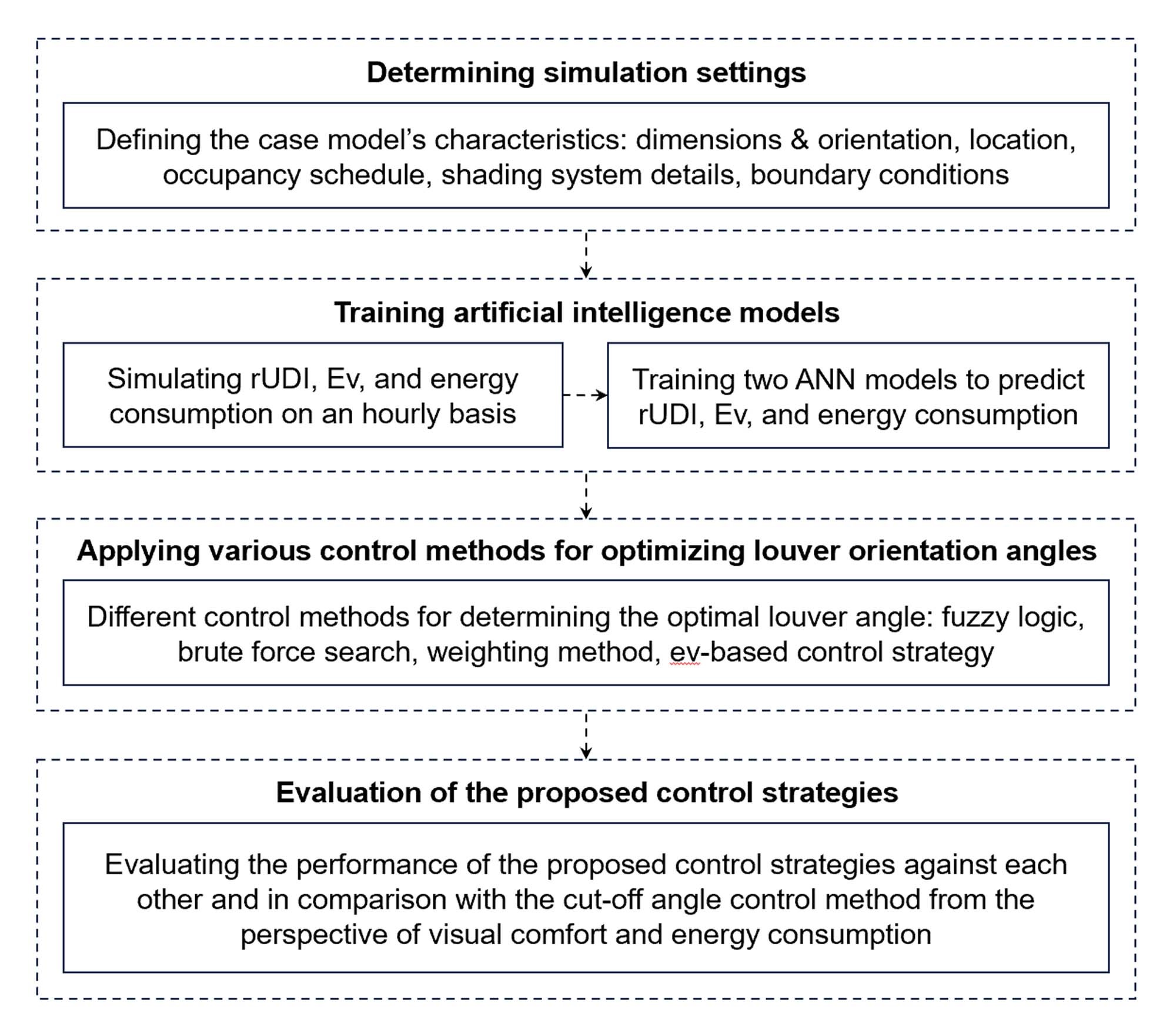
Fig. 1. Scheme of the methodology.
2.1. Case study
The case study focuses on an open-plan office space with dimensions of 6 m (width) × 8 m (depth) × 3.5 m (height), oriented along a north–south axis and located in Yazd, Iran (Fig. 2). These geometric characteristics are selected based on typical office space configurations commonly used in Iranian office buildings. The space features a south-facing window equipped with an external kinetic shading system, with a WWR of 0.7, reflecting the prevalent use of relatively large glazed areas in office façades to enhance daylight availability. Occupancy schedules are defined from Monday to Friday, between 08:00 AM and 05:00 PM, corresponding to standard working hours in office buildings in Iran. This schedule is integrated into the simulation process.
Figure 2
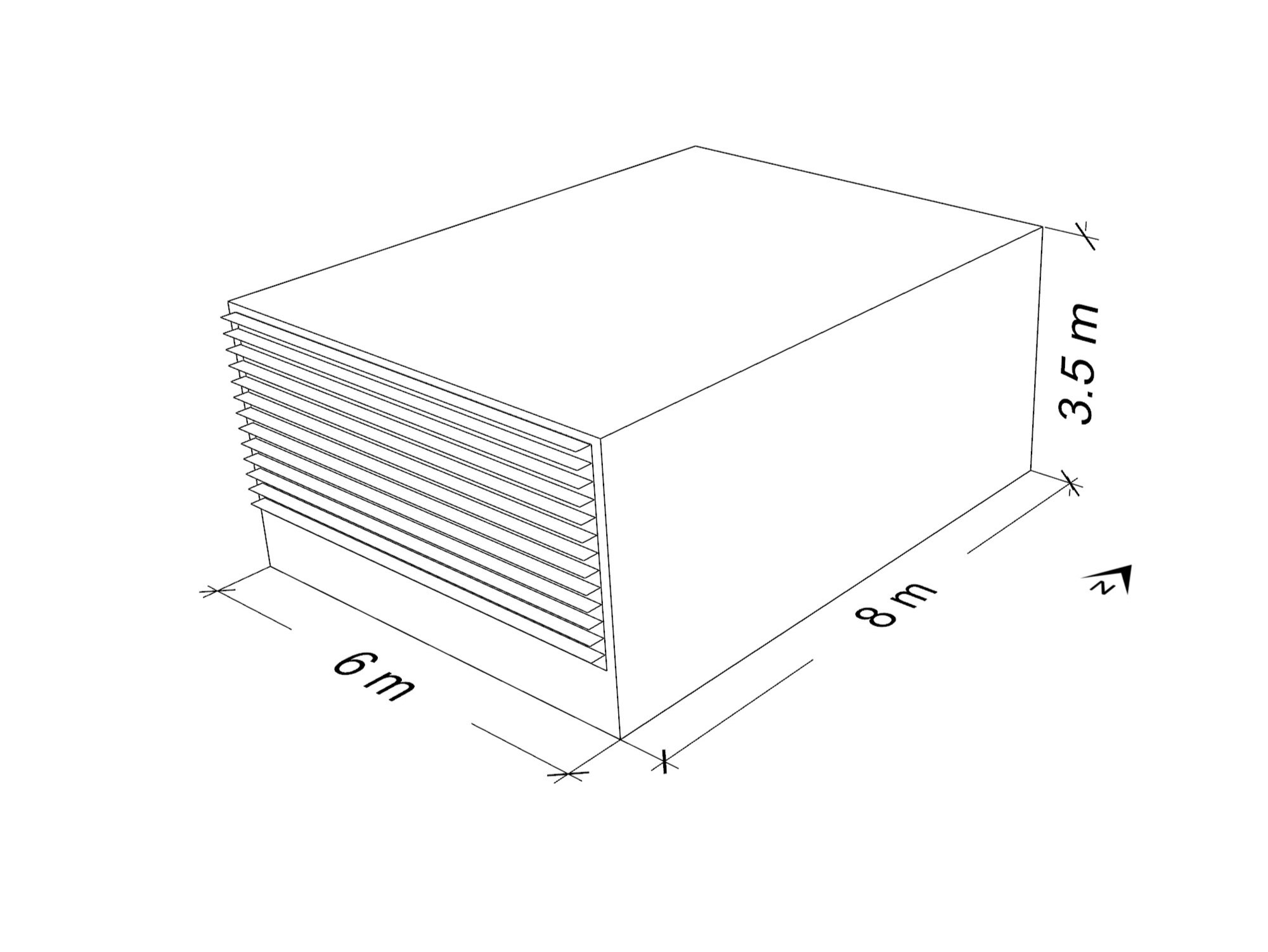
Fig. 2. Case study model.
This study focuses on horizontal louvers because they are widely used in south-facing façades.
Restricting the analysis to a single shading typology enables a more controlled evaluation of the trade-offs among daylighting, glare, and energy performance. Although the inclusion of multiple shading archetypes could broaden the scope of the study, it would also introduce additional variables that could obscure the isolated effect of the control strategy. By keeping the façade typology constant, the influence of the proposed control methods can be assessed more precisely. The studied space is equipped with an external shading system comprising 13 horizontal louvers, each 20 cm in depth, spaced at 20 cm vertical intervals. Louver orientation can be adjusted hourly to dynamically respond to solar conditions and occupant comfort needs, with all louvers moving in unison. Louver tilt angles can vary within a range of –40° to +60°, in 10° increments, resulting in 11 discrete positions. This angular range is defined based on solar path analyses performed using Climate Consultant software. The analysis is used to exclude louver angles that would permit direct solar radiation during warm periods of the year, when such penetration is undesirable due to its adverse impact on both visual comfort and energy consumption. In addition, angles below the winter solstice are removed from the control domain. As a result, the selected angular range includes only solar-relevant configurations, reducing the solution space while ensuring effective solar protection throughout the year (Fig. 3). Details regarding the spatial configuration and shading system geometry are summarized in Table 1.
Figure 3
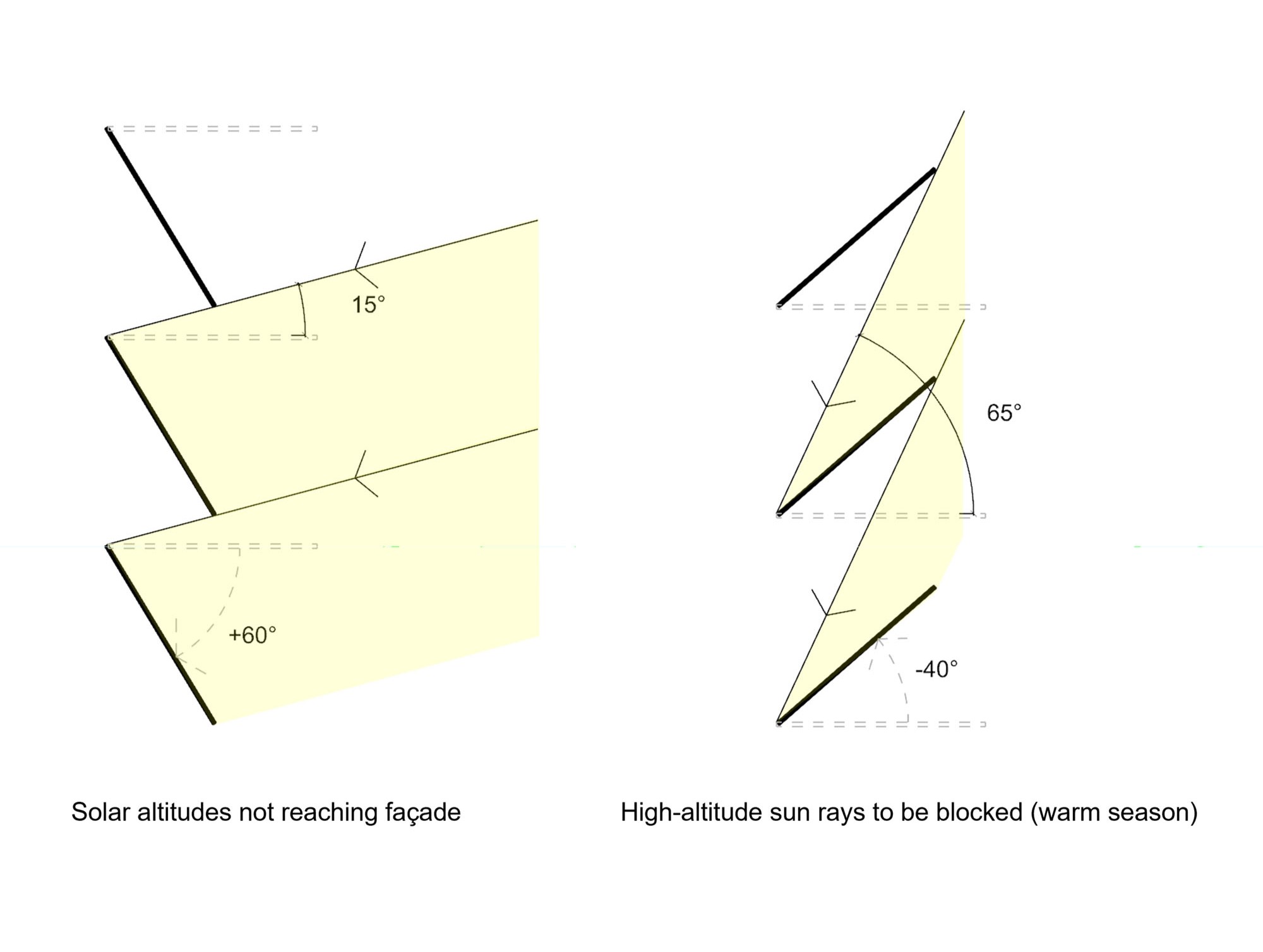
Fig. 3. Operational range of louver tilt angles.
Table 1
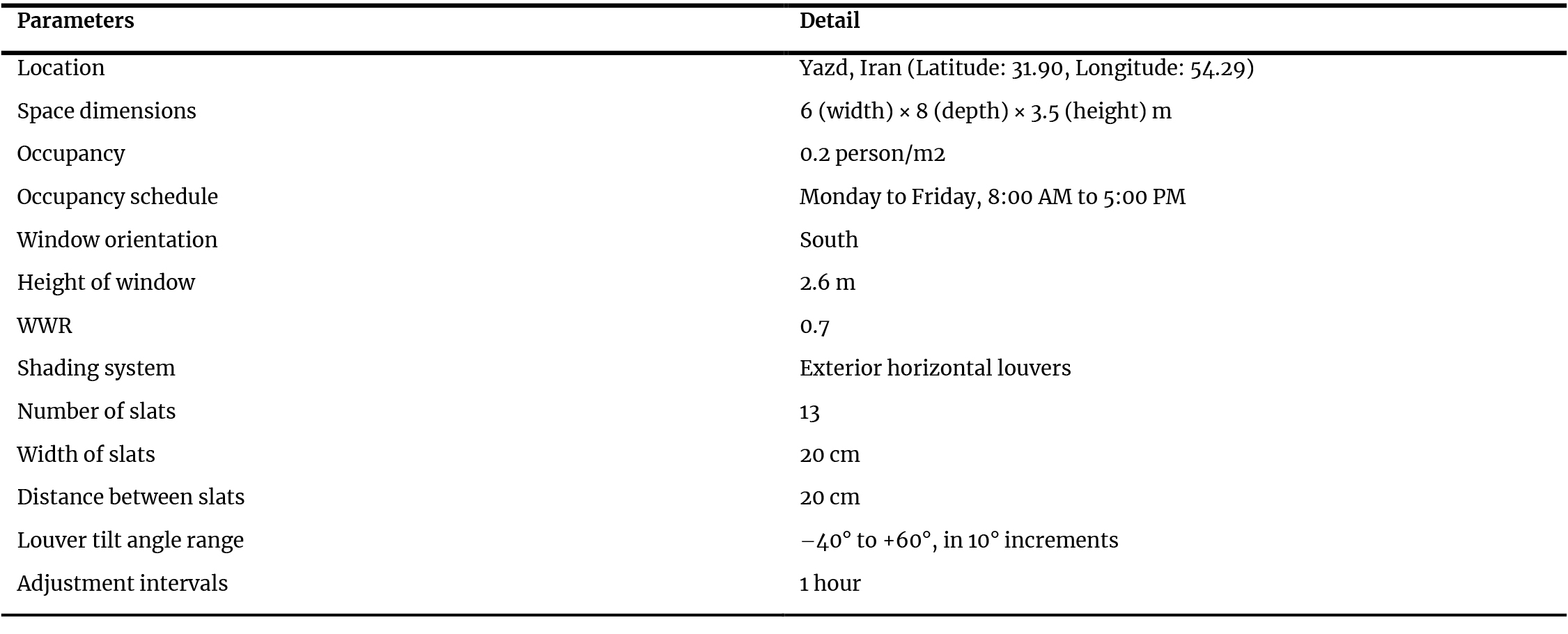
Table 1. Case study characteristics.
2.2. Simulation
Parametric simulations are conducted to generate datasets for daylighting performance (Ev and rUDI) and energy consumption. The simulation domain consists of 25,740 hourly configurations, corresponding to all occupied hours of a year combined with the discrete louver angle settings.
Due to the high computational cost of hourly daylighting simulations, Latin Hypercube Sampling (LHS) [35] is used to select 3,200 representative samples from the complete set of configurations. This number is initially selected based on computational feasibility, and its sufficiency is subsequently confirmed through ANN training and validation, as the trained models achieve acceptable predictive accuracy. In contrast, energy performance simulations are computationally less demanding; therefore, energy consumption is simulated for all 25,740 hourly configurations corresponding to the annual occupancy period.
The 3D building model is developed using Rhino, and Grasshopper is utilized for parametric modelling. The Ladybug Tools v1.8.15 plugin, comprising Honeybee and Ladybug, is used within Grasshopper to conduct environmental simulations. Daylighting analysis is performed using the Radiance engine, while energy performance simulations are carried out using the OpenStudio engine.
For the purposes of thermal simulation, all walls of the space are modelled as adiabatic, except for the south-facing wall, which has a thermal resistance (R-value) of 1.1 m²·K/W. The glazing used for the window has a thermal transmittance (U-value) of 3.1 W/m²·K and a solar heat gain coefficient (SHGC) of 0.55. For the daylight simulation, interior surface reflectance values are set as follows: walls at 0.5, ceiling at 0.7, floor at 0.2, and louvers at 0.35. The visible light transmittance (Tv) of the glass is 0.71. These characteristics of the building are determined in accordance with the requirements of Chapter 19 of the Iranian National Building Regulations.
Daylight analysis settings in Radiance follow Chapter 19 of the Iranian National Building Regulations, with ambient bounces (ab) set to 6 and ambient divisions (ad) set to 1000. Energy simulation settings follow ASHRAE 90.1 standards, as summarized in Table 2.
Table 2
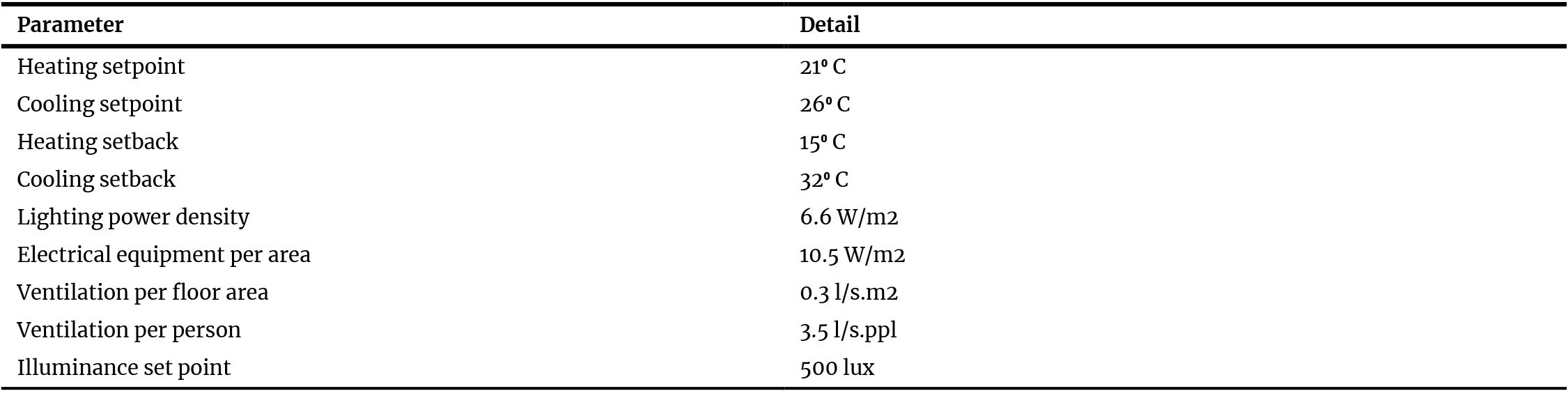
Table 2. Energy simulation parameters.
2.3. Simulation outputs
The outputs generated from the simulation process are: daylighting performance indicators (rUDI500-2000 and Ev) and hourly total energy consumption (cooling, heating, and lighting).
The UDI index is a daylight metric that calculates the percentage of annual occupied hours during which the illuminance level at a given point falls within an acceptable range [36]. This study investigates real-time louver adjustments on an hourly basis, so a dynamic version of UDI referred to as rUDI is adopted [26]. This metric calculates the proportion of sensors located on the work plane receiving illuminance between 500 and 2000 lux at each time step, providing an instantaneous assessment of daylight quality across the space.
The formula used to calculate rUDI is as follows:
Where G500−2000lux is the number of sensors receiving illuminance between 500 and 2000 lux and Gtotal is the total number of sensors placed in the space.
Ev is selected as the metric for assessing glare risk within the space. Numerous studies have investigated the correlation between Ev and visual perception by occupants, demonstrating that Ev provides a reliable performance in predicting glare [37-39]. Additionally, computing Ev involves significantly less computational complexity than simulating more advanced glare indices like DGP, making it a practical and efficient indicator for assessing glare. Ev is widely adopted as a simplified criterion in the control of dynamic shading systems [11,30,32].
According to Lue et al., the acceptable threshold for Ev can be derived using the simplified Daylight Glare Probability (DGPs) index proposed by Wienold [40]:
To avoid disturbing glare inside the space, the DGP value should remain below 0.35. By applying reverse calculations based on this criterion, the corresponding glare threshold for Ev is determined to be 2670 lux.
In this study, Ev is simulated under the assumption that users' line of sight is parallel to the façade, as is typical in office layouts. The spatial arrangement considered in the simulation, including furniture placement and viewing direction, is illustrated in Fig. 4 as a common and widely used arrangement for office spaces.
Figure 4
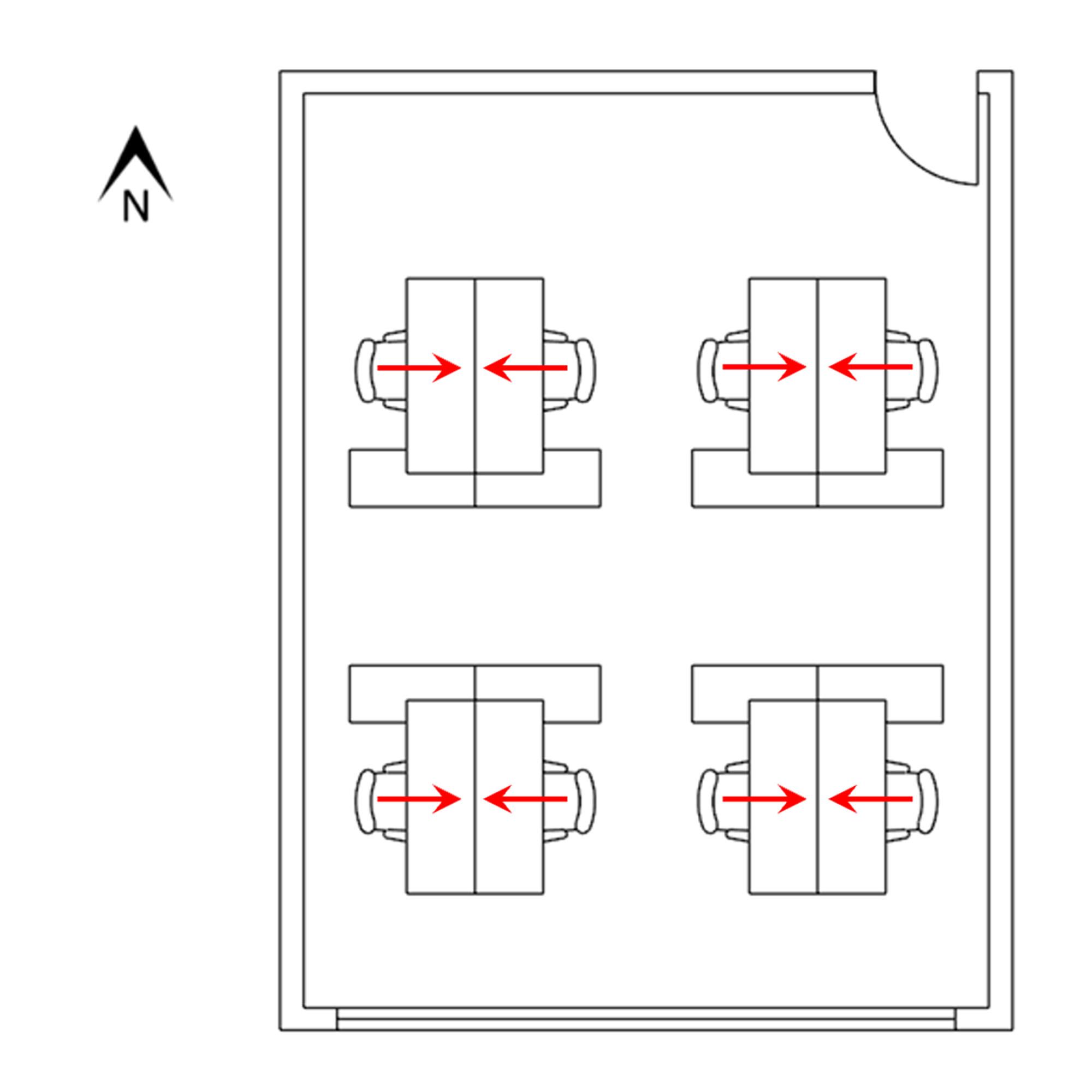
Fig. 4. Furniture placement and viewing direction.
To simulate Ev, a sensor grid consisting of 108 points was used. The simulation considered two primary viewing directions: eastward and westward, based on furniture layout and window position. For each sensor point, two independent Ev values are recorded corresponding to these two viewing directions. This approach generated 216 output data points per simulation run (108 sensors × 2 directions). During the post-processing stage, the maximum Ev value among the 216 recorded data points is extracted for each hourly time step. Employing a sensor grid and calculating the peak Ev at each time step ensures that variations in spatial arrangements and furniture placements are adequately accounted for.
For the rUDI and Ev simulations, sensor placement followed the national guidelines outlined in Chapter 19 of the Iranian National Building Regulations, which prescribe a sensor spacing of 60 cm and wall offsets between 30 cm and 60 cm. For work plane illuminance (rUDI), sensors were positioned 30 cm from the walls to provide a representative assessment of usable daylight distribution. For Ev measurements, sensors were placed 60 cm from the walls to better represent the eye position of a typical seated occupant and to avoid overemphasizing extreme glare values near the façade. The sensor placement details are summarized in Table 3.
Table 3

Table 3. Sensor placement.
The hourly rUDI and peak Ev values are used to train the daylight ANN model, enabling real-time assessment of daylight availability and glare under dynamic shading control.
To evaluate the energy performance, the total hourly energy consumption (cooling, heating, and lighting energy use) is simulated in kilowatt-hours (kWh). This metric is used for training the energy ANN model developed to estimate energy consumption in this study.
2.4. ANN models
In this study, two ANN models are employed in Python using TensorFlow and Jupyter Notebook to predict hourly daylight availability, glare risk, and energy consumption, thereby enabling the optimization of kinetic shading configurations at short time intervals. These predictions are subsequently used to identify the optimal louver angle at each time step.
ANN is a branch of AI that learns patterns from training data and applies this knowledge to generate accurate predictions based on new input data [41]. They have been widely used in building performance assessment, and due to their high accuracy and computational efficiency, ANNs have proven to be an effective machine learning technique in this field [42,43]. ANNs consist of multiple layers, each composed of processing units known as neurons. Networks typically include an input layer that receives the input data, hidden layers that perform internal computations and feature extraction, and an output layer that produces the final predicted output [44]. Two developed ANN models are:
- Daylight Model: to predict the hourly peak Ev and rUDI.
- Energy Model: to predict the hourly total energy use.
Although the energy performance of the space is simulated for the entire year, an ANN-based model is developed to support predictive control under varying conditions. The annual simulations provide a comprehensive dataset; however, real-time façade control requires rapid energy estimation under conditions that may differ from the simulated scenarios. The energy model enables fast and reliable prediction of hourly energy consumption, without the computational burden of running full simulations. This approach is particularly essential for implementing intelligent control strategies that require frequent decision-making and adaptability throughout the year.
Table 4 represents the input variables of both ANN models. Climate parameters are extracted from the EPW file IRN_YA_Yazd.Sadooghi.Intl.AP.408210_TMYx.2009–2023.
Table 4
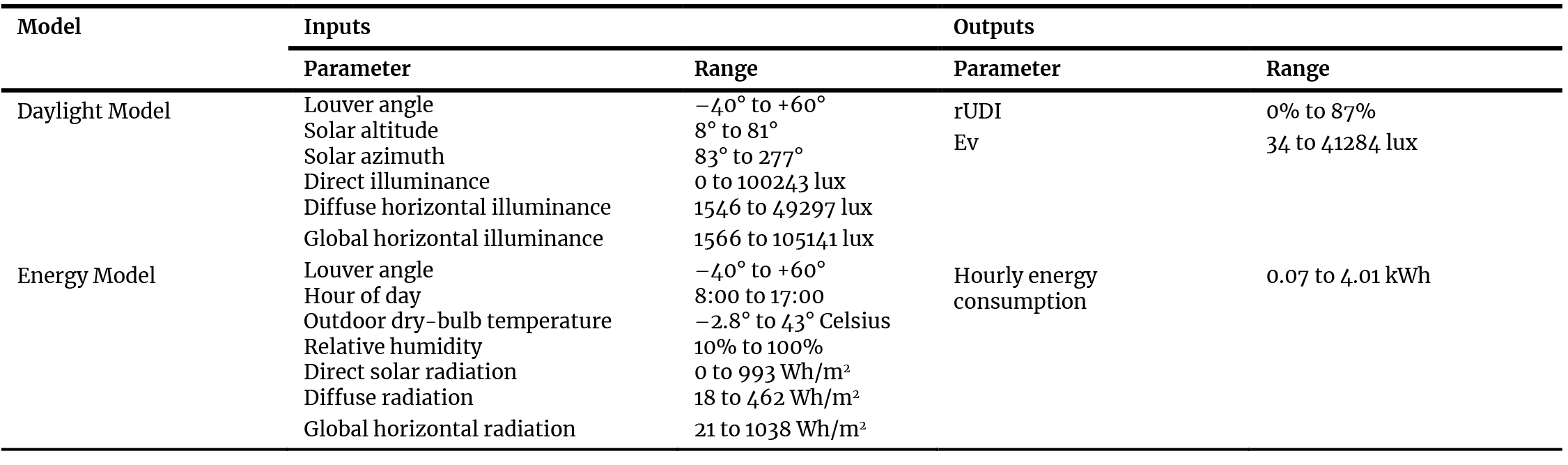
Table 4. ANN models’ details.
2.5. Control strategy
The control strategy applied to the horizontal kinetic louvers is based on occupancy status. When occupants are present, louver orientation is dynamically adjusted using the introduced intelligent control strategies. In contrast, when the space is unoccupied, the louver angles are set based on seasonal conditions and solar irradiation levels. In Fig. 5, the used control strategy is illustrated.
Figure 5
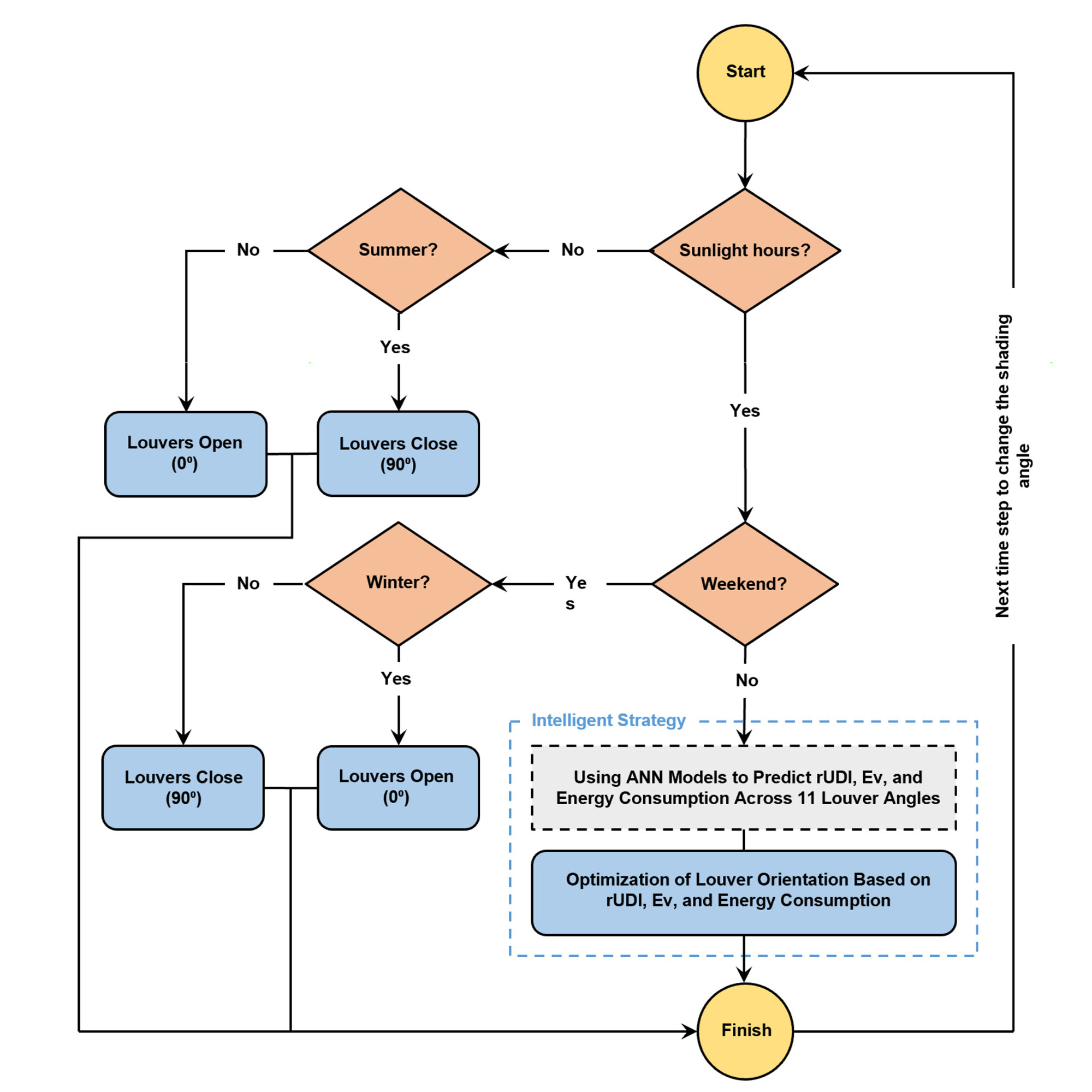
Fig. 5. Kinetic shading control strategy.
After developing the AI models, four strategies are designed to adjust louver angles dynamically. These strategies, which aim to enhance visual comfort and energy efficiency simultaneously, are introduced below and explained in detail in the subsequent sections:
- fuzzy logic control
- brute force search
- weighted scoring
- Ev-based control
2.5.1. Fuzzy logic control
Fuzzy logic is a multi-valued reasoning approach that allows truth values to range between 0 and 1, representing degrees of truth rather than strict binary outcomes [45]. This makes it especially useful in modeling complex systems where uncertainty and imprecision are present. Introduced by Lotfi Zadeh (1965) [46] through the theory of fuzzy sets, this method has been widely adopted in intelligent control strategies for buildings [30,47,48].
Input variables are each categorized into three fuzzy sets: Low, Medium, and High. The output is a performance score indicating the suitability of a given louver configuration. Then, eleven if–then rules are developed to assess and rank louver configurations. Key principles include:
- Prioritizing glare reduction (Ev)
- Maximizing daylight availability (rUDI)
- Minimizing energy use
Example rule:
- If Ev = Low, Energy = Low, and rUDI = High → System Performance = High
If glare exceeds acceptable levels (Ev > 2670 lux), the system automatically downgrades the configuration regardless of other indicators.
In the last stage, the Center of Gravity method is used to convert fuzzy outputs into a numeric score between 0 and 100, enabling direct comparison and selection of the best louver angle at each time step.
2.5.2. Brute force search
The brute force search algorithm is a systematic and deterministic method used in this study to identify the optimal louver angle configuration. This approach evaluates every possible configuration and selects the ones that best meet the objectives, ensuring that no potentially optimal solution is missed [49].
In this study, the brute force search is applied following these steps:
- Filtering by visual comfort: All configurations with Ev > 2670 lux are excluded to avoid discomfort glare.
- Selecting for daylight availability: Among the remaining configurations, the one with the highest rUDI value is selected to ensure sufficient natural light.
- Optimizing for energy efficiency: If multiple configurations have similar rUDI values, the one with the lowest energy consumption is chosen.
- Fallback mechanism: If all configurations exceed the Ev threshold, the one with the lowest maximum Ev is selected to minimize glare impact while allowing some daylight penetration.
2.5.3. Weighted scoring
The weighted scoring Method is a widely used multi-criteria decision-making (MCDM) technique. It is valued for its simplicity, transparency, and ease of implementation in optimization problems involving multiple conflicting objectives [50].
The process of finding the best louver angle involves three main steps:
- Glare Filtering: All configurations with Ev > 2670 lux are excluded from consideration to ensure visual comfort.
- Normalization: The remaining configurations are evaluated using normalized values of rUDI and energy consumption to allow fair comparison. Both metrics are scaled into the range [0,1] using the formula:
This ensures that both criteria contribute equally to the final evaluation while preserving their relative ranking.
- Scoring Function: A weighted scoring function is developed to balance daylight availability and energy use (Since higher rUDI and lower energy use are desirable, the energy term is assigned a negative coefficient to reflect this trade-off.):
- S: Final score
- rUDInorm: Normalized daylight index
- Enorm: Normalized energy consumption
The configuration achieving the highest score at each time step is selected as the optimal louver angle.
In the base case, equal weights are assigned to rUDI and energy consumption to represent a neutral design scenario in which both criteria are treated as co-objectives. To evaluate this assumption, additional weighting combinations were tested, ranging from energy-dominant to daylight-dominant cases. The resulting façade configurations were then compared using annual total energy consumption, sDA, and mean Ev. The results revealed a clear trade-off between energy performance and daylight availability. Increasing the weight assigned to energy reduced annual total energy consumption and mean Ev, but also decreased sDA. Specifically, the daylight-oriented case (Energy/rUDI = 0.1/0.9) achieved the highest sDA (97%) but higher energy use (2706 kWh), whereas the energy-oriented case (Energy/rUDI = 0.9/0.1) achieved the lowest energy use (2583 kWh) and lowest mean Ev (2187), but at the expense of substantially lower sDA (65%). The equal-weight case (0.5/0.5) yielded intermediate performance (annual energy consumption of 2635 kWh, 73% sDA, and mean Ev of 2315), and is therefore adopted as a balanced reference scenario rather than a universally optimal weighting. These findings indicate that the preferred weighting should be selected according to project-specific priorities regarding energy efficiency and daylight performance.
2.5.4. Ev-based control
The Ev-based control strategy, adopted from Lue et al., represents an alternative method for dynamically adjusting horizontal louver angles based only on Ev, an indicator of glare risk, without directly considering energy performance. In this strategy, all louver configurations resulting in Ev > 2670 lux are excluded from consideration. Among the remaining options, the configuration that yields the highest Ev value below the discomfort threshold is selected. This ensures maximum daylight availability while preventing visual discomfort, thereby increasing occupant satisfaction with indoor lighting conditions. In cases where all available configurations produce Ev values above the threshold, the one with the lowest peak Ev is chosen to minimize glare impact while still allowing some level of daylight penetration into the space.
2.5.5. Baseline control method: cut-off angle approach
One of the most commonly used strategies for controlling horizontal louvers is the cut-off angle method, which determines louver orientation to prevent direct solar radiation from entering the interior space [51-53]. This approach calculates the tilt angle of the louvers based on the sun’s position, ensuring that sunlight is fully blocked during intense solar hours.
The cut-off angle is calculated using the following formula [51]:
Where:
- βcut-off: Cut-off angle of the louvers
- Ω: Solar profile angle
The solar profile angle is computed as [52]:
Where:
- θaltitude: Solar altitude angle
- θazimuth: Solar azimuth angle
- θsurface: Surface orientation angle (relative to south)
Although widely adopted due to its simplicity and intuitive logic, studies have shown that this method alone is not sufficient for comprehensive visual comfort control, as it neglects diffuse daylight conditions and sky context [8]. Additionally, it does not account for energy performance, focusing solely on blocking direct sunlight.
In this study, the proposed intelligent control strategies are compared against the cut-off angle method to evaluate their effectiveness in improving both visual comfort and energy efficiency. The comparison aims to determine whether incorporating daylight, glare risk, and energy consumption into real-time façade control leads to significant improvements in indoor environmental quality and building energy use.
3. Results
3.1. ANN training
To develop high-performing surrogate models for predicting daylighting and energy performance indicators used in louver angle optimization, a hyperparameter tuning process is conducted. ANN models are optimized using a grid search method that systematically evaluates combinations of key architectural and training parameters. The objective is to identify model configurations that minimize prediction error while ensuring strong generalization capability on unseen data. Performance evaluation of ANN models is carried out using R² and MAE metrics.
Table 5 presents the ANN architecture details for the best daylight and energy prediction models.
Table 5
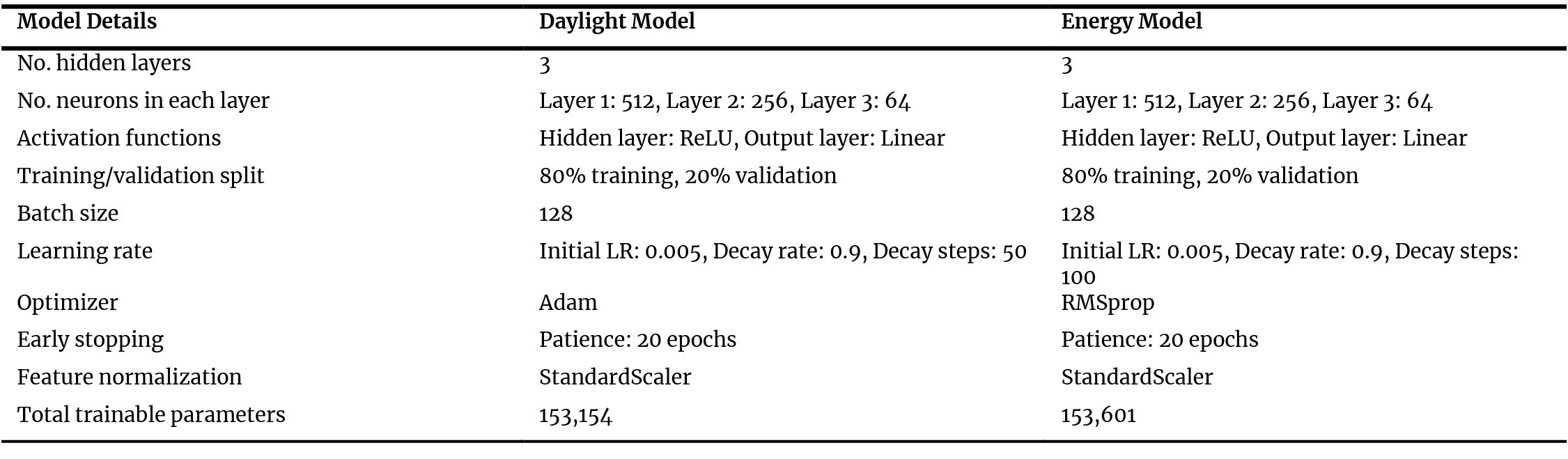
Table 5. Architecture of the ANN models used for daylighting and energy prediction.
The daylight prediction model aims to simultaneously predict two daylight performance metrics: rUDI and Ev. R² and MAE are calculated separately for each output variable to allow direct comparison of model accuracy across both indices. The daylight model with the highest overall accuracy is selected for integration into the control framework, achieving an R² of 0.98 for rUDI and 0.80 for Ev. Although Ev shows slightly lower accuracy, likely due to its higher variability and skewed distribution, the model still provided reliable predictions suitable for real-time façade control.
The lower R² obtained for Ev indicates that glare-related predictions are less reliable than those for rUDI, which may affect control strategies that rely directly on Ev, including the fuzzy logic, brute force search, and Ev-based control approaches. In real-time operation, this may occasionally lead to under- or overestimation of glare intensity and, consequently, to less consistent façade adjustments, particularly during periods of strong direct solar exposure. This behaviour is likely related to the training data distribution, in which low Ev values are more strongly represented than high-glare cases. Accordingly, results related to Ev should be interpreted more cautiously than those based on rUDI. Future work could improve Ev prediction by enriching the dataset with more high-glare cases and by exploring alternative architectures better suited to temporally dynamic solar conditions, such as recurrent neural networks (RNNs), including long short-term memory (LSTM) networks.
In parallel, an energy model is trained to predict hourly total energy consumption. The best model, which has the highest performance among all tested models, achieves an R² of 0.98 with a low MAE, confirming its suitability for real-time energy performance prediction.
3.2. Control strategies evaluation
3.2.1. Daylighting performance assessment
To evaluate the performance of control strategies in terms of daylight availability, two key daylight performance indicators are analyzed:
- UDI500–2000: The percentage of annual occupied hours during which illuminance levels fall within the acceptable range of 500 to 2000 lux [36].
- sDA300/50%: The proportion of floor area that receives at least 300 lux for at least 50% of annual occupied hours [54].
These indicators are simulated using Ladybug Tools.
The performance of UDI500–2000 across different control strategies is illustrated in Fig. 6 (spatial distribution maps) and summarized in Table 6 (mean UDI values across all sensors).
Figure 6
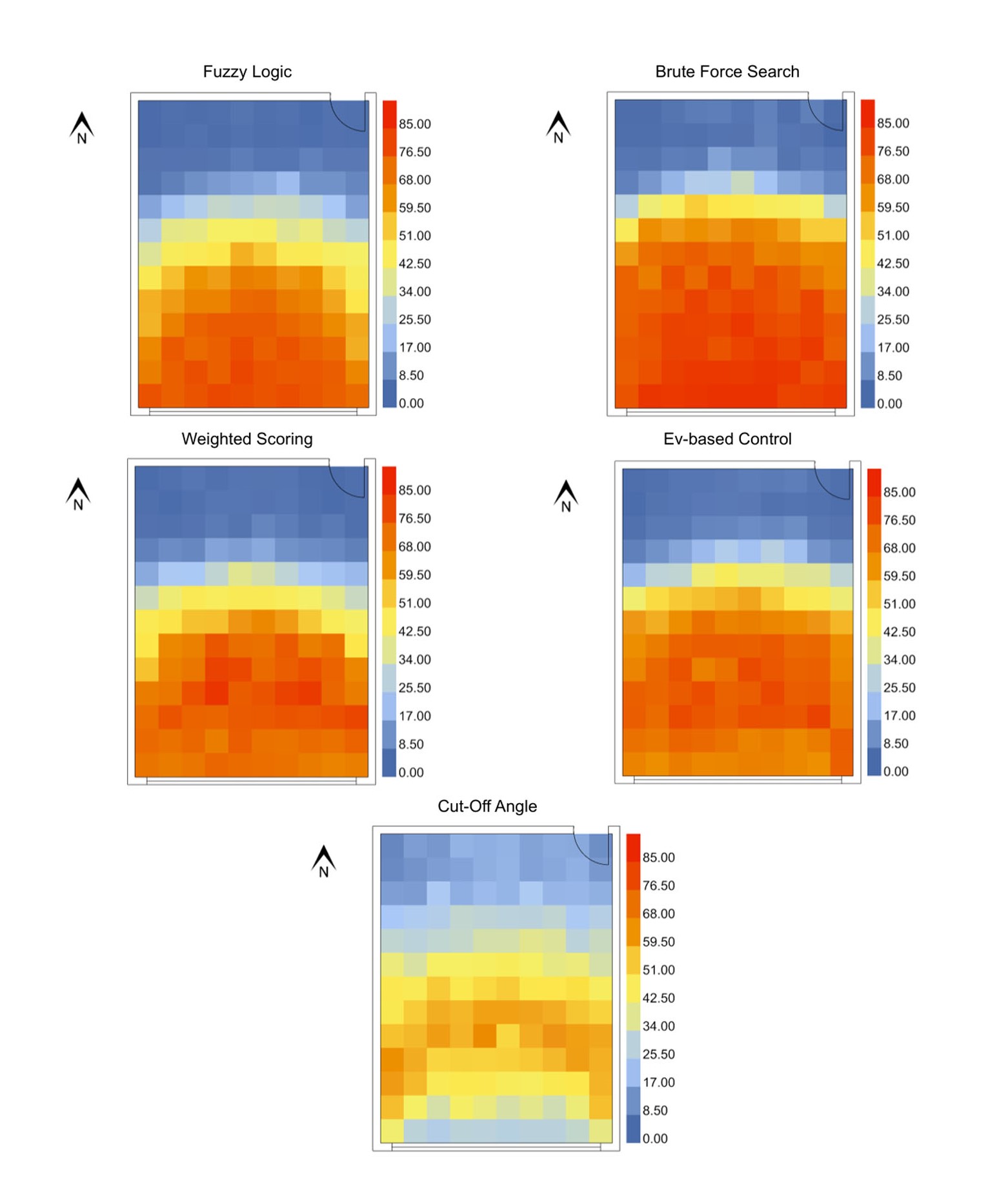
Fig. 6. Spatial distribution maps of UDI500–2000 for different control strategies.
Table 6

Table 6. Mean UDI values across all sensors for different control strategies.
Among the evaluated methods, the brute force search approach achieves the highest performance, with a mean UDI500–2000 of 50%. This is followed by Ev-based control (45%), weighted scoring (41%), and fuzzy logic (40%). By contrast, the Cut-Off Angle method has the lowest performance (35%). Nevertheless, this strategy provides the most uniform illuminance distribution across the space, resulting in reduced spatial contrast compared to the other control approaches.
The sDA300/50% metric across different control strategies is summarized in Table 7. According to the results, the brute force search method achieved the highest sDA value (0.98). This is followed by the Ev-based control strategy (0.82), weighted scoring (0.73), and Fuzzy Logic control strategy (0.69), showing lower performance in daylight distribution. The cut-off angle method yielded the lowest sDA value (0.66).
Table 7

Table 7. sDA values for different control strategies.
These findings demonstrate that all four AI-based control strategies introduced in this study outperformed the traditional cut-off angle control strategy in terms of UDI and sDA.
3.2.2. Glare performance assessment
To evaluate the likelihood of glare occurrence in the studied space using various louver control strategies, two key indicators are employed: hourly maximum Ev and DGP. The Ev values are calculated using the developed daylight model, while DGP is simulated and computed using Ladybug Tools. During DGP simulations, the observer’s viewing position is set at the middle of the space, 2 meters from the window and 1.2 meters above floor level (eye height), facing directly toward the window.
For the DGP index, the following classification is applied [55]:
- Values < 0.35: Undetectable or negligible glare
- Values between 0.35 and 0.4: Perceptible glare
- Values between 0.4 and 0.45: Disturbing glare
- Values > 0.45: Intolerable glare
Figure 7 presents the distribution of hourly maximum Ev values across occupied hours throughout the year, comparing proposed control strategies with the cut-off angle Method. The cut-off angle method produces the highest variability and average peak Ev, indicating a greater glare risk. In contrast, all proposed control strategies significantly reduce peak Ev. Among them, Ev-based control and brute force search most effectively constrain Ev near the glare threshold, while weighted scoring achieves the lowest average Ev.
Figure 7
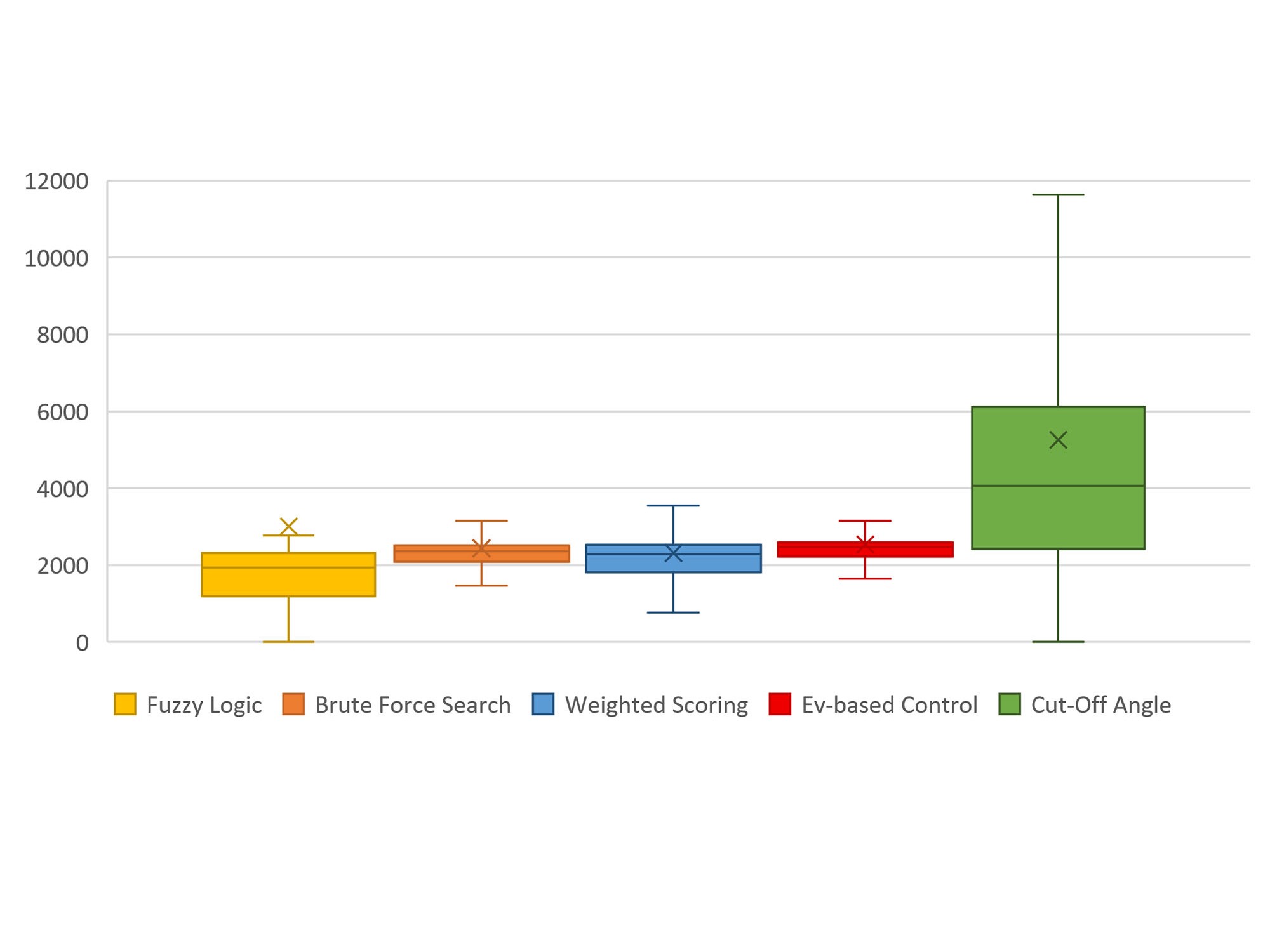
Fig. 7. Distribution of hourly maximum Ev (lux) during occupied hours throughout the year (The cross marker (×) indicates the average peak Ev for each control strategy).
The results indicate that four AI-based control strategies outperform the cut-off angle method, which produces an average peak Ev of 5255 lux, substantially exceeding the discomfort threshold. Although the cut-off angle strategy blocks direct solar radiation, it relies solely on geometric sun-position rules and does not account for diffuse sky luminance or view-dependent vertical illuminance at the occupant’s eye level. In the clear-sky climate of Yazd, high diffuse daylight and reflected radiation can therefore result in elevated Ev values even when direct sunlight is excluded. In contrast, the proposed AI-based strategies explicitly incorporate Ev into the control logic, enabling more effective glare mitigation.
Figure 8 presents a comparative analysis of glare conditions within the space using the DGP index, evaluated at 9:00, 12:00, and 15:00 on two specific days, June 21st and December 21st, under the DGP analysis shows that, on June 21st, the cut-off angle method achieves the lowest DGP values by almost blocking daylight, which substantially reduces indoor daylight availability. In contrast, the AI-based control strategies generally maintain DGP below 0.4—corresponding to perceptible or undetectable glare—while preserving daylight access. Among them, the fuzzy logic strategy performs best on June 21st, achieving the lowest DGP values at 9:00 and 15:00.
Figure 8
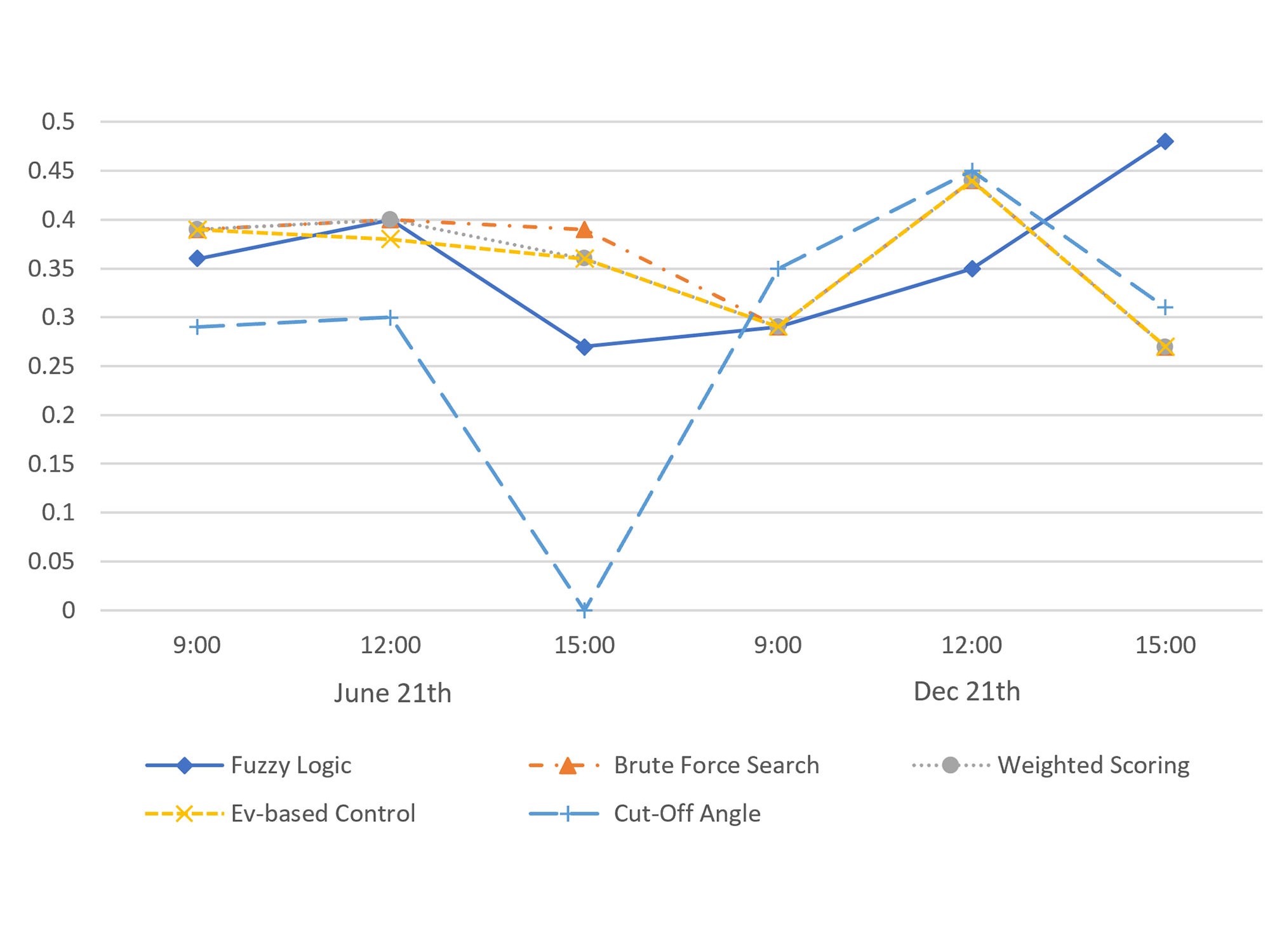
Fig. 8. DGP values on June 21st and December 21st at 9:00, 12:00, and 15:00 using different control strategies.
On December 21st, the cut-off angle method performs poorly, with DGP reaching 0.45 at 12:00. The fuzzy logic strategy also shows weak performance, producing intolerable glare at 15:00. In comparison, the brute force Search, weighted scoring, and Ev-based strategies yield similar louver configurations and achieve undetectable glare at 9:00 and 15:00, although disturbing glare persists at 12:00.
Overall, the AI-based strategies provide a better balance between daylight utilization and glare control than the cut-off angle method, avoiding excessive daylight obstruction while maintaining acceptable visual comfort, and are therefore more suitable for dynamic façade control in office spaces, regarding glare control and daylight availability.
3.2.3. Annual energy consumption assessment
To evaluate the energy performance of the building using different control strategies, the annual energy consumption for heating, cooling, and lighting is calculated using the developed energy model. Given the computational intensity and complexity of direct energy simulations for kinetic façades, the trained ANN model is employed to predict energy use efficiently. Table 8 compares the results for the four AI-based control strategies and the conventional cut-off angle method.
Table 8
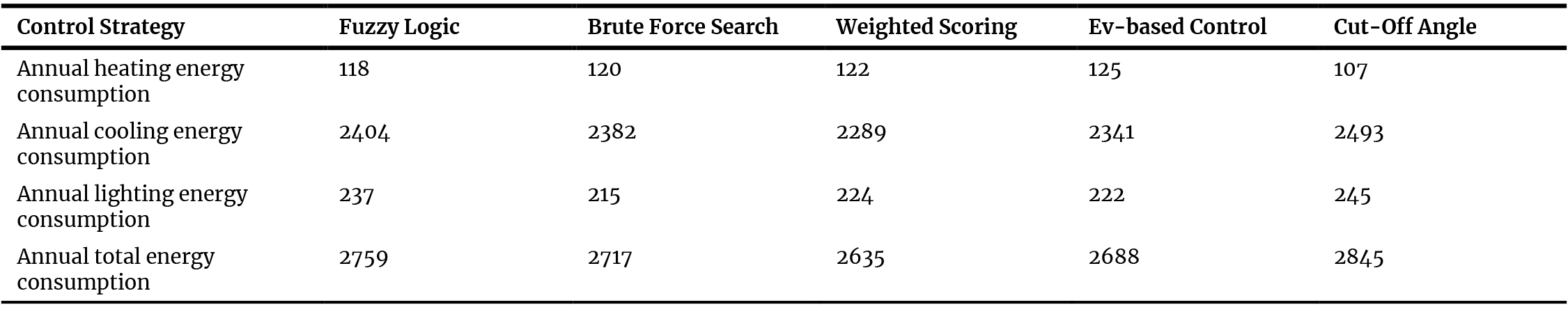
Table 8. Annual energy consumption (kWh) using different control strategies.
The cut-off angle strategy shows the highest total annual energy consumption (2845 kWh). Although it minimizes heating demand (107 kWh), it leads to the highest cooling (2493 kWh) and lighting (245 kWh) energy use. In contrast, all AI-based strategies reduce total energy consumption.
Among the data-driven control strategies, the weighted scoring method performs best, achieving the lowest annual energy use (2635 kWh), mainly through reduced cooling demand (2289 kWh), which is critical in Yazd’s hot and arid climate. The Ev-based control follows with 2688 kWh, while the brute force search method achieves the lowest lighting energy consumption (215 kWh) with a total of 2717 kWh. The fuzzy logic strategy shows the weakest performance among the AI-based methods (2759 kWh).
Overall, the results confirm that data-driven façade control strategies provide more energy-efficient alternatives to conventional cut-off angle control for kinetic shading systems in Yazd.
4. Discussion
The results demonstrate that integrating AI-based control significantly enhances the performance of kinetic horizontal louvers. Applying four intelligent optimization strategies—fuzzy logic, brute force search, weighted scoring, and Ev-based control—improves daylight availability, glare control, and energy efficiency compared to the conventional cut-off angle method. Each strategy exhibits distinct advantages in balancing these objectives, with different levels of computational complexity and predictive performance. Furthermore, the findings confirm the effectiveness of ANN-based models in enabling accurate real-time façade control, as the trained models achieve high predictive accuracy and support rapid decision-making under dynamically changing environmental conditions.
Table 9 summarizes the relative performance improvements of the proposed AI-based strategies over the cut-off angle method, based on sDA, average hourly peak Ev, and annual energy consumption.
Table 9
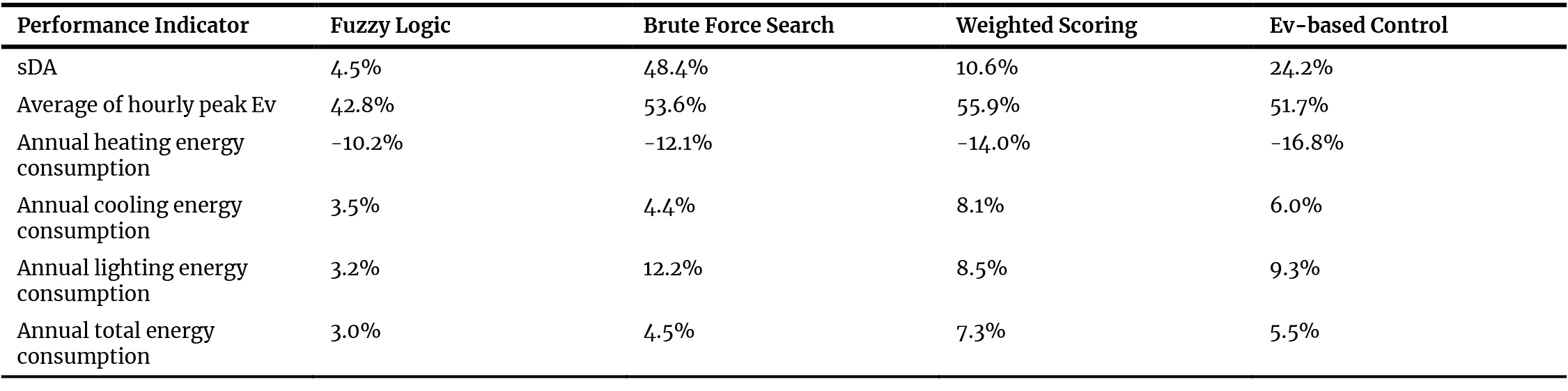
Table 9. Performance improvement of AI-based control strategies relative to the conventional cut-off angle method.
The weighted scoring system demonstrates the best overall balance between visual comfort and energy efficiency. It achieves approximately 56% improvement in glare prevention and a 10.6% increase in sDA, indicating enhanced access to useful daylight while minimizing discomfort. In terms of energy performance, the strategy reduces annual cooling energy by 8.1% and lighting energy by 8.5%, although heating energy increases by 14% due to reduced solar gains during colder periods. Overall, total annual energy consumption decreases by 7.3%, highlighting the method’s effectiveness as a holistic control strategy.
The comparison confirms that data-driven optimization strategies, particularly weighted scoring and brute force search, can significantly enhance kinetic façade performance. These strategies balance daylight access, glare prevention, and energy use, offering a promising approach for intelligent building design. In contrast, the cut-off angle method provides inadequate daylight levels and can exceed acceptable glare thresholds. Its rigid focus on blocking direct solar radiation neglects diffuse daylight and occupant needs, resulting in suboptimal indoor environmental quality.
These results support the integration of ANN-based models into façade control systems. Such models enable dynamic, responsive, and comfort-oriented shading adjustments. Combining machine learning with multi-criteria decision-making creates adaptive façades that respond intelligently to changing environmental conditions.
Although this study focuses on horizontal louvers in an office building in Yazd, the proposed hybrid framework has broader methodological relevance. By integrating energy and daylight simulations, ANN-based surrogate modelling, and multi-criteria decision-making, the framework can be adapted to other kinetic façade typologies, including vertical louvers, roller shades, and more complex adaptive envelope systems, as well as to other climates and building types. The transferable contribution of the study therefore lies not in the specific numerical results, which are context-dependent, but in the workflow used to generate simulation data, train surrogate models, and compare control strategies. Nevertheless, optimal control settings and the magnitude of performance improvements should be re-evaluated for each façade type, building geometry, occupancy pattern, and climate.
5. Conclusion
This study presents an integrated framework combining numerical simulations, ANN-based surrogate models, and intelligent control strategies to optimize the hourly angle of external kinetic horizontal louvers in an office space in Yazd, Iran. The framework aims to simultaneously enhance occupant visual comfort (daylight availability and glare control) and reduce total building energy consumption, including heating, cooling, and lighting. A comprehensive simulation database is developed using Ladybug Tools, generating 3,200 samples via Latin Hypercube Sampling for daylight indices and 25,740 hourly simulations for energy performance. Two ANN models are trained to serve as surrogate models: one for predicting daylight metrics and another for forecasting hourly energy demand. These models achieve R² values of 0.98 for rUDI, 0.80 for Ev, and 0.98 for energy, enabling accurate real-time control without the computational burden of full simulations.
Four control strategies are developed and evaluated against the conventional cut-off angle method: (1) fuzzy logic control, (2) brute force search, (3) weighted scoring, and (4) Ev-based control. The AI-driven strategies significantly outperformed the baseline in balancing daylight availability and glare mitigation. The weighted scoring system achieved the best overall balance, improving sDA by 10.6% and improving glare control by 55.9%, with a 7.3% decrease in total energy consumption. The brute force search strategy maximized daylight performance (48.4% sDA increase) and improved glare control by 53.6%, reducing energy use by 4.5%. The Ev-based strategy improved glare control by 51.7% and sDA by 24.2%, with a 5.5% reduction in total energy. In contrast, the fuzzy logic control strategy showed the weakest performance with only 4.5%, 42.8%, and 3% improvement in sDA, glare control, and annual total energy consumption, respectively.
Key contributions of this research include: introducing a hybrid shading control methodology that integrates machine learning with multi-criteria decision-making, demonstrating the feasibility of ANN surrogate models, providing a comparative evaluation of four intelligent strategies, and emphasizing the combined consideration of glare, daylight, and energy metrics.
Limitations of this study include its focus on a single-zone, south-facing office, the investigation of only one type of kinetic façade typology, and the training of the ANN models for a specific climate. Moreover, the findings have not yet been validated under real-world conditions. In addition, although Ev was adopted as a computationally efficient indicator for glare assessment, it remains a simplified indicator and does not fully account for the subjective nature of individual glare perception and sensitivity.
Future work should focus on physical validation, occupant-centerd adaptive control, life-cycle assessment, multi-zone and multi-climate applications, and integration with building management systems (BMS). The proposed framework could also be extended by reconfiguring the input parameters for different façade geometries and climate contexts to optimize context-specific performance and further assess the scalability of these data-driven control approaches. In addition, future efforts to improve Ev prediction could explore alternative network architectures, such as RNNs, including LSTM models. These architectures are well-suited to sequential data and may better capture the complex temporal dependencies that contribute to the variations in Ev.
In conclusion, this study demonstrates that AI-driven, multi-objective control strategies offer a superior alternative to the conventional cut-off angle method for dynamic shading systems. By striking a better balance between daylight quality, glare mitigation, and energy efficiency, these strategies offer a promising pathway toward more sustainable and occupant-centred building operations.
Funding
This research received no external funding.
Author Contributions
Conceptualization, Methodology, Software, Visualization, Data curation, Writing – original draft, Writing—review and editing, F.B.; Supervision, Methodology, Writing – Review and Editing, A.A. and H.H.; Supervision, Methodology, M.R. All authors have read and agreed to the published version of the manuscript.
Declaration of competing interest
The authors declare no conflicts of interest.
References
- P. R. Shukla et al., IPCC, Climate Change 2022: Mitigation of Climate Change, Cambridge University Press: Cambridge, UK and New York, NY, USA, 2022.
- F. Lima, M. L. Nunes, J. Cunha, A. F. P. Lucena, Driving Forces for Aggregate Energy Consumption: A Cross-Country Approach, Renewable and Sustainable Energy Reviews, 68 (2017) 1033-1050. https://doi.org/10.1016/j.rser.2016.08.009
- F. Lima, M. L. Nunes, J. Cunha, and A. F. P. Lucena, Global Scenarios of Urban Density and Its Impacts on Building Energy Use Through 2050, Proceedings of the National Academy of Sciences of the United States of America, 114:34 (2017) 8945-8950. https://doi.org/10.1073/pnas.1606035114
- F. Nicoletti, D. Kaliakatsos, V. Ferraro, M. A. Cucumo, Analysis of the Energy and Visual Performance of a Building with Photochromic Windows for a Location in Southern Italy, Building and Environment, 224 (2022) 109570. https://doi.org/10.1016/j.buildenv.2022.109570
- N. G. Vasquez, R. F. Rupp, R. K. Andersen, J. Toftum, Occupants' Responses to Window Views, Daylighting and Lighting in Buildings: A Critical Review, Building and Environment, 219 (2022) 109172. https://doi.org/10.1016/j.buildenv.2022.109172
- M. Brzezicki, A Systematic Review of the Most Recent Concepts in Kinetic Shading Systems with a Focus on Biomimetics: A Motion/Deformation Analysis, Sustainability, 16:13 (2024) 5697 https://doi.org/10.3390/su16135697
- F. Nicoletti, D. Kaliakatsos, M. Parise, Optimizing the Control of Venetian Blinds with Artificial Neural Networks to Achieve Energy Savings and Visual Comfort, Energy and Buildings, 294 (2023) 113279. https://doi.org/10.1016/j.enbuild.2023.113279
- L. Shen, Y. Han, Optimizing the Modular Adaptive Façade Control Strategy in Open Office Space Using Integer Programming and Surrogate Modelling, Energy and Buildings, 254 (2022) 111546. https://doi.org/10.1016/j.enbuild.2021.111546
- S. Mukherjee, D. Birru, D. Cavalcanti, E. Shen, M. Patel, Y. J. Wen, S. Das, Closed Loop Integrated Lighting and Daylighting Control for Low Energy Buildings, in: Proceedings of the 2010 ACEEE Summer Study on Energy Efficiency in Buildings, (2010), pp. 252-269.
- D. Plörer, S. Hammes, M. Hauer, V. Van Karsbergen, R. Pfluger, Control Strategies for Daylight and Artificial Lighting in Office Buildings - A Bibliometrically Assisted Review, Energies, 14:13 (2021) 3852. https://doi.org/10.3390/en14133852
- Z. Luo, C. Sun, Q. Dong, J. Yu, An Innovative Shading Controller for Blinds in an Open-Plan Office Using Machine Learning, Building and Environment, 189 (2021) 107529. https://doi.org/10.1016/j.buildenv.2020.107529
- A. Al Touma, D. Ouahrani, Shading and Daylighting Controls Energy Savings in Offices with Fully Glazed Façades in Hot Climates, Energy and Buildings, 151 (2017) 263-274. https://doi.org/10.1016/j.enbuild.2017.06.058
- N. Kunwar, K. S. Cetin, U. Passe, X. Zhou, Y. Li, Energy Savings and Daylighting Evaluation of Dynamic Venetian Blinds and Lighting Through Full-Scale Experimental Testing, Energy, 197 (2020) 117190. https://doi.org/10.1016/j.energy.2020.117190
- F. Fallahi, F. Ahmadi, M. Khakzand, Y. Shahbazi, Designing a Kinetic Façade to Control Glare: Inspiration of Long-Day Plants Pattern, Journal of Daylighting, 12:2 (2025) 265-277. https://doi.org/10.15627/jd.2025.18
- F. Sommese, S. M. Hosseini, L. Badarnah, F. Capozzi, S. Giordano, V. Ambrogi, G. Ausiello, Light-Responsive Kinetic Façade System Inspired by the Gazania Flower: A Biomimetic Approach in Parametric Design for Daylighting, Building and Environment, 247 (2024) 111052. https://doi.org/10.1016/j.buildenv.2023.111052
- M. Brzezicki, Enhancing Daylight Comfort with Climate-Responsive Kinetic Shading: A Simulation and Experimental Study of a Horizontal Fin System, Sustainability, 16:18 (2024) 8156. https://doi.org/10.3390/su16188156
- A. Yunitsyna, E. Sulaj, Daylight Optimization of the South-Faced Architecture Classrooms Using Biomimicry-Based Kinetic Facade Shading System, Journal of Daylighting, 12:1 (2025) 1-20. https://doi.org/10.15627/jd.2025.18
- G. Kang, K. Kang, D. Song, Optimized Blind Control Method to Minimize Heating, Cooling and Lighting Energy, Energy Procedia, 78 (2015) 2857-2862. https://doi.org/10.1016/j.egypro.2015.11.651
- F. Nicoletti, C. Carpino, M. A. Cucumo, N. Arcuri, The Control of Venetian Blinds: A Solution for Reduction of Energy Consumption Preserving Visual Comfort, Energies, 13:7 (2020) 1731. https://doi.org/10.3390/en13071731
- F. Nicoletti, C. Carpino, N. Arcuri, IoT Control-Based Solar Shadings: Advanced Operating Strategy to Optimize Energy Savings and Visual Comfort, Springer: Berlin, Germany, 2023, pp. 173-195. https://doi.org/10.1007/978-3-031-15160-6_8
- C. Ieracitano, F. Nicoletti, N. Arcuri, G. Ruggeri, M. Versaci, F. C. Morabito, N. Mammone, A Deep Cognitive Venetian Blinds System for Automatic Estimation of Slat Orientation, Cognitive Computation, 14:6 (2022) 2203-2211. https://doi.org/10.1007/s12559-022-10054-y
- S. Zhang, Z. Nie, S. Chen, L. Zhao, Adaptive Blind Control Strategy Based on Iterative Optimization to Minimize Cooling and Lighting Demands in Office Space, Building Simulation, 18:1 (2025) 207-223. https://doi.org/10.1007/s12273-024-1211-9
- M. Čekon, R. Slavik, J. Čurpek, R. Cottone, P. Bevilacqua, An Integrated Adaptive Façade System Using a Glass Block Filled with Phase Change Material: Cooling Energy Load and Performance Enhancement, Building and Environment, 273 (2025) 112724. https://doi.org/10.1016/j.buildenv.2025.112724
- T. R. Fattah, D. Mohammed, T. J. Katona, B. Baranyai, Cactus-Inspired Multifunctional Bio-Kinetic Façade for Energy Performance Improvement Assessed by a Novel Energy Simulation Framework, Energy and Buildings, 346 (2025) 116188. https://doi.org/10.1016/j.enbuild.2025.116188
- S. Yeon, B. Yu, B. Seo, Y. Yoon, K. H. Lee, ANN Based Automatic Slat Angle Control of Venetian Blind for Minimized Total Load in an Office Building, Solar Energy, 180 (2019) 133-145. https://doi.org/10.1016/j.solener.2019.01.027
- Z. Luo, C. Sun, Q. Dong, A Daylight-Linked Shading Strategy for Automated Blinds Based on Model-Based Control and Radial Basis Function Optimization, Building and Environment, 177 (2020) 106854. https://doi.org/10.1016/j.buildenv.2020.106854
- H. Yi, Y. Kim, Self-Shaping Building Skin: Comparative Environmental Performance Investigation of Shape-Memory-Alloy Response and Artificial-Intelligence Kinetic Control, Journal of Building Engineering, 35 (2021) 102113. https://doi.org/10.1016/j.jobe.2020.102113
- M.T. Manesh, M.R. Hoonejani, S.G. Gousheh, A. Abdolmaleki, A.N. Dehnavi, A. Shahrashoob, AI-Driven Control Algorithm Using Machine Learning and Genetic Optimization for Enhancing Visual Comfort in Adaptive Façades, Automation in Construction, 179 (2025) 106474. https://doi.org/10.1016/j.autcon.2025.106474
- M. Takhmasib, H. J. Lee, H. Yi, Machine-Learned Kinetic Façade: Construction and Artificial Intelligence Enabled Predictive Control for Visual Comfort, Automation in Construction, 156 (2023) 105093. https://doi.org/10.1016/j.autcon.2023.105093
- A. Tabadkani, A. Nikkhah Dehnavi, F. Mostafavi, H. G. Naeini, Targeting Modular Adaptive Façade Personalization in a Shared Office Space Using Fuzzy Logic and Genetic Optimization, Journal of Building Engineering, 69 (2023) 106118. https://doi.org/10.1016/j.jobe.2023.106118
- A. Tabadkani, A. Roetzel, H. Xian Li, A. Tsangrassoulis, S. Attia, Analysis of the Impact of Automatic Shading Control Scenarios on Occupant's Comfort and Energy Load, Applied Energy, 294 (2021) 116904. https://doi.org/10.1016/j.apenergy.2021.116904
- Z. Luo, C. Sun, Q. Dong, X. Qi, Key Control Variables Affecting Interior Visual Comfort for Automated Louver Control in Open-Plan Office - A Study Using Machine Learning, Building and Environment, 207 (2022) 108565. https://doi.org/10.1016/j.buildenv.2021.108565
- Z. Li, J. Tian, G. Ji, T. Cheng, V. Loftness, X. Han, Reinforcement Learning-Enabled Adaptive Control for Climate-Responsive Kinetic Building Facades, Buildings, 15:16 (2025) 2977. https://doi.org/10.3390/buildings15162977
- Y. Wang, S. Ji, G. Feng, C. Huang, Two-Stage Optimization of Infinite Rotation-Freedom Façade Systems Using Machine Learning Surrogate Models, Automation in Construction, 176 (2025) 106295. https://doi.org/10.1016/j.autcon.2025.106295
- M. D. McKay, R. J. Beckman, W. J. Conover, Comparison of Three Methods for Selecting Values of Input Variables in the Analysis of Output from a Computer Code, Technometrics, 21:2 (1979) 239-245. https://doi.org/10.1080/00401706.1979.10489755
- A. Nabil, J. Mardaljevic, Useful Daylight Illuminances: A Replacement for Daylight Factors, Energy and Buildings, 38:7 (2006) 905-913. https://doi.org/10.1016/j.enbuild.2006.03.013
- L. Karlsen, P. Heiselberg, I. Bryn, H. Johra, Verification of Simple Illuminance Based Measures for Indication of Discomfort Glare from Windows, Building and Environment, 92 (2015) 615-626. https://doi.org/10.1016/j.buildenv.2015.05.040
- K. Van Den Wymelenberg, M. Inanici, A Critical Investigation of Common Lighting Design Metrics for Predicting Human Visual Comfort in Offices with Daylight, LEUKOS - Journal of Illuminating Engineering Society of North America, 10:3 (2014) 145-164. https://doi.org/10.1080/15502724.2014.881720
- Y. Bian, T. Luo, Investigation of Visual Comfort Metrics from Subjective Responses in China: A Study in Offices with Daylight, Building and Environment, 123 (2017) 661-671. https://doi.org/10.1016/j.buildenv.2017.07.035
- J. Wienold, Dynamic Simulation of Blind Control Strategies for Visual Comfort and Energy Balance Analysis, in: Proceedings of Building Simulation, (2007).
- M. R. Berthold, D. J. Hand, Intelligent Data Analysis: An Introduction, Springer: Berlin, Germany, 2007.
- S. Seyedzadeh, I. Glesk, M. Roper, Machine Learning for Estimation of Building Energy Consumption and Performance: A Review, Visualization in Engineering, 6:5 (2018). https://doi.org/10.1186/s40327-018-0064-7
- F. Villano, G. M. Mauro, A. Pedace, A Review on Machine/Deep Learning Techniques Applied to Building Energy Simulation, Optimization and Management, Thermo, 4:1 (2024) 100-139. https://doi.org/10.3390/thermo4010008
- R. Hecht-Nielsen, Theory of the Backpropagation Neural Network, in: Neural Networks for Perception, Academic Press, 1992, pp. 65-93. https://doi.org/10.1016/B978-0-12-741252-8.50010-8
- V. Novák, I. Perfilieva, J. Močkoř, Mathematical Principles of Fuzzy Logic, Springer: Berlin, Germany, 1999. https://doi.org/10.1007/978-1-4615-5217-8
- L. A. Zadeh, Fuzzy Sets, Information and Control, 8:3 (1965) 338-353. https://doi.org/10.1016/S0019-9958(65)90241-X
- T. Zhang, Y. Liu, Y. Rao, X. Li, Q. Zhao, Optimal Design of Building Environment with Hybrid Genetic Algorithm, Artificial Neural Network, Multivariate Regression Analysis and Fuzzy Logic Controller, Building and Environment, 175 (2020) 106810. https://doi.org/10.1016/j.buildenv.2020.106810
- A. Marvuglia, A. Messineo, G. Nicolosi, Coupling a Neural Network Temperature Predictor and a Fuzzy Logic Controller to Perform Thermal Comfort Regulation in an Office Building, Building and Environment, 72 (2014) 287-299. https://doi.org/10.1016/j.buildenv.2013.10.020
- A. Mohammad, O. Saleh, R. A. Abdeen, Occurrences Algorithm for String Searching Based on Brute-Force Algorithm, Journal of Computer Science, 2:1 (2006) 82-85. https://doi.org/10.3844/jcssp.2006.82.85
- T. Van Dua, Combination of Design of Experiments and Simple Additive Weighting Methods: A New Method for Rapid Multi-Criteria Decision Making, EUREKA: Physics and Engineering, 1 (2023) 120-133. https://doi.org/10.21303/2461-4262.2023.002733
- Y. C. Chan, A. Tzempelikos, Efficient Venetian Blind Control Strategies Considering Daylight Utilization and Glare Protection, Solar Energy, 98 (2013) 241-254. https://doi.org/10.1016/j.solener.2013.10.005
- Y. B. Seong, M. S. Yeo, K. W. Kim, Optimized Control Algorithm for Automated Venetian Blind System Considering Solar Profile Variation in Buildings, Indoor and Built Environment, 23:6 (2014) 890-914. https://doi.org/10.1177/1420326X13487918
- A. K. Athienitis, A. Tzempelikos, A Methodology for Simulation of Daylight Room Illuminance Distribution and Light Dimming for a Room with a Controlled Shading Device, Solar Energy, 72:4 (2002) 271-281. https://doi.org/10.1016/S0038-092X(02)00016-6
- Approved Method: IES Spatial Daylight Autonomy (sDA) and Annual Sunlight Exposure (ASE), IES, 2013.
- J. Y. Suk, M. Schiler, K. Kensek, Development of New Daylight Glare Analysis Methodology Using Absolute Glare Factor and Relative Glare Factor, Energy and Buildings, 64 (2013) 113-122. https://doi.org/10.1016/j.enbuild.2013.04.020
2383-8701/© 2026 The Author(s). Published by solarlits.com. This is an open access article distributed under the terms and conditions of the Creative Commons Attribution 4.0 License.