 HOME
HOMEAbout the Journal
Journal of Daylighting is a peer-reviewed international journal devoted to investigations of daylighting in buildings. It is the leading journal that publishes original research on all aspects of Energy, buildings, and lighting.
Quartile Ranking JCR - Q2 (Energy (miscellaneous))
RESEARCH ARTICLE
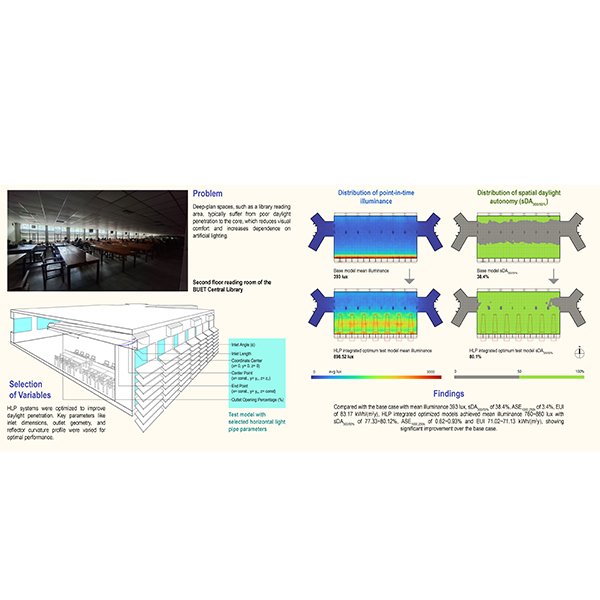
Horizontal Light Pipe System for Daylight Optimization in Deep-Plan
Deep-plan spaces, such as a library reading area, typically suffer from poor daylight penetration to the core, which reduces visual comfort and increases dependence on artificial lighting.
Journal of Daylighting 13 (2026) 227-252
RESEARCH ARTICLE
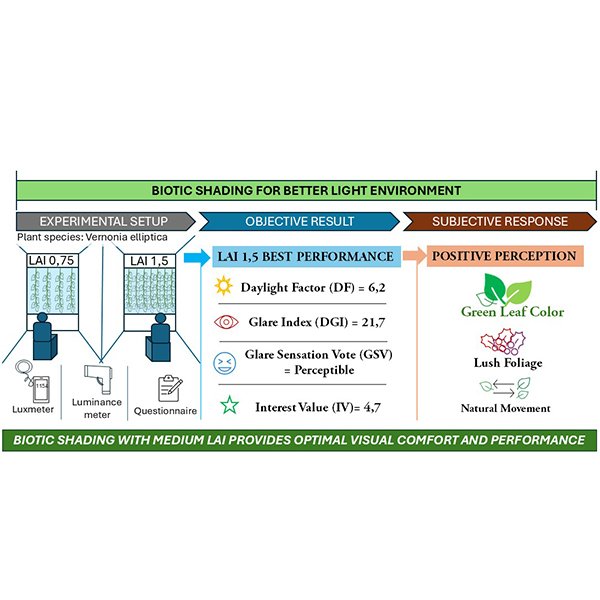
Biotic Shading for Better Light Environment
Tropical climates with partially cloudy skies are characterized by high luminance on the glass façades of high-rise buildings, which is a significant challenge as it causes glare and eyestrain among workers..
Journal of Daylighting 13 (2026) 214-226
RESEARCH ARTICLE
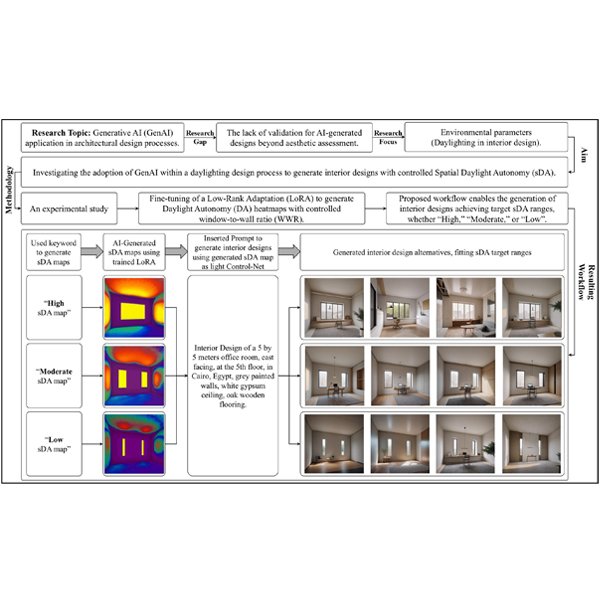
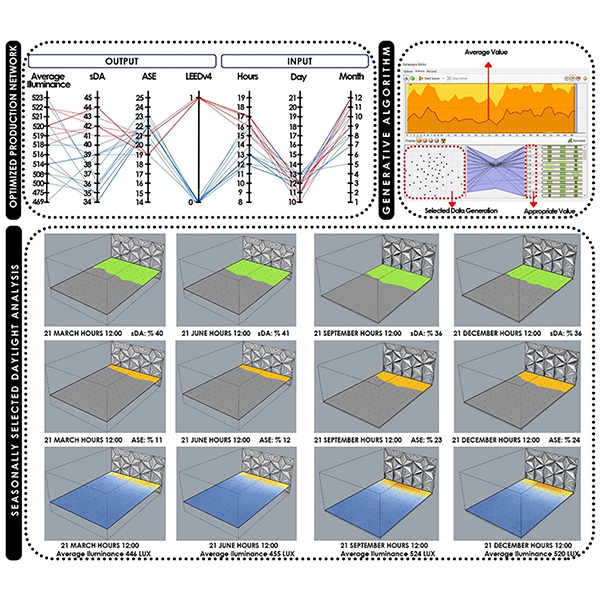
Adopting Generative Artificial Intelligence in Daylighting Design Process
Generative Artificial Intelligence (GenAI) is increasingly adopted in architectural design and widely investigated in the research field. However, several limitations hinder its broader integration into design processes.
Journal of Daylighting 13 (2026) 196-213
RESEARCH ARTICLE
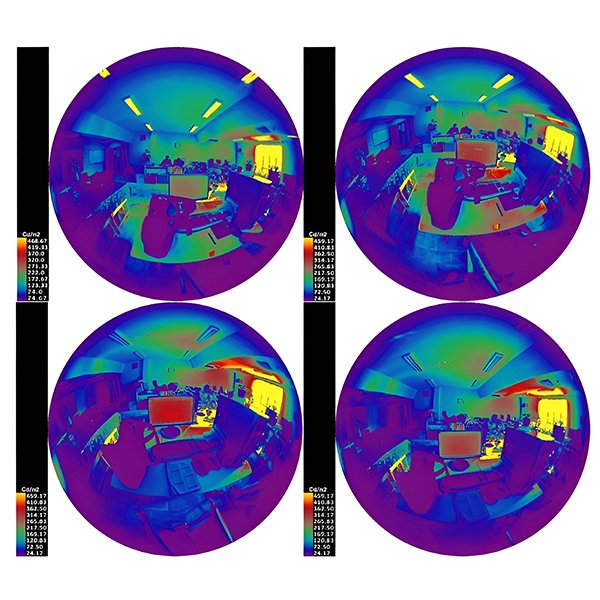
Window Orientation, Glare, and Visual Comfort in Offices
This study explores the relationship between glare and visual comfort in office environments in relation to daylight conditions in office spaces. The research combines three approaches: field measurements of illumination, user surveys to assess visual comfort, and 3D daylight simulations using Rhino and DIVA software, which studied 21 participants (13 men and 8 women) working in 14 office rooms with window orientations.
Journal of Daylighting 13 (2026) 167-195
RESEARCH ARTICLE
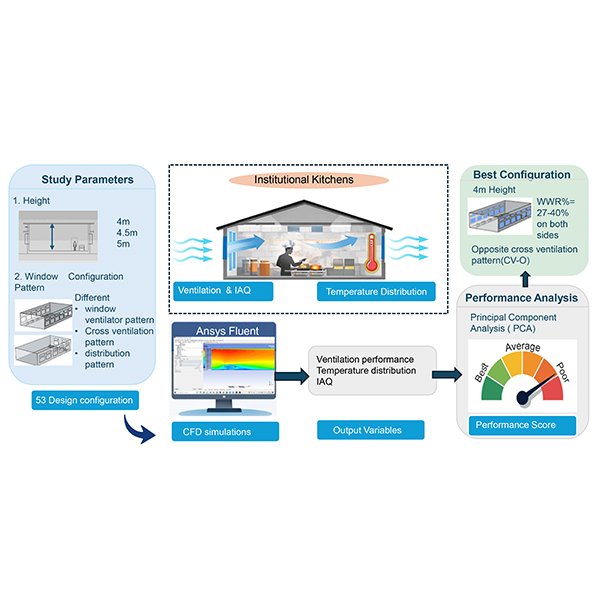
Impact of Building Height and Window Configurations on Ventilation Performance
Institutional kitchens often experience inadequate thermal comfort and indoor air quality (IAQ) due to intense heat generation and pollutant emissions from cooking activities, increasing workers’ exposure to heat stress and related health risks. .
Journal of Daylighting 13 (2026) 143-166
RESEARCH ARTICLE
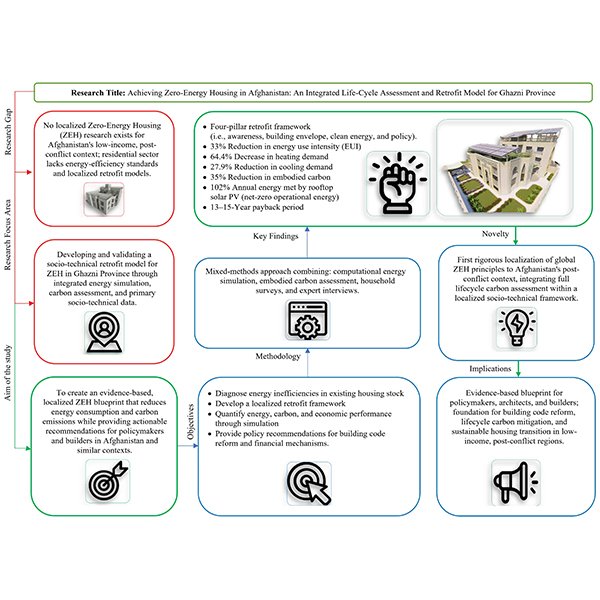
Achieving Zero-Energy Housing in Afghanistan: an Integrated Life-Cycle
The residential building sector in Afghanistan (AFG) is a significant contributor to energy consumption and greenhouse gas (GHG) emissions, exacerbated by non-adherence to architectural standards and a critical lack of localized energy-efficiency (EE) research.
Journal of Daylighting 13 (2026) 124-142
RESEARCH ARTICLE
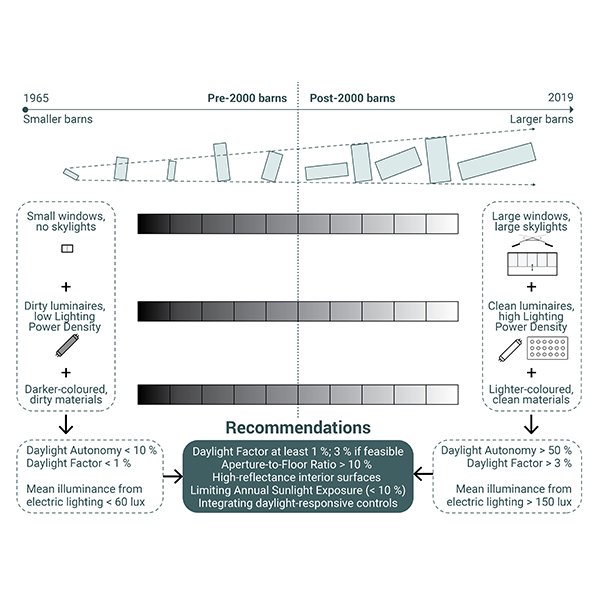
Architectural Factors Affecting Illumination in Swedish Dairy Barns: Insights from
Illumination of dairy barns impacts animal health, milk production, and building energy efficiency. The aim of this study was to assess the existing daylighting and electric lighting conditions of dairy barns located in Southern Sweden.
Journal of Daylighting 13 (2026) 108-123
RESEARCH ARTICLE
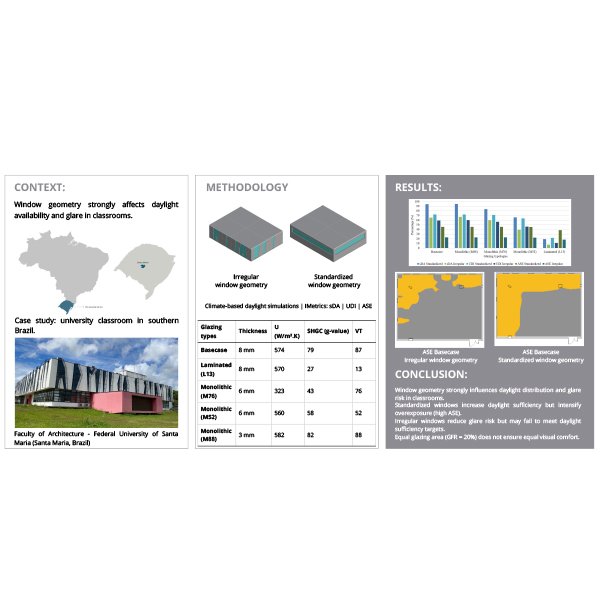
Evaluating Daylighting Gains from Window Geometry Reconfiguration in a Classroom
Daylighting is a key aspect of educational building design, supporting both visual comfort and energy efficiency. However, design practice often reduces the role of windows to aperture ratios, with limited attention to the influence of window geometry on daylight performance.
Journal of Daylighting 13 (2026) 97-107
RESEARCH ARTICLE
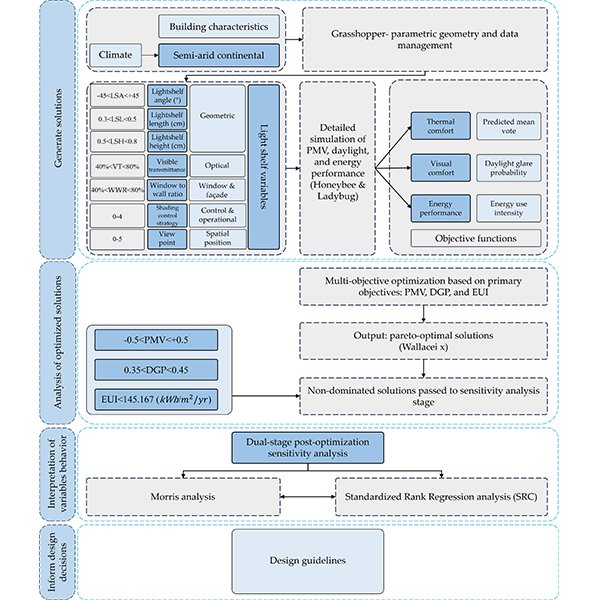
Sequential Multi-Objective Optimization and Post-optimization Sensitivity Analysis of
Global climate action necessitates the optimization of building envelopes during early design to enhance energy efficiency and occupant comfort. Exterior light shelves are a critical passive strategy for improving thermal and visual comfort while simultaneously reducing energy consumption.
Journal of Daylighting 13 (2026) 76-96
REVIEW ARTICLE
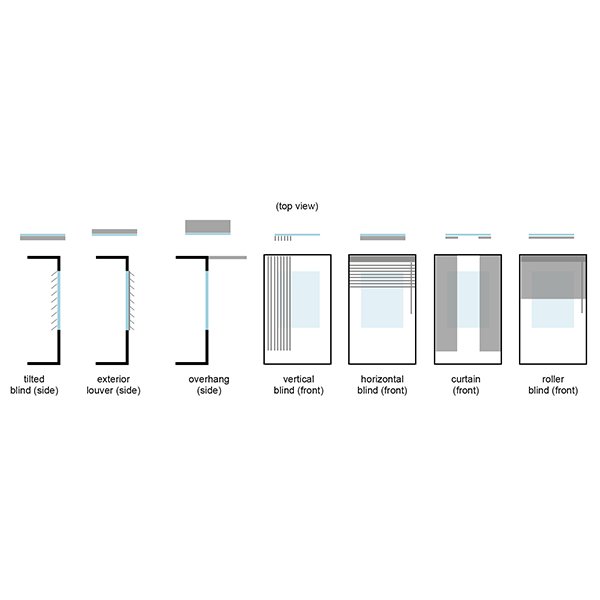
Daylight Enhancement Strategies for Historic Buildings: A Critical Review of
With the growing urgency to reduce carbon emissions in the built environment, enhancing daylight availability in historic buildings has become a critical and challenging task due to the required balance between environmental sustainability objectives and cultural heritage conservation principles.
Journal of Daylighting 13 (2026) 57-75
RESEARCH ARTICLE
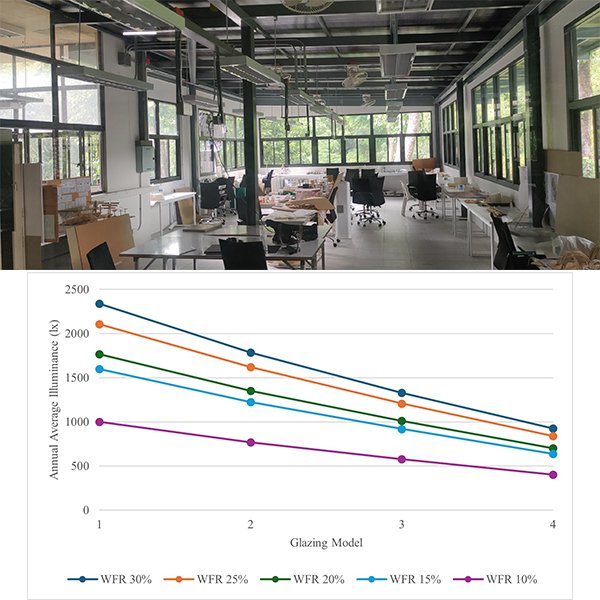
Optimizing Window-to-Floor Ratio and Glazing for Daylight and
In tropical climates, where cooling loads dominate building energy use, minimizing cooling demand is particularly critical for achieving carbon neutrality in educational buildings while maintaining adequate daylight and visual comfort.
Journal of Daylighting 13 (2026) 44-56
RESEARCH ARTICLE
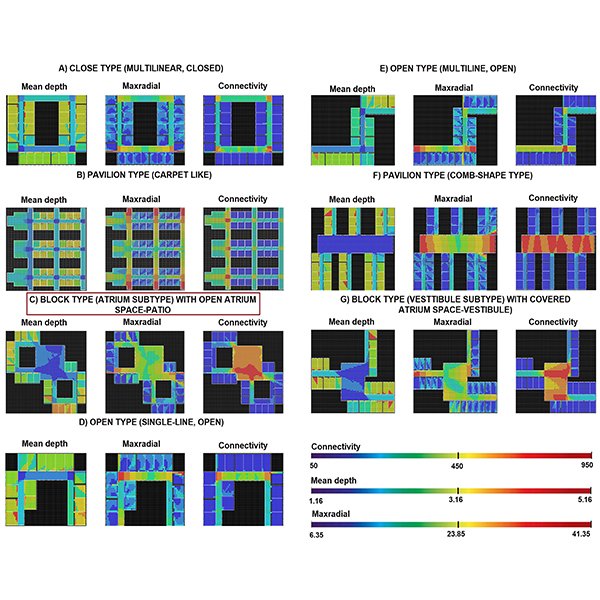
Comparative Analysis of Daylight and Visual Quality Across School Plan
Designing daylight-based spaces has gained increasing attention due to its numerous benefits and alignment with global sustainability standards. However, limited research has focused on how architectural layouts affect daylight distribution and visual quality, particularly in educational environments.
Journal of Daylighting 13 (2026) 20-43
RESEARCH ARTICLE
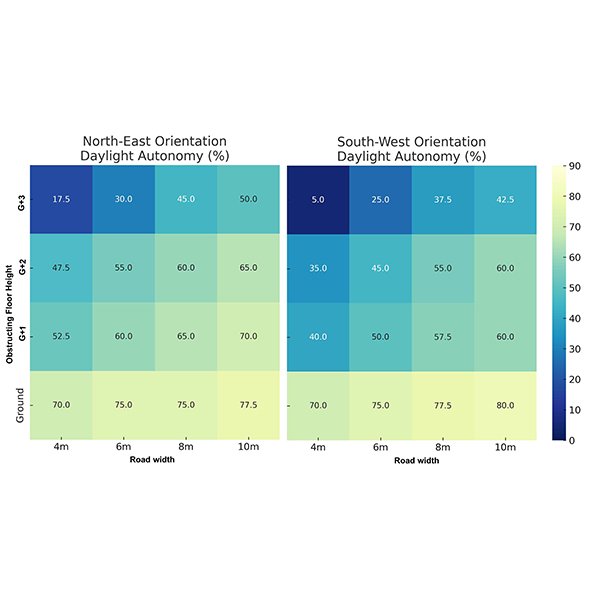
Effects of Urban Obstructions on Spatial Daylight Autonomy (sDA) and
The limited research on obstruction-driven daylight reduction continues to hinder efforts to optimize natural daylight in compact mid-rise residential buildings.
Journal of Daylighting 13 (2026) 1-19
RESEARCH ARTICLE
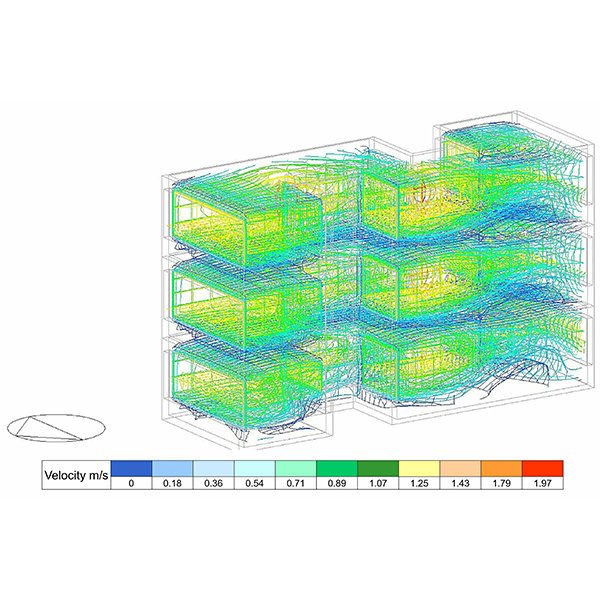
Integration of light well through generative design to achieve optimal
A case of urban densification in heritage towns like Pondicherry has led to deep-plan wall to wall layouts, where the depth of the plot is considerably more than its width and multi-storey buildings with limited access to day light and natural ventilation.
Journal of Daylighting 12 (2025) 548-560
RESEARCH ARTICLE
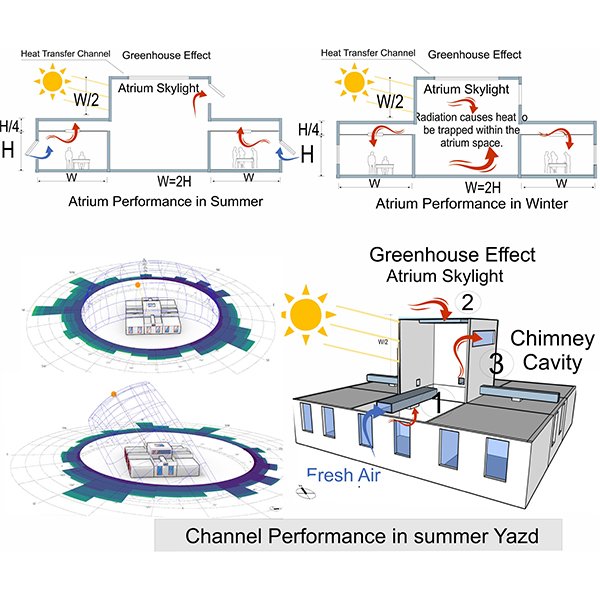
Design Optimization of Atrium Skylights for Enhanced Office Building Performance
The increasing demand for energy and the impact of climate change underscore the necessity of energy-efficient building designs. This study optimizes atrium skylights as a passive design solution for Yazd, Iran aiming to enhance thermal and visual comfort.
Journal of Daylighting 12 (2025) 520-547
RESEARCH ARTICLE
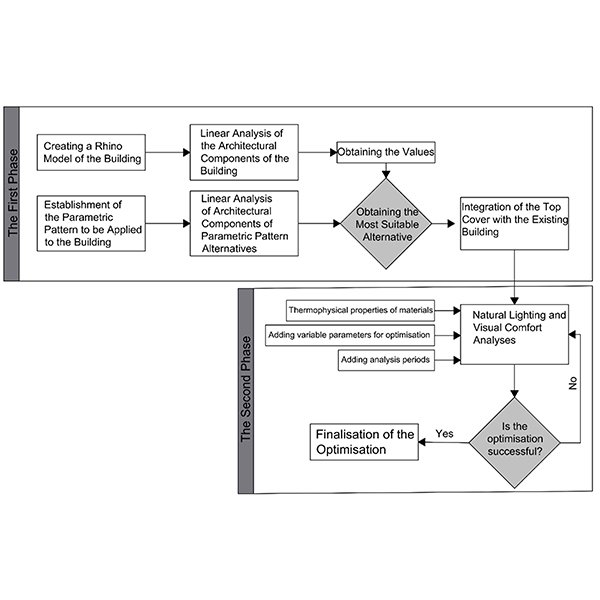
Parametric Exploration of Natural Lighting and Visual Comfort in Contemporary
The re-functioning of historical buildings frequently necessitates new additions. This is particularly relevant for historical buildings with open courtyards, where interventions often involve the installation of upper covers using contemporary materials and techniques This issue can become especially apparent in historical buildings that are completely enclosed with transparent materials, raising concerns about the greenhouse effect and its potential to compromise indoor comfort.
Journal of Daylighting 12 (2025) 506-519
RESEARCH ARTICLE
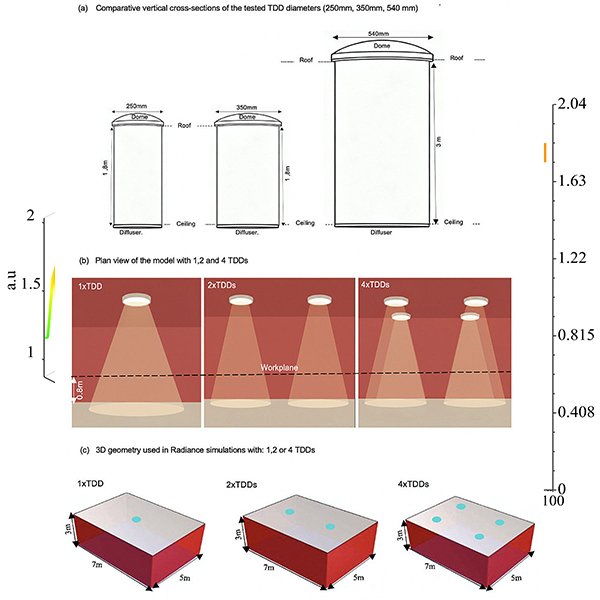
Multi-Criteria Optimization of Tubular Daylighting Devices for Classrooms in
In educational architecture, particularly in high-solar climates, achieving a balance between ample daylight and visual comfort is a significant challenge.
Journal of Daylighting 12 (2025) 491-505
RESEARCH ARTICLE
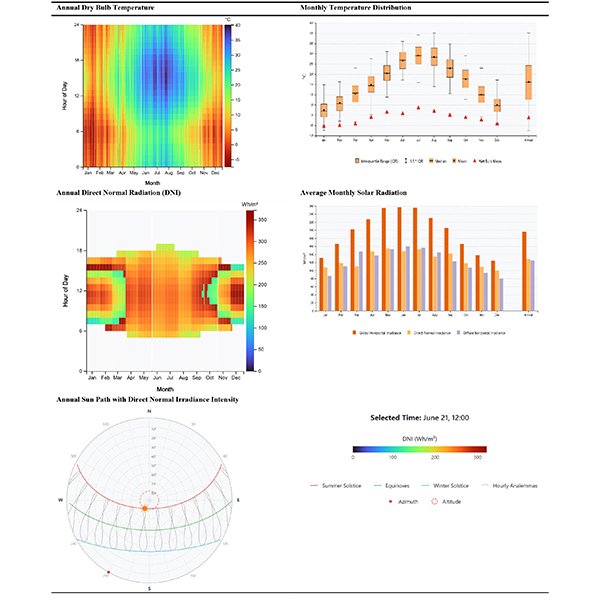
Multi-objective Optimization of Girih Tile Patterns and Colored Glass
Efficient energy use is vital in architecture, and the building envelope plays a key role in aesthetics, thermal comfort, energy efficiency, and natural lighting.
Journal of Daylighting 12 (2025) 441-467
REVIEW ARTICLE
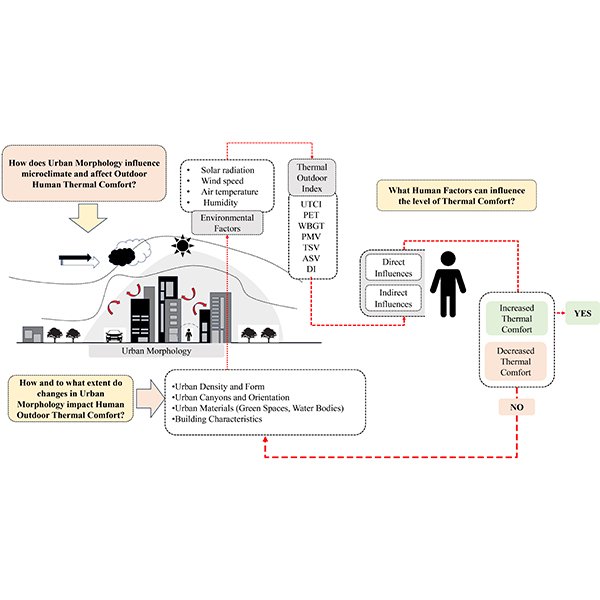
Human Interaction with Urban Morphology under the Influence of Urban
Outdoor urban spaces are essential to residents’ well-being, yet their thermal comfort is increasingly compromised by urbanization and climate change. .
Journal of Daylighting 12 (2025) 468-490
RESEARCH ARTICLE
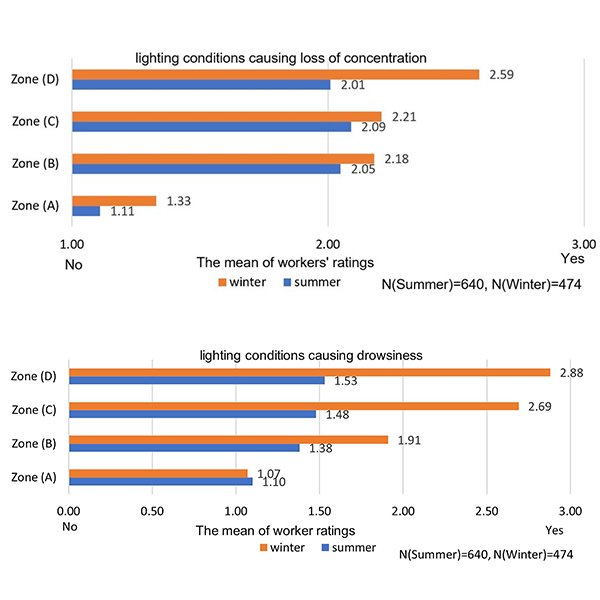
Evaluating the Impact of Lighting Conditions on Workers’ Safety and
Lighting is a key element of design that plays a significant role in affecting workers’ health and safety in industrial workspaces. Given the scarcity of scientific studies addressing visual environments in relation to workers health in industrial buildings, this field study was conducted to explore workers' responses to multiple lighting scenarios inside production halls on their occupational health and safety in six factories in Sadat City, Egypt. .
Journal of Daylighting 12 (2025) 420-440
RESEARCH ARTICLE
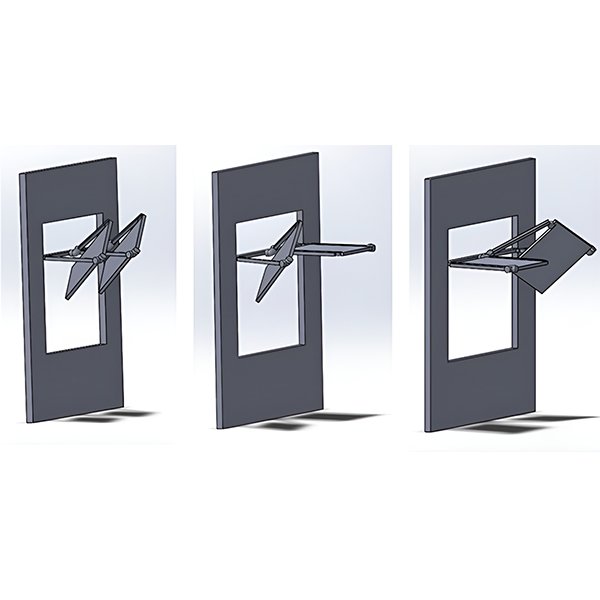
Design Alternatives of Light Shelves using Altmann Linkage
This paper proposes a novel new light shelf design with Altmann linkage using its kinetic principles: geometry and rotational angles. As previous studies explain a light shelf’s design in two ways: static and movable, the proposed one in this study has the potential to track the path of the sun due to its diagonal movement. .
Journal of Daylighting 11 (2024) 391-407
RESEARCH ARTICLE
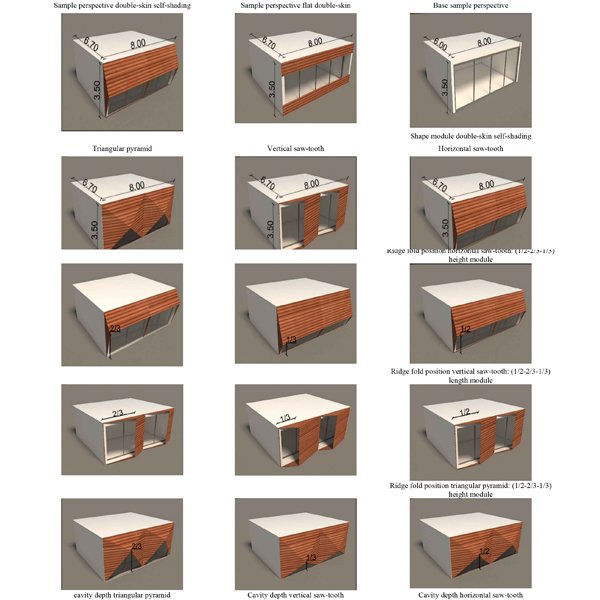
Optimum Geometry of Double-skin Self-Shading Facade of Classrooms
The significant energy consumption in educational spaces worldwide and its environmental impact greatly influence the quality of space, learning levels, and student comfort.
Journal of Daylighting 11 (2024) 372-389
RESEARCH ARTICLE
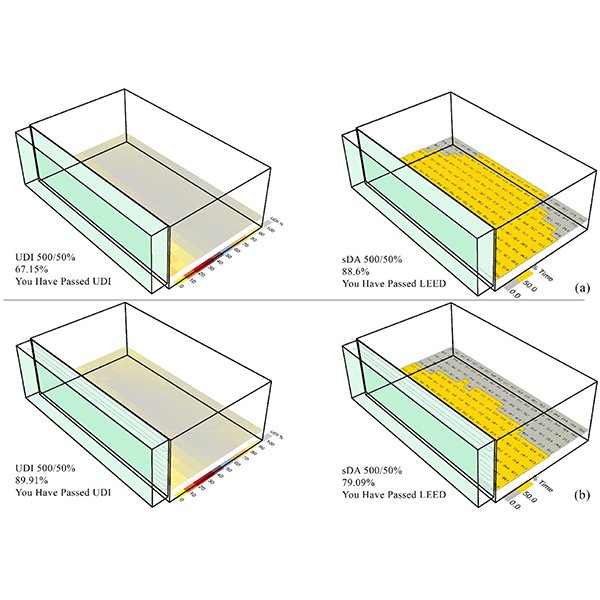
Parametric Optimization Approach to Evaluate Dynamic Shading Within Double-Skin
This research aims to support the choice of an appropriate dynamic louver shading system (DL-SS) within double-skin facade insulated glazed units (DSF-IGUs) as a high-performance integrated window system (DSF-IGUs/DL-SS) that meets both thermal and energy performance via daylight availability under a tropical climate.
Journal of Daylighting 11 (2024) 349-371
RESEARCH ARTICLE
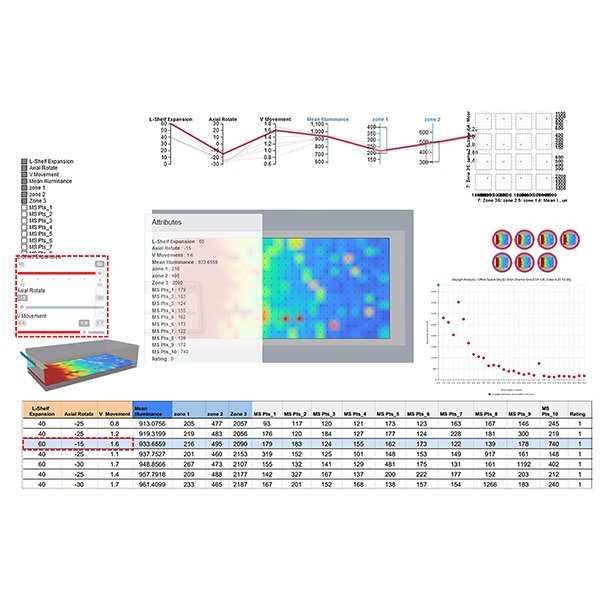
Artificial Neural Network to Predict Curvature Light Shelf Design Related
Energy Optimization in building design field now has been revolutionized due to AI and machine learning applications. Leveraging daylight to reduce artificial lighting consumption holds promise for significant energy savings, yet the nonlinear nature of daylight patterns poses challenges in prediction and optimization.
Journal of Daylighting 11 (2024) 334-348

RESEARCH ARTICLE
Investigation of the Effect of Parametric Patterned Façade and
Parametric design is one of the thriving contemporary architectural treatments that not only has an influence on the design of building envelopes but is capable of affecting the users physically and psychologically.
Journal of Daylighting 11 (2024) 312-333

RESEARCH ARTICLE
Analyzing Passive Design Retrofits using Pareto Front Optimization to Reduce
Buildings are one of the leading sources of carbon emissions in the world. Most of the carbon emissions are released during the operation phase of the building.
Journal of Daylighting 11 (2024) 290-311

RESEARCH ARTICLE
Tracker-less Sunlight Collection Apparatus, using an Array of Optical
The paper describes an array of optical cones as a potential configuration for tracker-less daylighting, without using an electro-mechanical tracker. Subsequently, a single optical cone is analyzed, mainly in terms of sunlight collection efficiency and acceptance angle, as a function of the cone's geometrical dimensions.
Journal of Daylighting 11 (2024) 279-289

RESEARCH ARTICLE
Analytical Study on Reducing the Heating Effects of Daylight and
Climate change is an environmental issue that is rapidly escalating due to the effects of global warming. The increase in carbon emissions, along with various human activities such as industrial processes, land use changes, and the reckless consumption of natural resources, are among the primary causes of global warming.
Journal of Daylighting 11 (2024) 268-278

RESEARCH ARTICLE
Optimising Daylighting Performance Through Side light with Passive Devise Design
Passive lighting design plays an important role in providing natural lighting to save electricity consumption in buildings. This study aims to investigate the performance of natural lighting and the potential of alternative designs through sidelights with 3 shading device models and light shelves with different sizes in north, west, east, and south orientations.
Journal of Daylighting 11 (2024) 247-267

RESEARCH ARTICLE
Daylight Enhancement Strategies Through Roof for Heritage Buildings
Enhancing daylighting in heritage buildings is a complex challenge that requires a delicate balance between preserving architectural integrity and improving visual comfort.
Journal of Daylighting 11 (2024) 234-246

RESEARCH ARTICLE
Investigation of daylight availability in university dining halls: A case
This study evaluates the availability of daylight inside a university’s dining halls over two days (one sunny and one cloudy) using light meters in real-life sittings. .
Journal of Daylighting 11 (2024) 216-233

RESEARCH ARTICLE
Energy efficiency in smart schools using renewable energy strategy
As smart schools increasingly rely on technology, achieving energy efficiency becomes crucial for cost reduction and sustainability. This study investigates energy efficiency strategies in smart schools, focusing on the integration of renewable energy technologies.
Journal of Daylighting 11 (2024) 203-215
RESEARCH ARTICLE
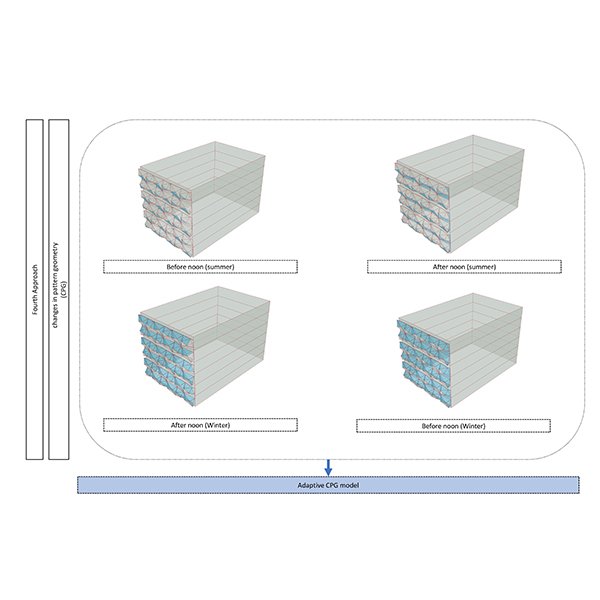
Synergistic Strategies: Comparing Energy Performance in Climate-Adaptive Building Envelopes
Climate change and improving building energy performance are significant contemporary concerns. Conversely, climate-adaptive building envelopes (CABEs) offer promising solutions to enhance structural performance amidst fluctuating environmental conditions.
Journal of Daylighting 11 (2024) 181-202
RESEARCH ARTICLE
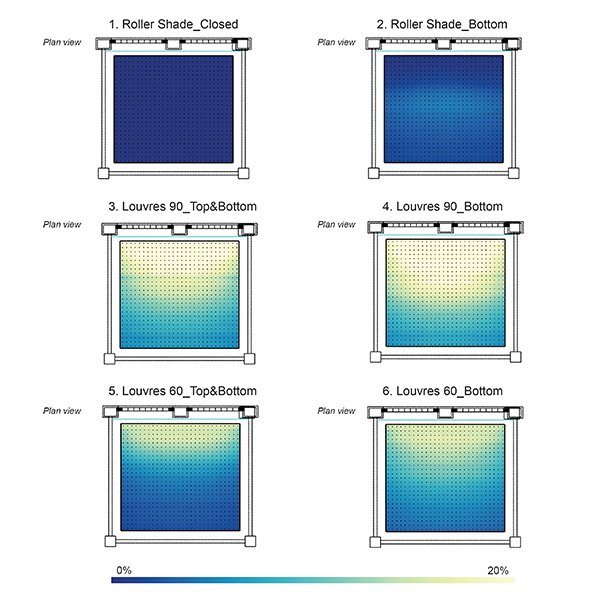
Design Adjustments For Daylighting and Visual Comfort in a Classroom
This paper evaluates how design adjustments applied to roller shades and louvres (namely the height of the shadings head and the angles of the louvre slats) can improve their annual and spatial effectiveness to provide autonomous daylight levels, reduce daylight glare problems, and offer views outside.
Journal of Daylighting 11 (2024) 165-180
RESEARCH ARTICLE
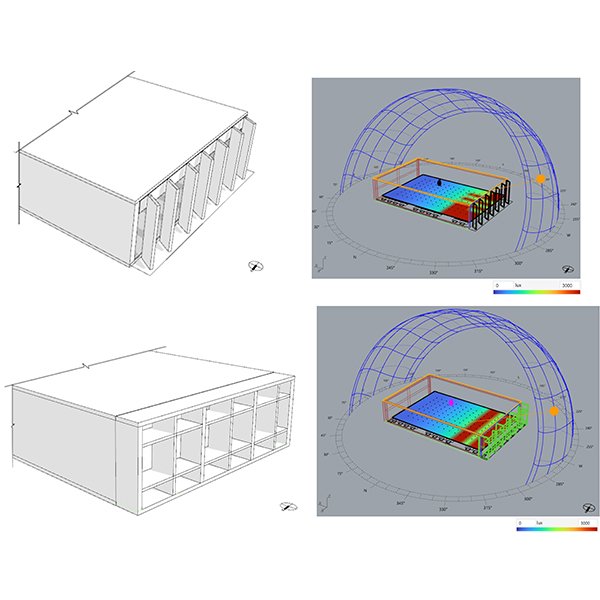
Performance of Shading Against West Glass Facades to Optimise Daylight,
In tropical urban areas, the vertical facades of buildings often play a crucial role in capturing solar radiation and heat, especially for office buildings facing west during the afternoon.
Journal of Daylighting 11 (2024) 131-148
RESEARCH ARTICLE
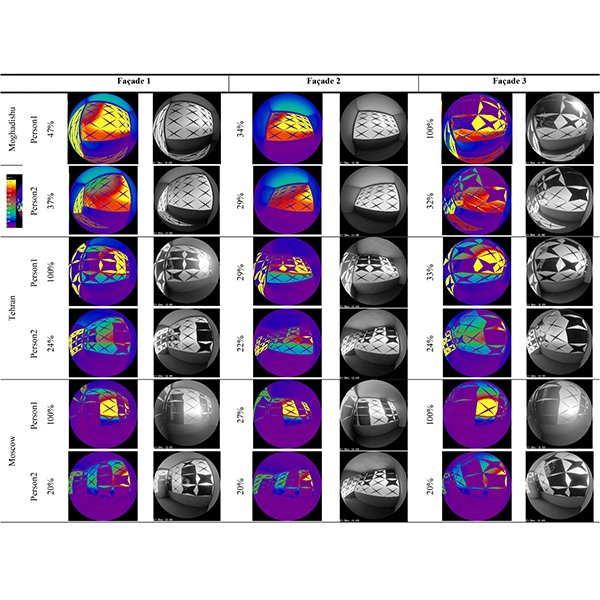
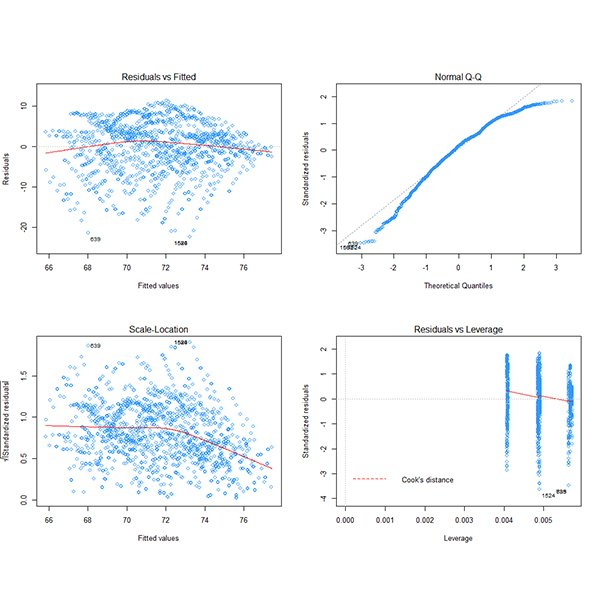
Designerly Approach to Design Responsive Façade for Occupant Visual
In recent years, attention has focused on improving the health and satisfaction of employees by enhancing visual comfort in workplaces. This involves providing adequate natural daylight, glare control, and outdoor views.
Journal of Daylighting 11 (2024) 149-164
RESEARCH ARTICLE
Geometry Optimization of Industry Buildings for Energy-Driven Design Development
Even though the manufacturing industry consumes roughly 54% of total available energy globally, little consideration has been devoted to optimizing energy in the early stages of industry design, particularly in densely populated cities.
Journal of Daylighting 11 (2024) 119-130
REVIEW ARTICLE
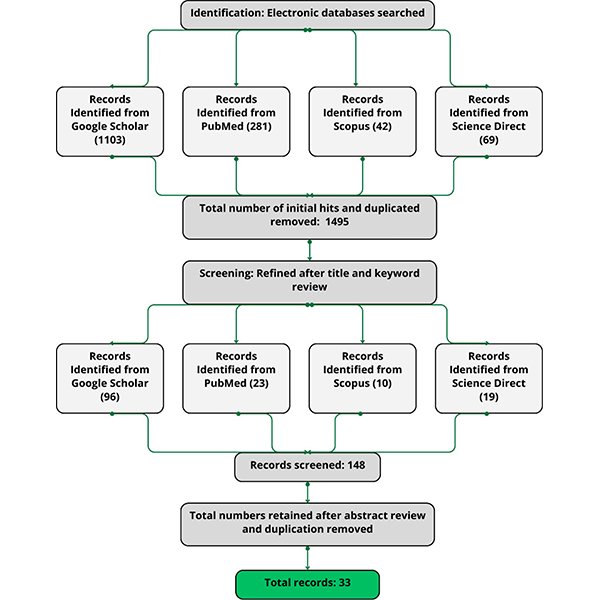
Exploring Methodological Considerations: A Literature Review on How Lighting Affects
The impacts of lighting conditions on human circadian rhythms, sleep quality, and cognitive performance have been extensively investigated in the past two decades; however, these studies have yielded inconclusive and variable outcomes.
Journal of Daylighting 11 (2024) 97-118
RESEARCH ARTICLE
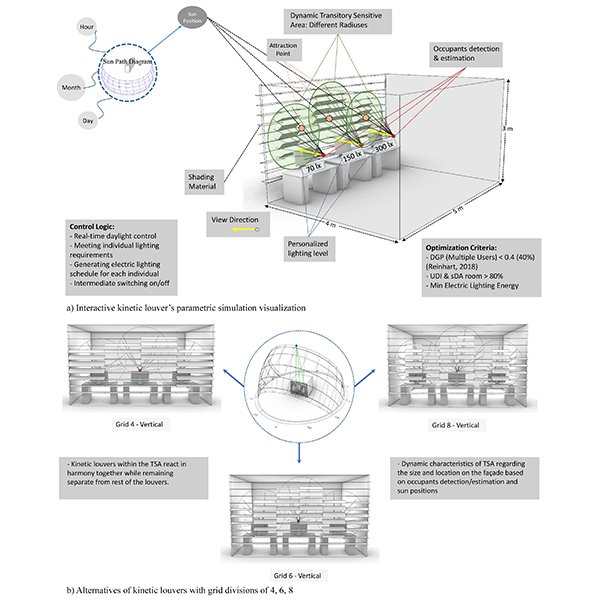
Enhancing Visual Comfort and Energy Efficiency in Office Lighting Using
The number of desk workers who frequently conduct their jobs at home has increased dramatically during Covid-19. Work-from-home flexibility makes it attractive for workers and companies, resulting in a “Work-Style Reform” after the Covid-19 pandemic. Ho.
Journal of Daylighting 11 (2024) 69-96

RESEARCH ARTICLE
A Multi-objective Optimization of Window and Light Shelf Design
In office buildings, an efficient design of windows and using light shelves as a passive design strategy significantly influence the thermal and visual comfort of occupants while enhancing the productivity and health of users.
Journal of Daylighting 11 (2024) 55-68
Article Publishing Charge (APC)
No publication fees are charged to authors, and articles are published as open access.
Publication timeline
| 3 days
Submission to first decision |
50 days
Submission to acceptance |
70 days
Submission to publication |
Editorial board

Prof Laura Bellia
University of Naples Federico II, Italy

Dr Boon Han Lim
Universiti Tunku Abdul Rahman, Malaysia

Dr Arsenio Barbón
University of Oviedo, Spain

Dr Fabio Peron
IUAV University of Venice, Italy

Prof. Barbara Szybinska Matusiak
NTNU, Norway

Dr Ferdinando Salata
University of Rome, Italy

Prof Umberto Berardi
Politecnico di Bari, Italy

Dr Susana Lagüela López
University of Vigo, Spain

Dr Canan Kandilli
Usak University, Turkey

Dr Guiqiang Li
University of Science and Technology of China, China

Prof. Nabil Elminshawy
Port Said University, Egypt

Prof. Önder Güler
Istanbul Technical University, Türkiye

Dr Valerio Roberto Maria LO VERSO
Politecnico di Torino (Polytechnic University of Turin), Italy

Prof. Yuehong Su
University of Nottingham, UK

Prof Hongfei Zheng
Beijing Institute of Technology, China

Dr Lim Yaik Wah
Universiti Teknologi Malaysia, Malaysia

Dr Doris Abigail Chi Pool
Universidad de las Américas Puebla, Mexico

Dr. Francesco Nocera
Department of Civil Engineering and Architecture, University of Catania (ITALY), Italy

Wei Wang
Southeast University, 中国

Dr. Michele Rocca
University of Pisa, Italia

Dr. Peng XUE
Beijing University of Technology, China

Dr Mohammed Salah Mayhoub
Al-Azhar University, Egypt

Dr Marina Bonomolo
University of Palermo, Italia

Dr. Francesca Fragliasso
University of Naples Federico II, Italy

Prof. BANU MANAV
Kadir Has University, Turkey

Dr jian yao
Ningbo University, China

Dr Hui Shen
Texas A&M University-Kingsville, USA

Dr Ahmed A. Y. Freewan
Jordan University of Science and Technology, Jordan

Prof Jitka Mohelnikova
Brno University of Technology, Czech Republic

Dr Petar Pejic
University of Niš, Serbia

RESEARCH ARTICLE
Acrylic Panels Applications as Building Materials and Daylighting Devices
Enormous studies have been conducted to enhance the daylighting utilization in buildings either by direct lighting techniques, lighting reflection systems, lighting transporting systems, or by light tracking systems.
Journal of Daylighting 7 (2020) 258-272
RESEARCH ARTICLE
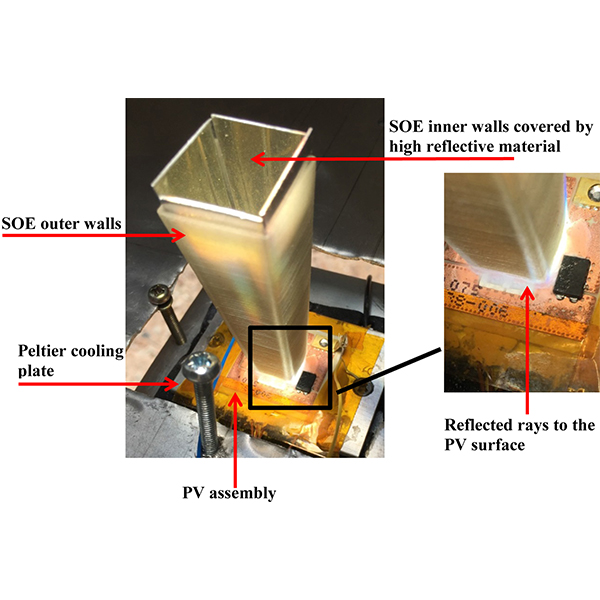
Outdoor Investigation of High Concentrator Photovoltaic Under Uniform and Non-
This study was performed in outdoor conditions to quantify the level of influence on the electrical performance of the Multi-junction (MJ) solar cells.
Journal of Daylighting 7 (2020) 1-12
RESEARCH ARTICLE
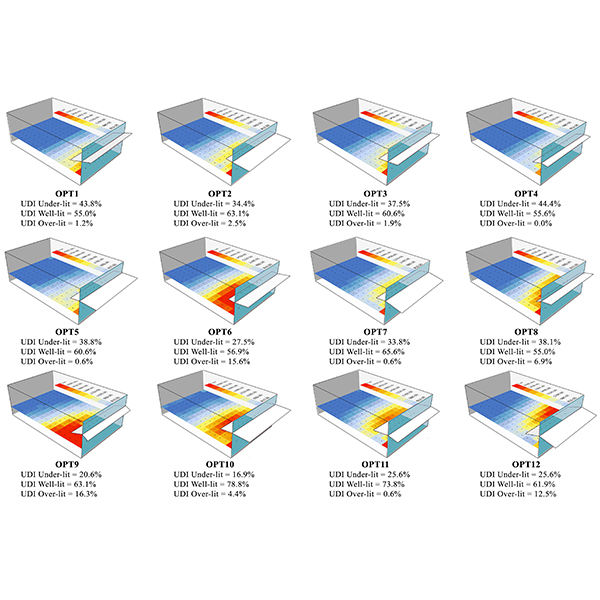
Optimization of Daylight Performance Based on Controllable Light-shelf Parameters
This study aims to achieve a balance of daylight availability in the work-plane environments of a fully glazed facade integrated with a light shelf system using an optimization procedure that can assist architects with assessing the daylighting performance of numerous design alternatives, and build-up the optimized design.
Journal of Daylighting 7 (2020) 122-136
RESEARCH ARTICLE
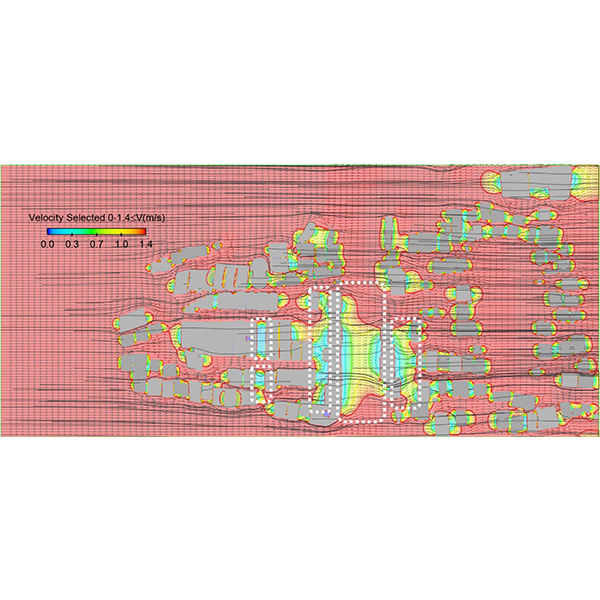
The Effects of Orientation and Width of Space Between Buildings
Excessive heat in the high-rise urban fabric has contributed to pedestrian and occupants' discomfort. Establishing wind circulation in space with an environmentally compatible and optimal configuration is necessary to improve comfort in this region.
Journal of Daylighting 10 (2023) 99-116
RESEARCH ARTICLE
Evaluation of Daylight and Glare Quality of Office Spaces with
There has been an increasing awareness in recent years about the evaluation of daylight and glare quality in buildings. In the study, an office space with a flat and a dynamic shading system facade (triangular cell facade) is discussed in the province of Mardin, which is in a hot and arid climate zone.
Journal of Daylighting 9 (2022) 197-208

RESEARCH ARTICLE
Visual Comfort Assessment of Hospital Patient Rooms with Climate Responsive
As advanced technologies become prevalent, they are being used more widely in numerous fields. The building sector is not an exception. One of these cutting-edge technologies is responsive facades, which are used in buildings and have an undeniable effect on daylighting.
Journal of Daylighting 10 (2023) 17-30
RESEARCH ARTICLE
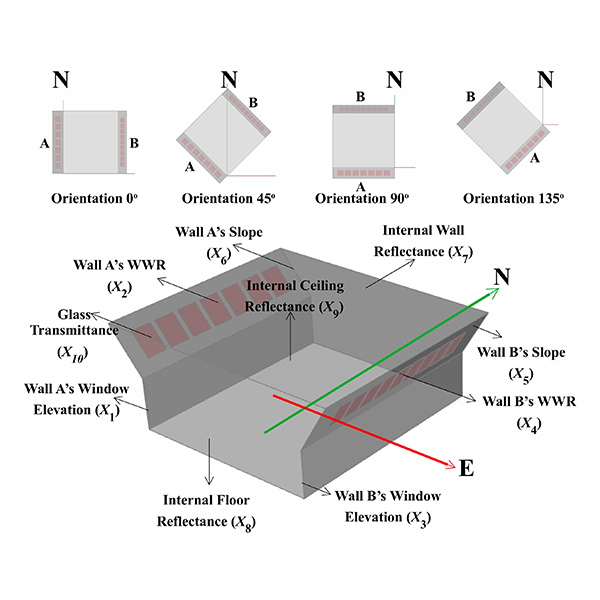
Optimization of Daylighting Design Using Self-Shading Mechanism in Tropical
Despite its potential, daylighting strategies in school classrooms in the tropical climate regions is little explored in the literature. The use of two-sided or bilateral daylight opening, as well as the self-shading mechanism using sloped walls, are currently seen as potential strategies to achieve good daylighting in tropical buildings.
Journal of Daylighting 9 (2022) 117-136
SHORT COMMUNICATION
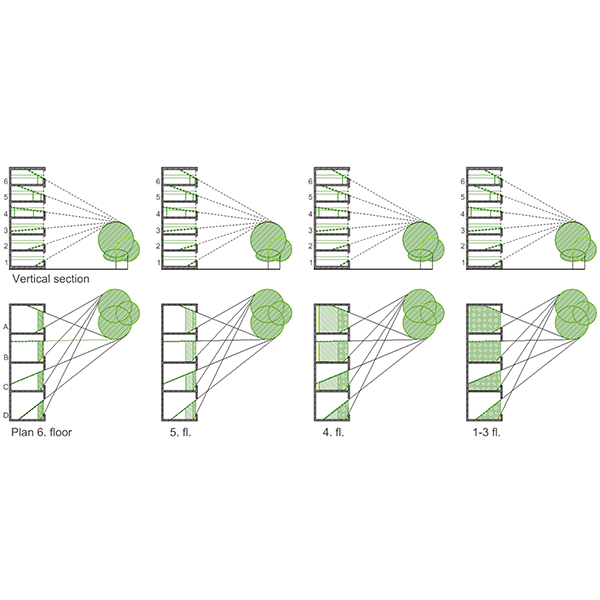
No-Greenery Line and Greenery-View Factor, New Architectural Design
The paper proposes a new tool for evaluation of the degree of visual contact with the outdoor greenery, the Greenery-View factor (GV), intended to be easy to grasp and simple to use.
Journal of Daylighting 7 (2020) 282-286
RESEARCH ARTICLE
Analysing the Daylighting Performance of the Main Prayer-hall in
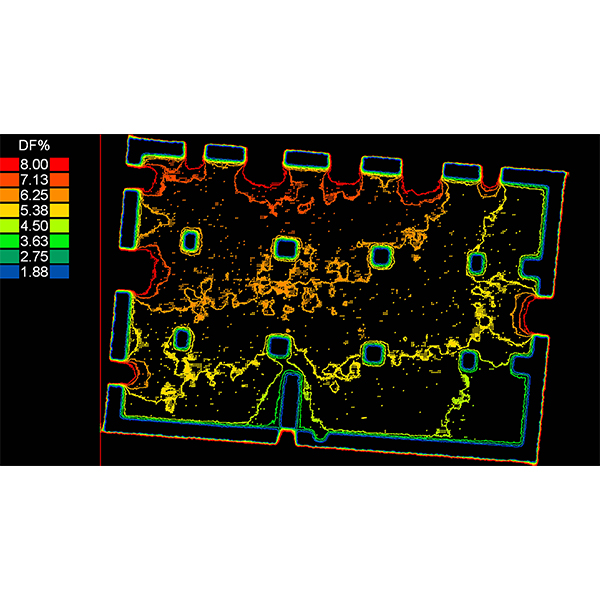
This paper studies the daylighting quality of the indoor prayer-hall in The Great Upper Mosque of Hama city in Syria, highlighting this distinctive historical converted building that has been functioning as a mosque since the entry of Islam in the 6th century AD.
Journal of Daylighting 10 (2023) 153-172
RESEARCH ARTICLE
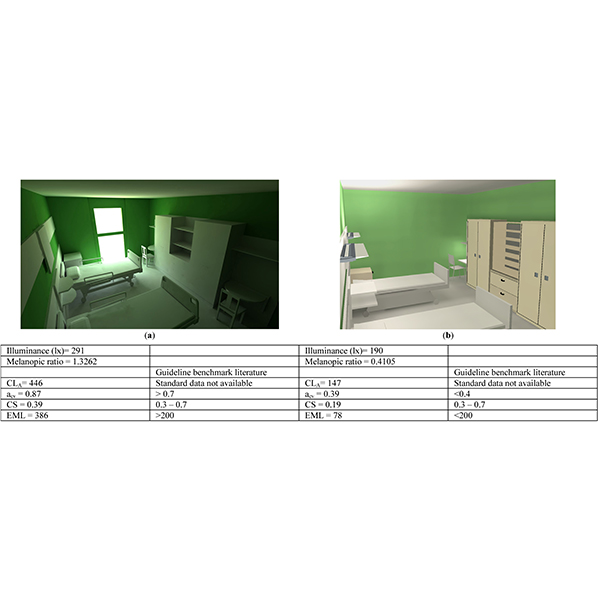
Application of Different Circadian Lighting Metrics in a Health Residence
During the last three decades, various scientific researchers analysed the connection between natural elements and human life, both as far as well-being and productivity.
Journal of Daylighting 7 (2020) 13-24
RESEARCH ARTICLE
A Combined Method for an Exhaustive Investigation of the Anidolic
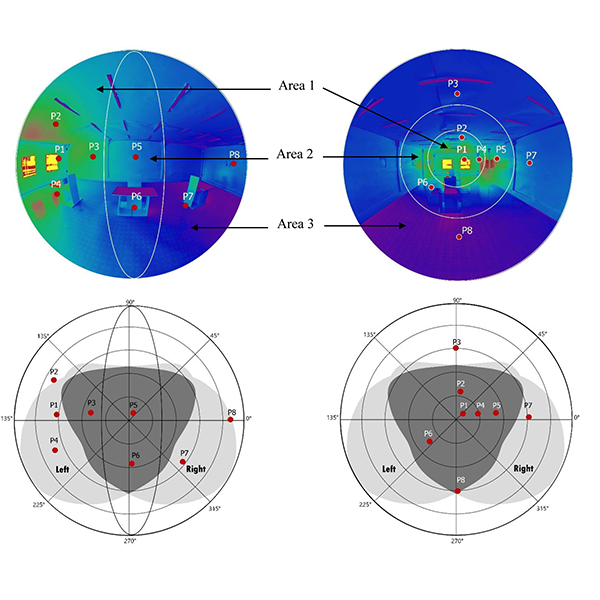
Lighting quality in office environments is a broad concept that must be taken into account in the design stage to deliver comfortable spaces to reduce workers' stress.
Journal of Daylighting 8 (2021) 149-164
RESEARCH ARTICLE
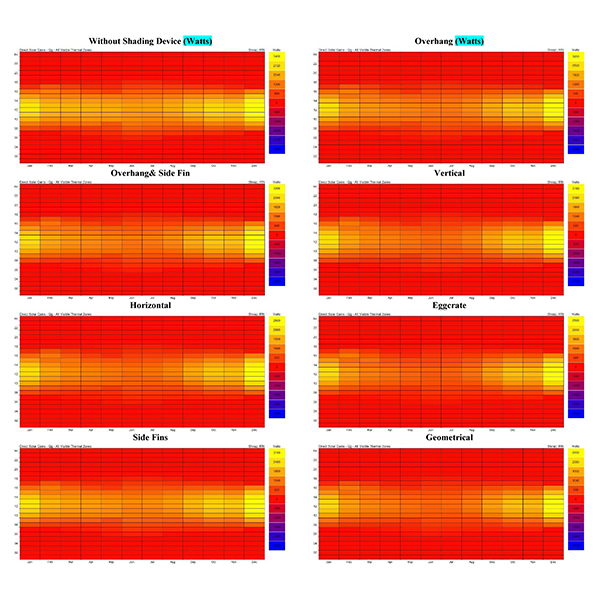
The Effect of Fixed External Shading Devices on Daylighting and
Building shading devices can improve the thermal comfort in indoor environment, and also reduce cooling and heating energy consumption in dry and hot climate.
Journal of Daylighting 8 (2021) 165-180
RESEARCH ARTICLE
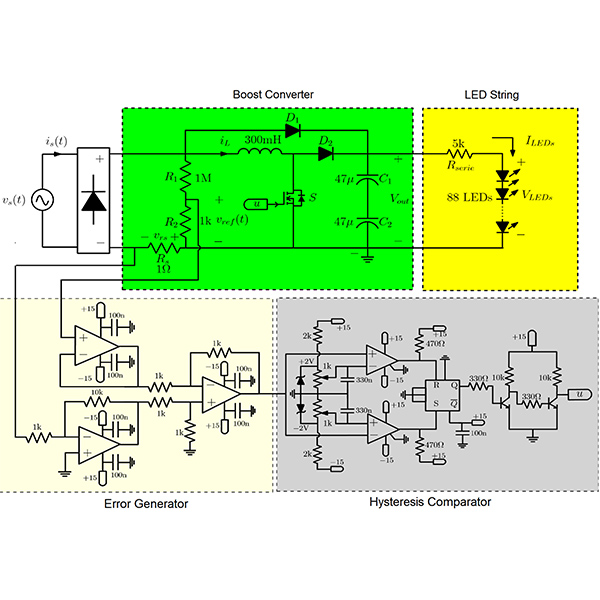
Power Factor Correction of Compact Fluorescent and Tubular LED Lamps
Compact Fluorescent Lamps (CFLs) and Light-emitting Diode (LED) lamps have received wide acceptance in lighting applications during the last few years.
Journal of Daylighting 7 (2020) 73-83
RESEARCH ARTICLE
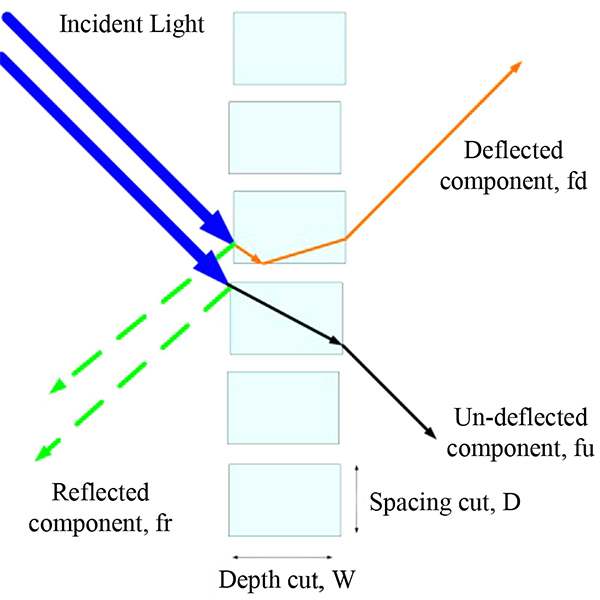
Maximizing the Performance of Laser Cut Panel by Interaction of
The interaction between different ceiling geometries with laser cut panels (LCPs) is investigated using real experiments and computer simulations to maximize the daylight performance of the LCP.
Journal of Daylighting 1 (2014) 29-35
RESEARCH ARTICLE
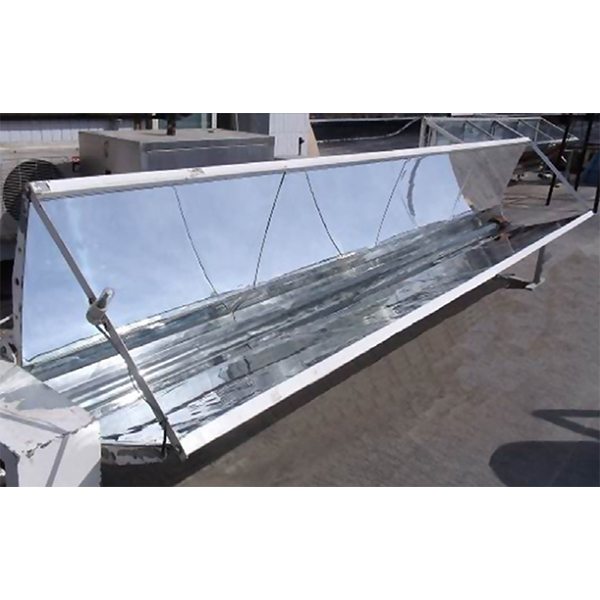
Design of a Multi-Surface Solar Concentrator
A multi-surface solar concentrator is proposed in this study. The concentrator is designed by improving the light receiving rate of a parabola when the incident angle changes within 0°~20° by adding involute, shifting the involute up, and changing the shape of the parabolic top. .
Journal of Daylighting 6 (2019) 176-186
RESEARCH ARTICLE
Impact of Building Typology on Daylight Optimization Using Building Information
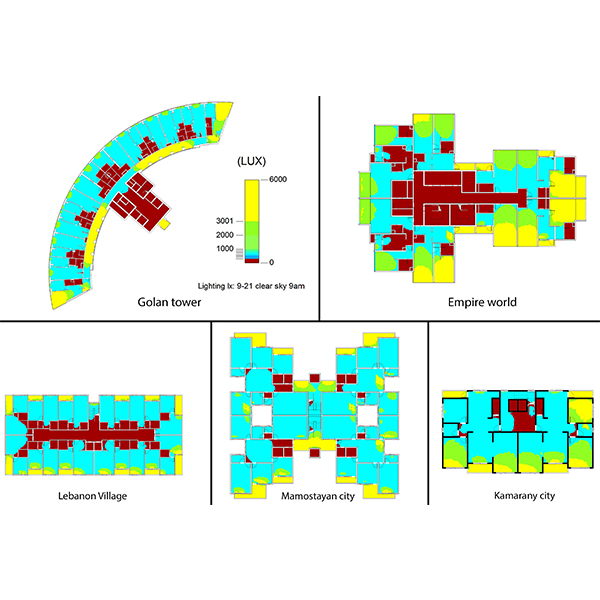
Daylight represents one of the crucial factors that affect directly on the building performance and its occupants. This study assesses the daylight performance in the multi-storey residential buildings (apartments) in Erbil city.
Journal of Daylighting 6 (2019) 187-201
RESEARCH ARTICLE
Illumination and Lighting Energy Use in an Office Room with
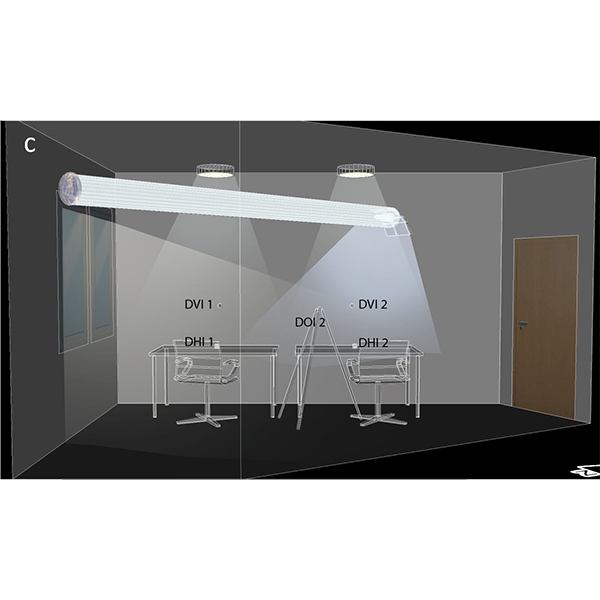
This paper describes a field study of the illumination and lighting energy use in a full-scale test office in a building located in southern Norway. Natural light is provided to the office via southwest-oriented windows and a horizontal light pipe (HLP) with a daylight entrance facing the south.
Journal of Daylighting 9 (2022) 209-227
RESEARCH ARTICLE
Daylighting as the Driving Force of the Design Process: from
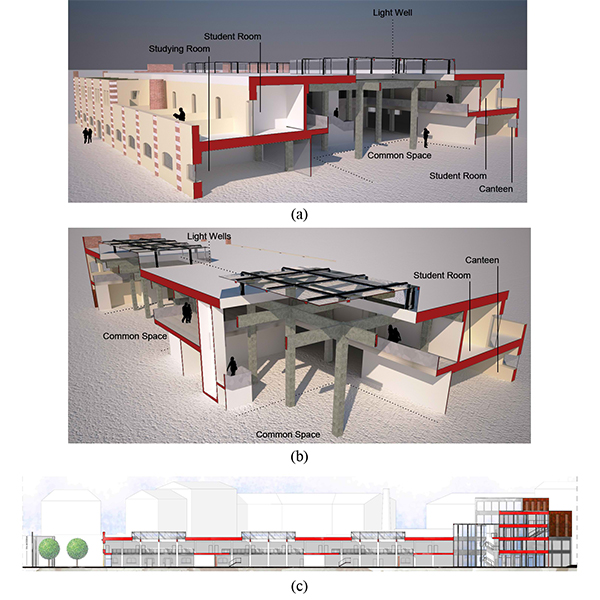
This paper presents a study for the transformation of an industrial area in Turin, Italy. The area hosts two buildings (one of which appointed as listed) to be transformed into dwellings.
Journal of Daylighting 1 (2014) 36-55
RESEARCH ARTICLE
A Comprehensive Evaluation of Perforated Façades for Daylighting and
New design tools have enabled architects to explore complex geometries for building envelopes. Perforated Screens (PS) have gained popularity but their design is still intuitive, often focused on aesthetic and morphological criteria.
Journal of Daylighting 6 (2019) 97-111
RESEARCH ARTICLE
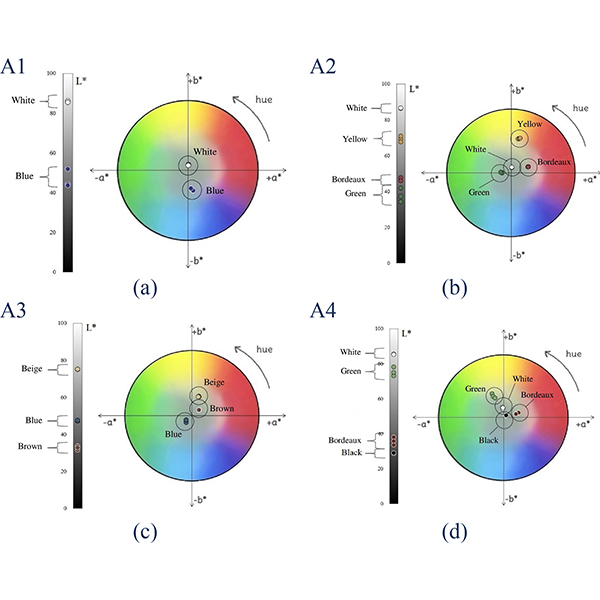
Optical Characteristics of Traditional Portuguese Azulejos: Mixing Colors to Obtain “
The need to reduce energy consumptions in buildings brings modern research to focus on the use of natural sources. In this context, the interest towards traditional architecture has been fueled, since one of the characteristics identifying it is the intuitive and intrinsic link between the building and the surrounding environment.
Journal of Daylighting 7 (2020) 273-281
RESEARCH ARTICLE
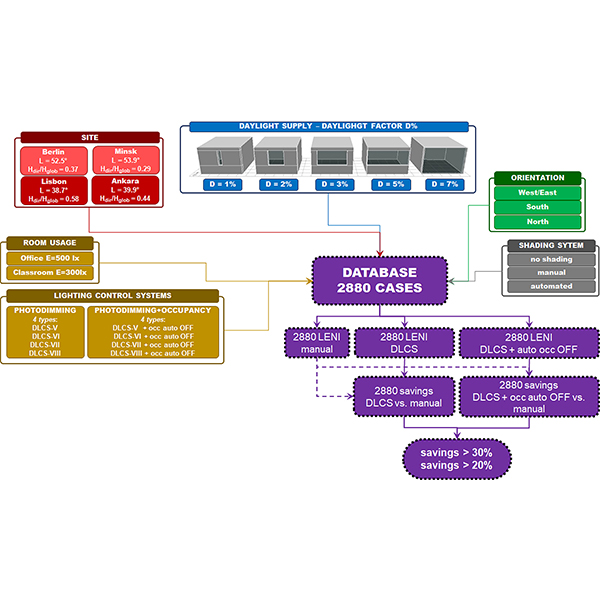
Energy Saving Generated Through Automatic Lighting Control Systems According to
The standard EN 15193-1:2017 “Energy performance of buildings - Energy requirements for lighting” introduced a detailed method to calculate the energy demand for lighting in buildings. Th.
Journal of Daylighting 6 (2019) 131-147
RESEARCH ARTICLE
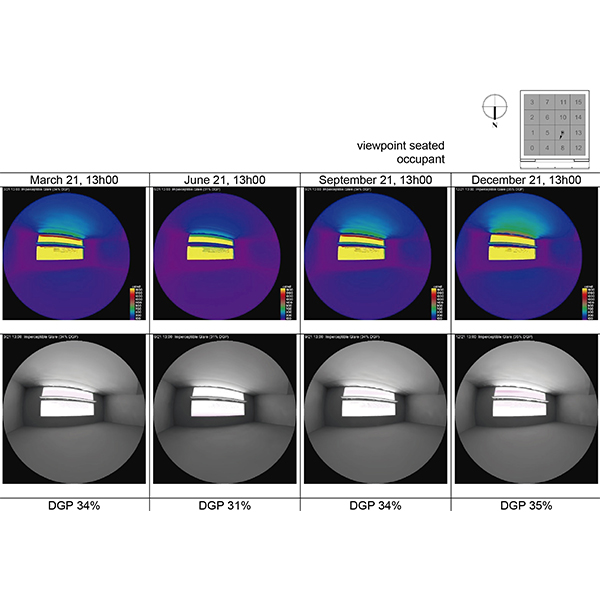
Optimisation of Passive Solar Design Strategies in Side-lit Offices:
It has been shown that in buildings with fully glazed facades designed to save electricity and increase daylight, overheating due to excessive solar gains and glare have become recurrent problems, affecting the quality of the indoor environment in office buildings.
Journal of Daylighting 7 (2020) 107-121
RESEARCH ARTICLE
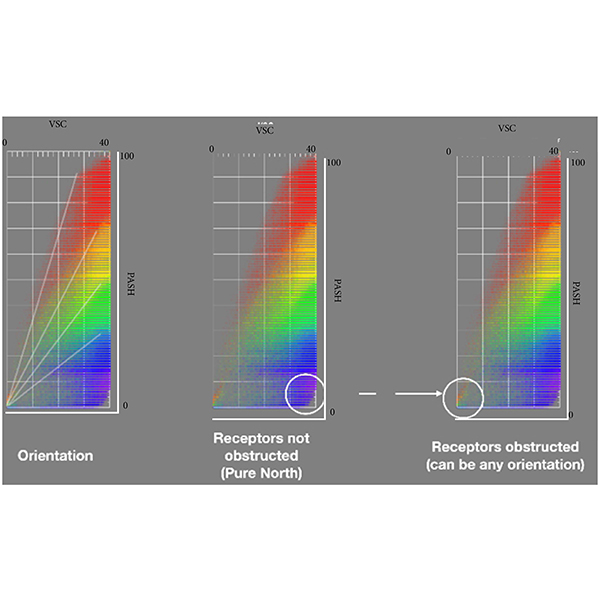
Sunlight-Daylight Signature: a Novel Concept to Assess Sunlight and
Daylighting and solar availability at urban scale has come to play a crucial role in the perception of discomfort conditions for people, both in outdoor and indoor spaces, and on the energy consumption of buildings.
Journal of Daylighting 10 (2023) 136-152
RESEARCH ARTICLE
A Field-validated Multi-objective Optimization of the Shape and
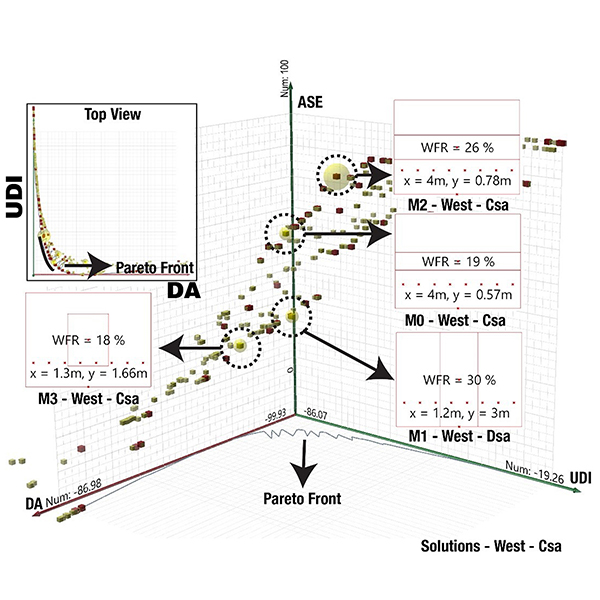
This study aims to determine the optimum size of windows based on the window-to-floor ratio (WFR) for the main cardinal directions in Hot-summer Mediterranean (Csa) and Dry Summer Continental (Dsa) climates (Köppen–Geiger classification system) by carrying out a multi-objective optimization that relies on three dynamic metrics of Useful Daylight Illuminance (UDI-a (autonomous)), Daylight Autonomy (DA), and Annual Sunlight Exposure (ASE1000,250) in Radiance version 5.1..
Journal of Daylighting 7 (2020) 222-237
RESEARCH ARTICLE
Solar Angle Model for Daylight Redirection in Prismatic Panel
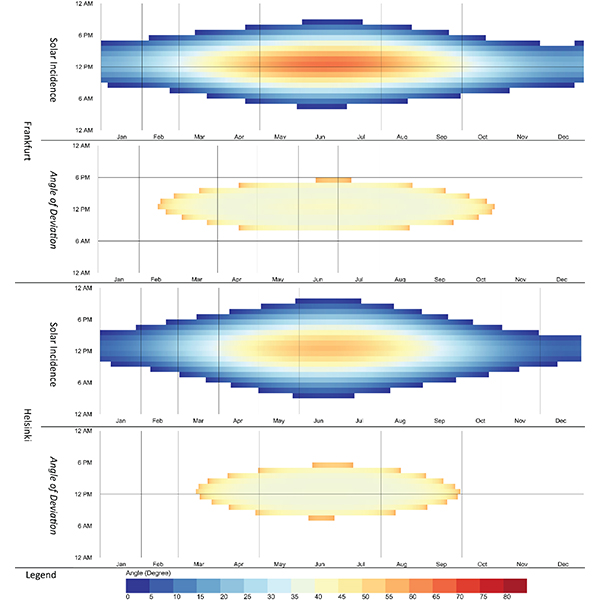
An advanced complex fenestration system can utilize uniform daylight. Nonetheless, an inefficient design would increase solar heat gain and indoor temperatures, besides uneven light distribution that would cause the "cave effect.
Journal of Daylighting 9 (2022) 257-265
RESEARCH ARTICLE
The optimization of louvers shading devices and room orientation under
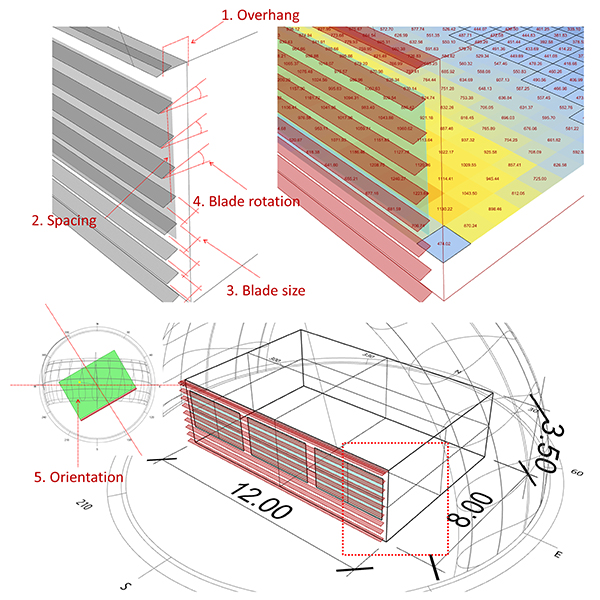
This paper presents parametric and multi-objective optimization (MOO) approach in optimizing daylight and energy consumption by incorporating louvres shading devices depicting three different sky conditions: Birmingham, UK, Jakarta, Indonesia, and Sydney, Australia.
Journal of Daylighting 9 (2022) 137-149
RESEARCH ARTICLE
Application of Micro-structured Sunlighting Systems in Different Climatic Zones
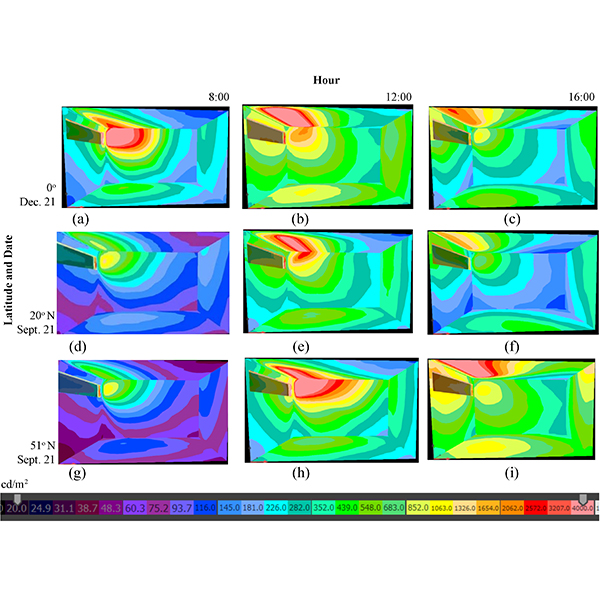
Two-sided micro-structures on windowpanes have been developed for redirecting sunlight into the depth of rooms in order to improve daylighting. In a joint research project comprehensive sunlighting-systems for windows are developed, integrating micro-structures in triple-glass units.
Journal of Daylighting 6 (2019) 52-59
RESEARCH ARTICLE
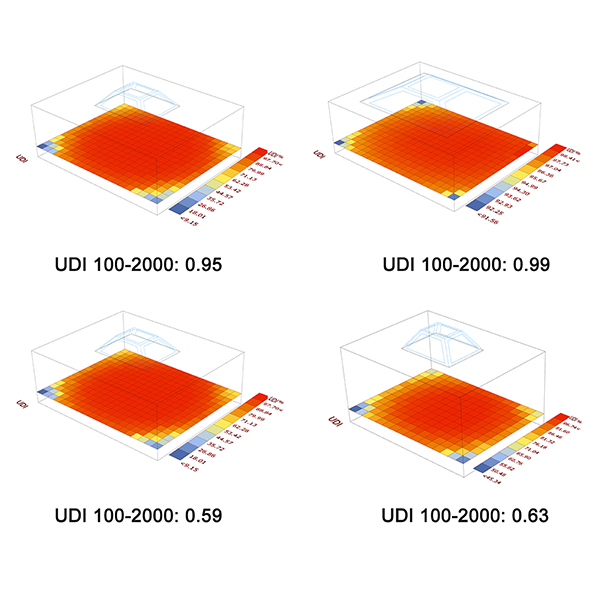
Design Optimization of the Skylight for Daylighting and Energy Performance
In terms of sustainable design, lateral windows and skylights are important. Daylighting has become a vital component in office buildings because it increases occupants' productivity, well-being, and energy savings via windows and skylights.
Journal of Daylighting 10 (2023) 72-86
RESEARCH ARTICLE
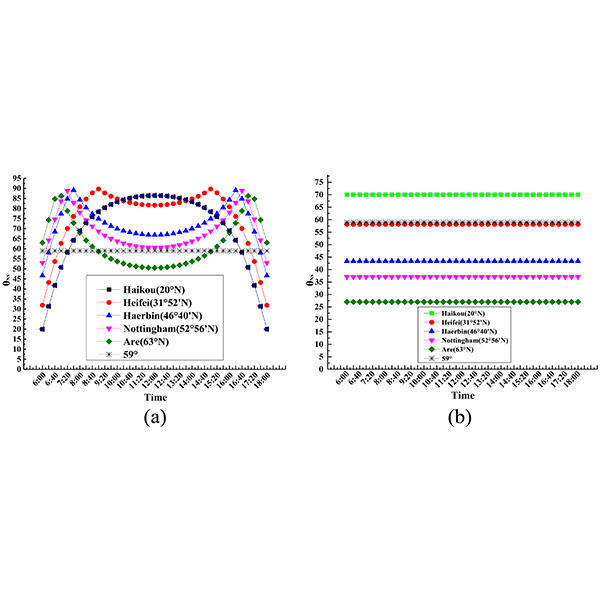
Design and optical evaluation of a novel asymmetric lens-walled
Solar concentrating system is an effective way of combing solar energy with the building to satisfy the needs besides of electricity and hot water, also includes building heating, refrigeration, dehumidification, which require higher quality heat source.
Journal of Daylighting 4 (2017) 26-37
RESEARCH ARTICLE
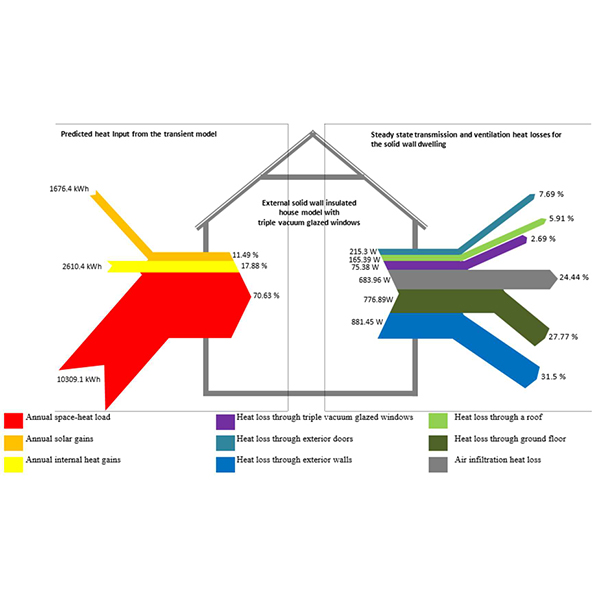
Solar Energy Gain and Space-Heating Energy Supply Analyses for
A considerable effort is devoted to devising retrofit solutions for reducing space-heating energy in the domestic sector. Existing UK solid-wall dwellings, which have both heritage values and historic fabric, are being improved but yet they tend to have meagre thermal performance, partly, due to the heat-loss through glazings.
Journal of Daylighting 4 (2017) 15-25
RESEARCH ARTICLE
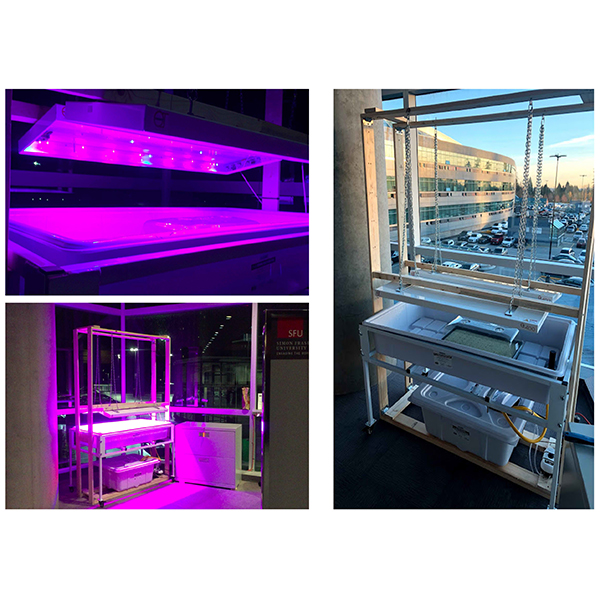
An Intelligent IoT-enabled Lighting System for Energy-efficient Crop
In this paper, an intelligent lighting instrumentation and automation system is presented with the objective of achieving high energy-efficiency in greenhouse supplemental lighting based on the Internet of Things (IoT) technology.
Journal of Daylighting 8 (2021) 86-99
RESEARCH ARTICLE
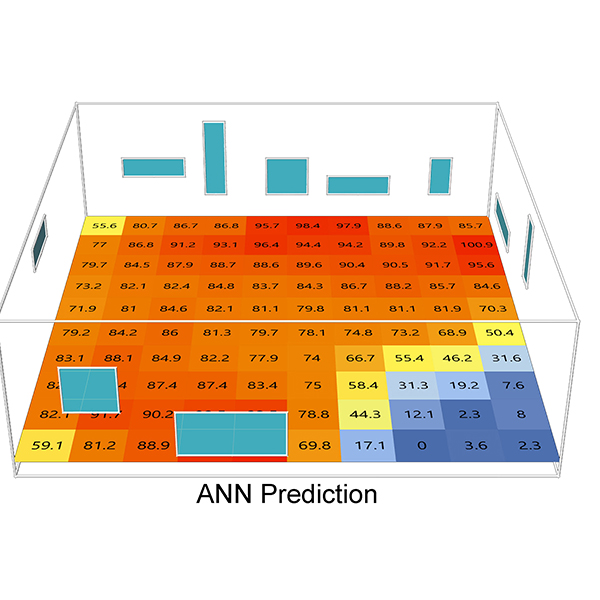
Unfolding 3D Space into Binary Images for Daylight Simulation via
Daylighting plays a crucial role in building science, impacting both occupants’ well-being and energy consumption in buildings. Balancing the size of openings with energy efficiency has long been a challenge. .
Journal of Daylighting 10 (2023) 204-2013
RESEARCH ARTICLE
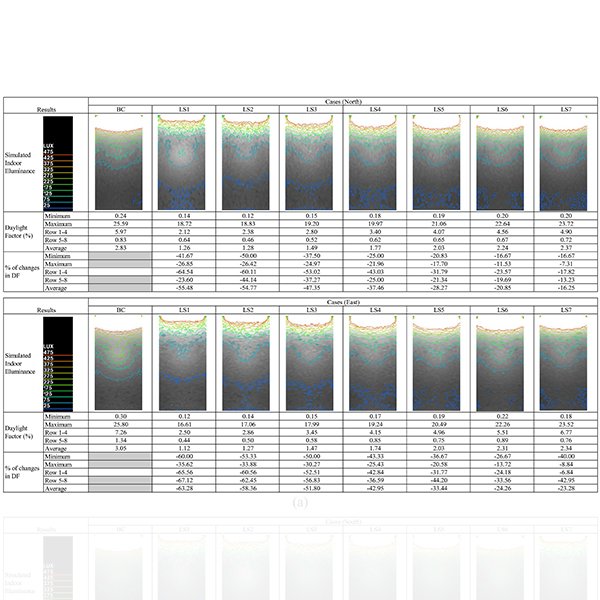
Daylighting Performance of Integrated Light Shelf with Horizontal Light Pipe
Tropical countries such as Malaysia receives a significant amount of daylight. The utilisation of this renewable resource in a high-rise office building leads to opportunities and challenges.
Journal of Daylighting 9 (2022) 83-96
RESEARCH ARTICLE
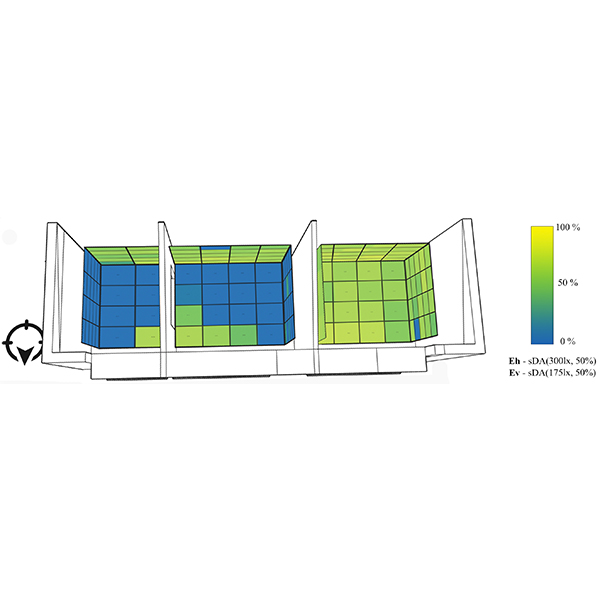
Daylighting metrics: an approach to dynamic cubic illuminance
Advances in research work in the field of numerical analysis of daylight performance have generated in-depth knowledge on photometric measurements of daylight quality.
Journal of Daylighting 5 (2018) 34-42
RESEARCH ARTICLE
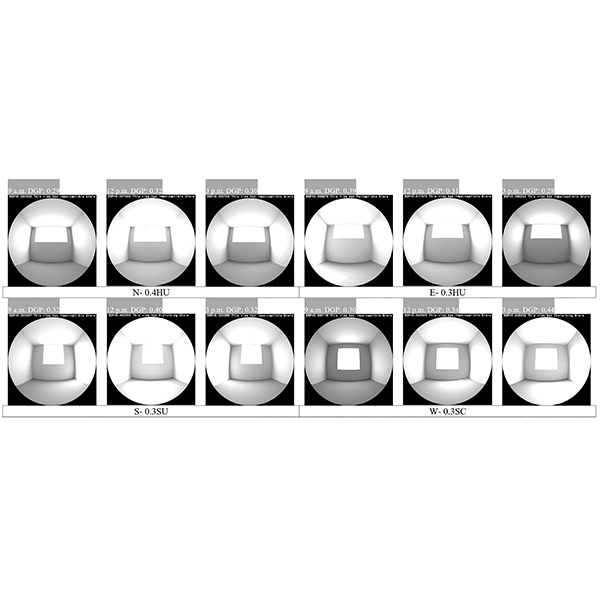
Optimum Characteristics of Windows in an Office Building in Isfahan
Nowadays, the use of renewable energies has increased due to the energy crisis and subsequent environmental issues. The window design significantly affects energy consumption and natural light absorption regarding preventing visual discomfort and improving indoor quality with effective external features.
Journal of Daylighting 8 (2021) 222-238